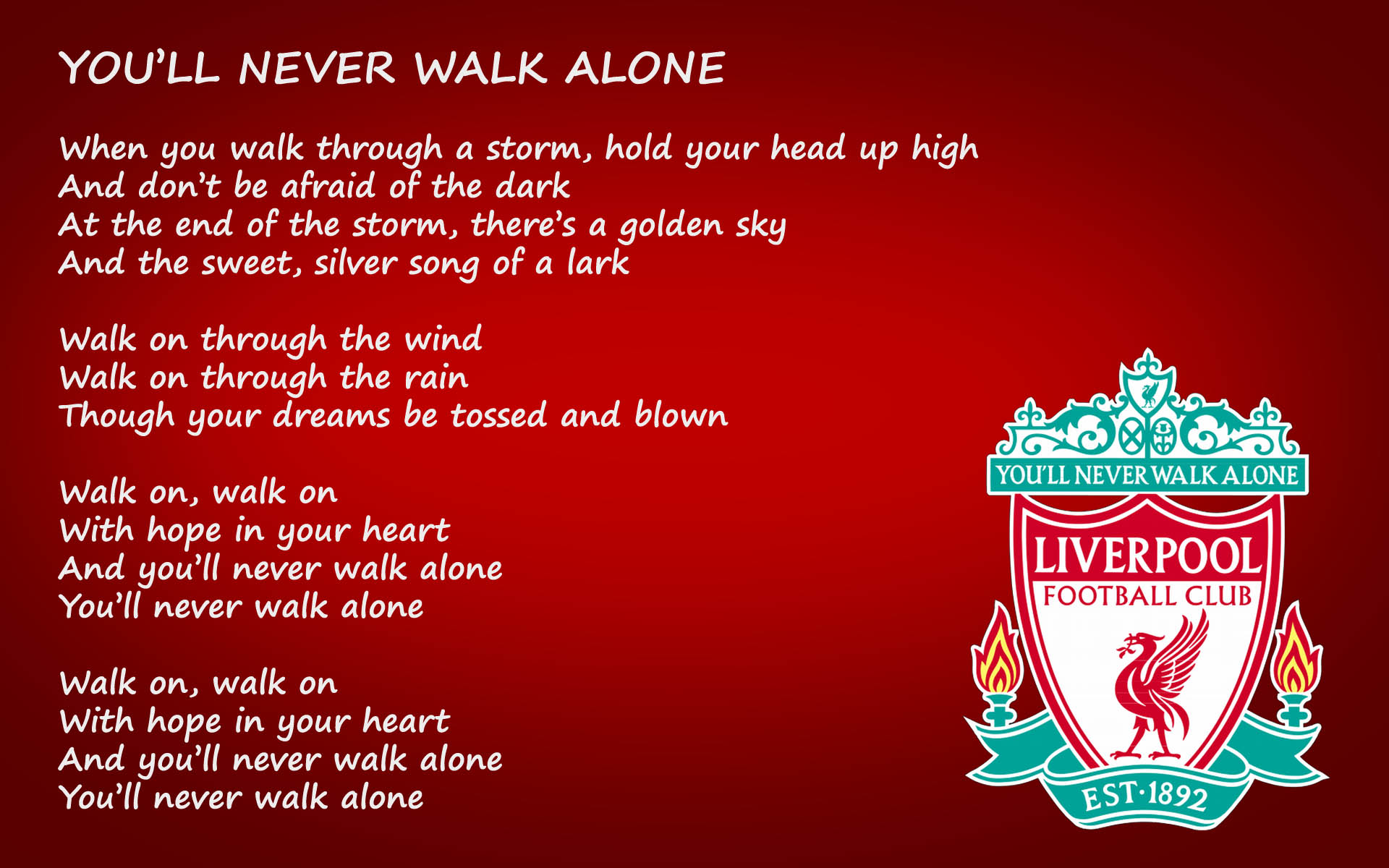
It starts with a simple, almost mournful organ or a lone voice. You’ve heard it. Even if you aren't a fan of musical theater or a die-hard "Red" at Anfield, the You'll Never Walk Alone lyrics have likely vibrated through your chest at some point. It’s a strange phenomenon when you actually stop to think about it. How did a song written for a 1945 Rodgers and Hammerstein musical called Carousel—a show about a carnival barker who commits suicide—end up as the definitive global anthem for solidarity, grief, and football?
Most people think of it as a sports song. It isn't. Not originally.
When Oscar Hammerstein II sat down to write these words, he wasn't thinking about a pitch in Liverpool. He was trying to provide a moment of solace for a character named Julie Jordan, whose husband had just died. The lyrics were meant to be a literal lifeline. "Walk on through the wind / Walk on through the rain." It’s visceral. It’s messy. It’s about the stubborn, almost annoying human refusal to just give up when things get dark.
The Broadway Roots You Probably Forgot
In the context of the play Carousel, the song appears twice. First, it’s a song of comfort after a tragedy. Later, it’s sung at a graduation ceremony. It was a hit, sure, but it stayed within the confines of the theater world for a while. Frank Sinatra gave it a go. So did Judy Garland. They sang it with that polished, mid-century vibrato that makes everything sound a bit like a postcard. It was pretty. It was moving. But it hadn't yet become the roar we know today.
Then came 1963.
Gerry Marsden and his band, Gerry and the Pacemakers, were part of that massive Merseybeat explosion. They took this show tune and stripped away the theatrical fluff. They gave it a beat. They gave it a sense of urgency. Legend has it that Marsden gave a copy of the record to Bill Shankly, the legendary Liverpool FC manager, during a pre-season trip. Shankly loved it. The fans at the Kop, who used to sing along to the top ten hits played over the stadium speakers before kickoff, just... kept singing it. Even after it dropped off the charts.
Why the You'll Never Walk Alone Lyrics Hit Different
There is a psychological weight to these specific words. Look at the structure. It doesn't start with a celebration. It starts with a storm.
"When you walk through a storm / Hold your head up high / And don't be afraid of the dark."
Most "inspiring" songs try to tell you that the sun is already out. This one doesn't lie to you. It acknowledges that the rain is coming and your dreams are probably going to get "tossed and blown." That's the secret sauce. It’s honest. In a world of toxic positivity, these lyrics admit that walking through life is often just a long slog through bad weather.
I've talked to musicologists who point out the "crescendo of hope" built into the melody. It starts in a lower register, almost a whisper, and climbs. By the time you get to "Walk on, walk on," you’re hitting notes that require a lot of lung power. It forces a physical reaction. You can't half-sing it. You have to commit.
The Liverpool Connection and the Weight of History
You cannot discuss the You'll Never Walk Alone lyrics without mentioning the Hillsborough Disaster of 1989. This is where the song transcended being a "football chant" and became a sacred hymn. In the wake of the tragedy that claimed 97 lives, the song provided a vocabulary for a city that was literally drowning in grief.
It wasn't just about a game anymore. It was about a collective promise. When 50,000 people sing "You'll never walk alone" in unison, it stops being a lyric and starts being a pact. It’s been adopted by Celtic, Borussia Dortmund, and Feyenoord. Each club claims a piece of it, but the DNA remains the same: a refusal to leave anyone behind in the dark.
Common Misconceptions About the Words
Honestly, people mess up the lyrics all the time.
For one, it’s not "at the end of the storm." It’s "At the end of a storm, there's a golden sky." A subtle difference, but "a" storm implies that this is just one of many. It’s a cycle. You get through one, you see the light, and you prepare for the next.
Also, the "sweet silver song of a lark" line? Most football fans mumble through that part. It’s the most "musical theater" line in the whole piece. It feels a bit flowery compared to the grit of the rest of the song, but it serves a purpose. It’s the reward for the "walk."
A Global Healing Tool
During the 2020 pandemic, the song saw a massive resurgence. Radio stations across Europe played it simultaneously. Why? Because the You'll Never Walk Alone lyrics are uniquely suited for isolation. It’s a song about being alone, physically, but being connected, spiritually.
Captain Tom Moore, the UK veteran who raised millions for the NHS by walking laps of his garden, even recorded a version. It went to number one. He was 99 years old. If that doesn't prove the song has a universal shelf life, nothing does. It works for a toddler and it works for a centenarian.
The Technical Brilliance of Rodgers and Hammerstein
Musically, the song is a masterclass in tension and release.
- The Hook: That opening G-major chord (in the standard key) feels like a deep breath.
- The Ascent: The melody climbs steadily. It mirrors the act of "holding your head up high."
- The Octave Jump: When the song hits "Walk on," it often jumps an octave. This is the moment where the hair on your arms stands up.
It’s built to be sung by people who can’t sing. That’s the genius. You don’t need to be Pavarotti. In fact, it almost sounds better when it’s sung by 40,000 out-of-tune voices. The imperfections are what make it feel human.
What the Song Teaches Us About Resilience
We live in an era of "individualism." Everything is about "my journey" and "my brand." This song is the antithesis of that. It says "You." It says "We."
It’s about the endurance of the human spirit. It’s about the fact that the "golden sky" isn't a gift; it’s something you earn by walking through the wind.
If you're looking to truly understand the impact of the You'll Never Walk Alone lyrics, don't just read them on a screen. Go watch a video of the Kop singing it after a Champions League comeback. Or watch the final scene of Carousel. The context changes, but the emotion is identical. It’s the sound of people refusing to be broken.
Practical Ways to Engage with the Anthem
If you're a musician, a fan, or just someone who needs a boost, here is how to actually dive into this piece of history:
- Listen to the 1945 Original: Find the original Broadway cast recording. It’s much faster than you’d expect. Hearing it as a show tune helps you appreciate the lyrical craft before it became a stadium anthem.
- Compare the Covers: Listen to Elvis Presley’s version versus Aretha Franklin’s. Elvis treats it like a gospel hymn. Aretha turns it into a soulful prayer. It shows the elasticity of the writing.
- Check the Gates: If you ever find yourself in Liverpool, visit the Bill Shankly Gates at Anfield. The words are forged in iron. It’s a reminder that sometimes, art becomes architecture.
- Analyze the Poetry: Forget the music for a second. Read the words as a poem. Note the lack of "I." It’s all about the "You" being supported by an unseen "We."
The song isn't going anywhere. As long as people lose jobs, lose loved ones, or lose football matches, they’re going to keep singing about walking through the rain. It’s the ultimate "hang in there" note, written by a man in 1945 who had no idea he was writing the soundtrack for the next century.
Next Steps for the Reader
To truly grasp the technical construction of the song, your next move should be to look up the "sheet music chord progression for You'll Never Walk Alone." Pay close attention to how the transition from the "storm" section to the "golden sky" section uses a major lift to shift the listener's emotional state. If you are interested in the cultural history, research the "1963 Merseybeat movement" to see how Liverpool’s music scene transformed American theater into British folk culture. Or, simply put on a high-quality recording of Gerry and the Pacemakers and pay attention to the exact moment the strings swell—it’s a lesson in production that still holds up sixty years later.



