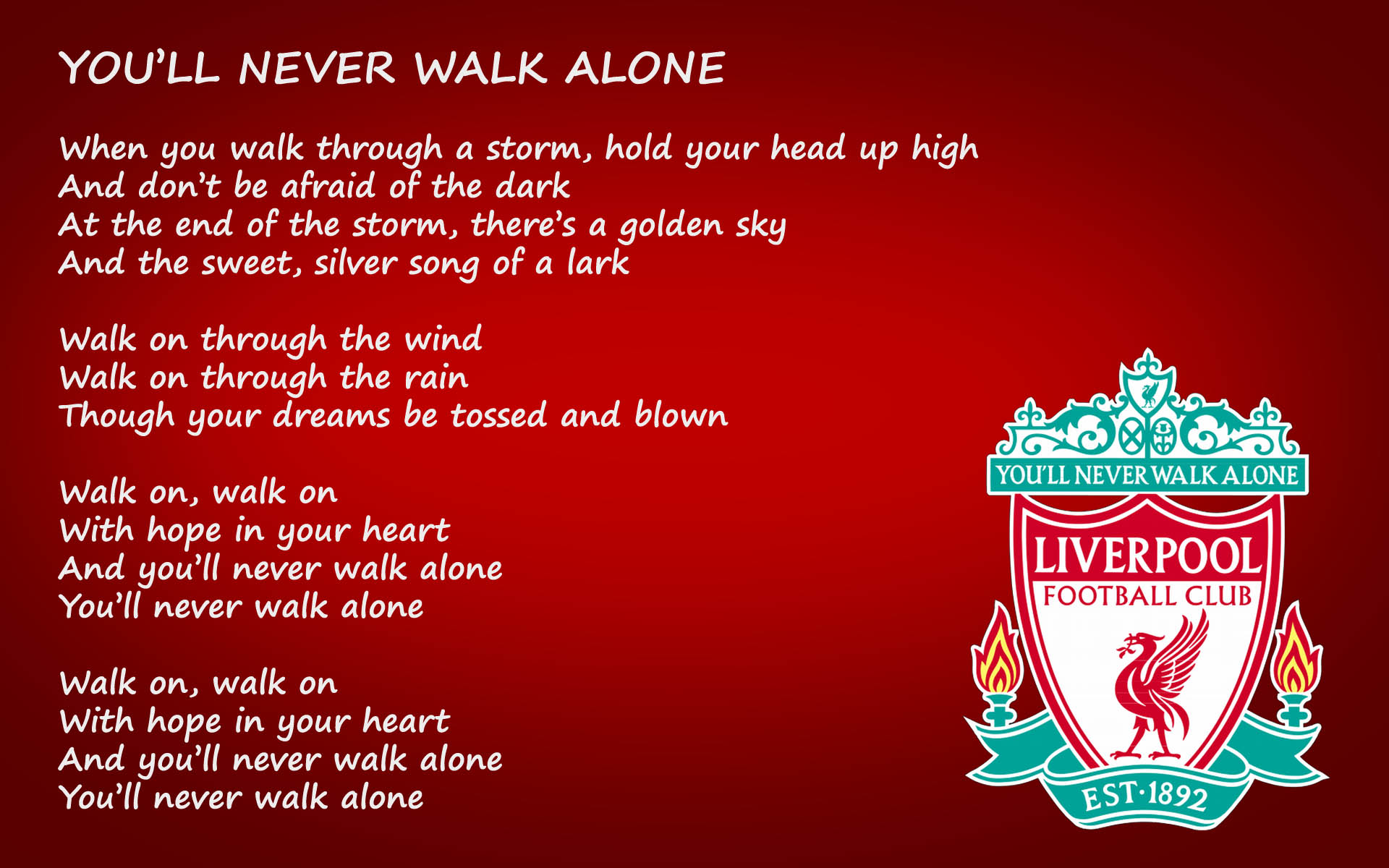
It starts with a simple, lonely C major chord. Then the words kick in: "When you walk through a storm, hold your head up high." Most people today hear those lines and immediately picture a sea of red scarves at Anfield or a flickering candle at a memorial service. They think of football. They think of Liverpool FC. But honestly, the You’ll Never Walk Alone lyrics didn't start on a pitch in North West England. They started in the mind of Oscar Hammerstein II, a man trying to figure out how to make a 1945 audience cry over a dead carnival barker.
It’s kinda wild when you think about it.
The song comes from the musical Carousel. In the original play, it’s sung to comfort a character named Julie Jordan after her husband, Billy Bigelow, literally kills himself to avoid being caught by the police. It’s dark stuff. It’s heavy. Yet, the lyrics have this weird, gravity-defying ability to pull people out of the dirt. Whether it’s a global pandemic or a 3-0 deficit in a Champions League final, these words have become the default setting for human resilience.
From Broadway to the Kop: The Gerry Marsden Effect
So, how does a show tune from the mid-forties become a terrace chant? You can thank a guy named Gerry Marsden. In 1963, Gerry and the Pacemakers—part of that same Merseybeat explosion that gave us the Beatles—recorded a cover. According to legend (and Gerry’s own interviews), he gave a copy of the record to Liverpool manager Bill Shankly. Shankly loved it. The fans loved it.
Back then, the DJ at Anfield would play the top ten hits of the week in descending order. When "You’ll Never Walk Alone" hit number one, the fans sang along. When it dropped out of the top ten, they kept singing it anyway. They just refused to let it go.
The You’ll Never Walk Alone lyrics are essentially a set of instructions for surviving grief. "Walk on through the wind / Walk on through the rain." It’s not telling you the storm will stop. It’s telling you that you aren't the only one getting wet. That distinction matters. It’s why the song felt so visceral during the aftermath of the Hillsborough disaster in 1989. For the families of the 97 who lost their lives, the lyrics weren't just a song; they were a lifeline, a public declaration that the city would carry the weight together.
The Anatomy of the Lyrics
Let’s actually look at what Hammerstein wrote. He was a master of the "simple but profound" school of lyricism.
- The Storm Imagery: The song uses nature as a proxy for internal struggle. You have "the storm," "the wind," and "the rain." It’s relentless.
- The Golden Sky: This is the payoff. "At the end of a storm, there’s a golden sky / And the sweet silver song of a lark." It’s almost religious imagery, though the song itself is secular.
- The Command: "Walk on." It’s repeated four times. It’s an imperative. It doesn’t suggest you might want to consider moving forward; it orders you to.
Why the Lyrics Work When Others Don’t
Most "inspirational" songs are pretty cheesy. They're glossy. They're fake. But these lyrics work because they acknowledge the "dark" first. You don't get to the "golden sky" without the "tossed and driven" part. It’s a song that earns its optimism.
Musically, it’s built on a steady crescendo. It starts in a low, almost whispered register and ends with a high G that requires a fair bit of lung capacity. When 50,000 people sing that together, the physical vibration is enough to make the hair on your neck stand up. Pink Floyd even recognized this, sampling the Anfield crowd singing the You’ll Never Walk Alone lyrics at the end of their track "Fearless" on the 1971 album Meddle.
It’s not just Liverpool, either. Celtic fans in Scotland claim they were the first to adopt it (though the timeline usually favors the Scousers). Borussia Dortmund fans sing it with a precision that’s almost terrifying. It’s been covered by everyone. Elvis Presley. Aretha Franklin. Frank Sinatra. Johnny Cash. Even Judy Garland.
Sinatra’s version is particularly haunting because he treats it like a prayer. He strips away the bravado. He makes it about the "walk."
Common Misconceptions About the Song
People get stuff wrong about this song all the time.
First off, people think it was written for a funeral. Nope. It was written for a specific plot point in a musical based on a Hungarian play called Liliom. Second, a lot of folks think the Pacemakers wrote it. They didn't; they just "Scousified" it.
Then there’s the debate about the "correct" way to sing it. If you’re at a football match, you scream it. If you’re at a theater, you belt it. If you’re at home alone, you probably just hum it and hope things get better. All of them are right. The You’ll Never Walk Alone lyrics are flexible enough to hold whatever meaning you pour into them.
The Global Impact: Beyond the Pitch
In 2020, at the height of the COVID-19 lockdowns, radio stations across Europe coordinated to play the song at the exact same time. It was a moment of rare, genuine synchronization in a world that felt like it was falling apart. It reminded people that "walking alone" was a physical reality but a psychological lie.
You see it in hospitals. You see it at protests.
There is a specific psychological phenomenon where singing in unison releases oxytocin and reduces cortisol. When you analyze the You’ll Never Walk Alone lyrics through that lens, you realize it’s basically a collective therapy session. It’s a way of saying "I’m scared" without having to admit it out loud, because the person next to you is saying it too.
Actionable Takeaways for Using the Song’s Spirit
You don’t have to be a football fan or a musical theater nerd to get something out of this. The song’s longevity is a masterclass in emotional resonance. If you’re a creator, a leader, or just someone trying to get through a rough week, there are lessons here:
- Acknowledge the struggle: Don't skip to the happy ending. The "storm" part of your story is why people listen to the "golden sky" part.
- Keep it simple: Hammerstein didn't use big words. He used "rain," "sun," and "heart." High-impact communication doesn't need a thesaurus.
- Community is the "How": The song isn't called "I Will Never Walk Alone." It’s "You’ll." It’s an address to another person. Find your "you."
The next time you hear those opening notes, listen to the transition. Listen to how it goes from a single voice to a wall of sound. That is the entire point of the You’ll Never Walk Alone lyrics. It’s the transition from the individual to the collective. It’s a reminder that while the storm is inevitable, facing it alone is optional.
To truly understand the song, you have to look at the "lark." The lark is a bird that sings at dawn. It’s the signal that the night is over. That’s what the song is: a signal. It’s a way of marking the end of the dark and the beginning of whatever comes next.
How to Experience the Song Properly
- Watch the Carousel version: Specifically the 1956 film version with Shirley Jones. It gives you the narrative weight of the words.
- Listen to Gerry & The Pacemakers: This is the "gold standard" for the modern era.
- Find a live recording from Anfield: Search for the 2005 Champions League homecoming or the 2016 match against Dortmund. The raw emotion is unmatched.
- Read the lyrics as poetry: Strip away the music and just read the words. They hold up on their own as a testament to human endurance.
The You’ll Never Walk Alone lyrics are more than just a song. They are a cultural monument. They remind us that even when the wind is blowing so hard you can't see your hand in front of your face, you keep moving. You keep your head up. You walk on.
Next Steps for Deepening Your Connection to the Anthem:
- Research the 1989 Hillsborough Tribute: To understand the song's gravity, look into the 1989 FA Cup Final where Liverpool and Everton fans sang it together in a show of unity.
- Explore the Broadway Roots: Compare the original 1945 cast recording with modern interpretations to see how the "vibe" of the song has shifted from theatrical to anthemic.
- Analyze the Musical Structure: Look for the "bridge" of the song where the tempo picks up; this is intentionally designed to simulate the feeling of gaining momentum and courage.
- Check Out the Global Covers: Listen to the version by Aretha Franklin to hear how soulful the You’ll Never Walk Alone lyrics can become when infused with gospel roots.



