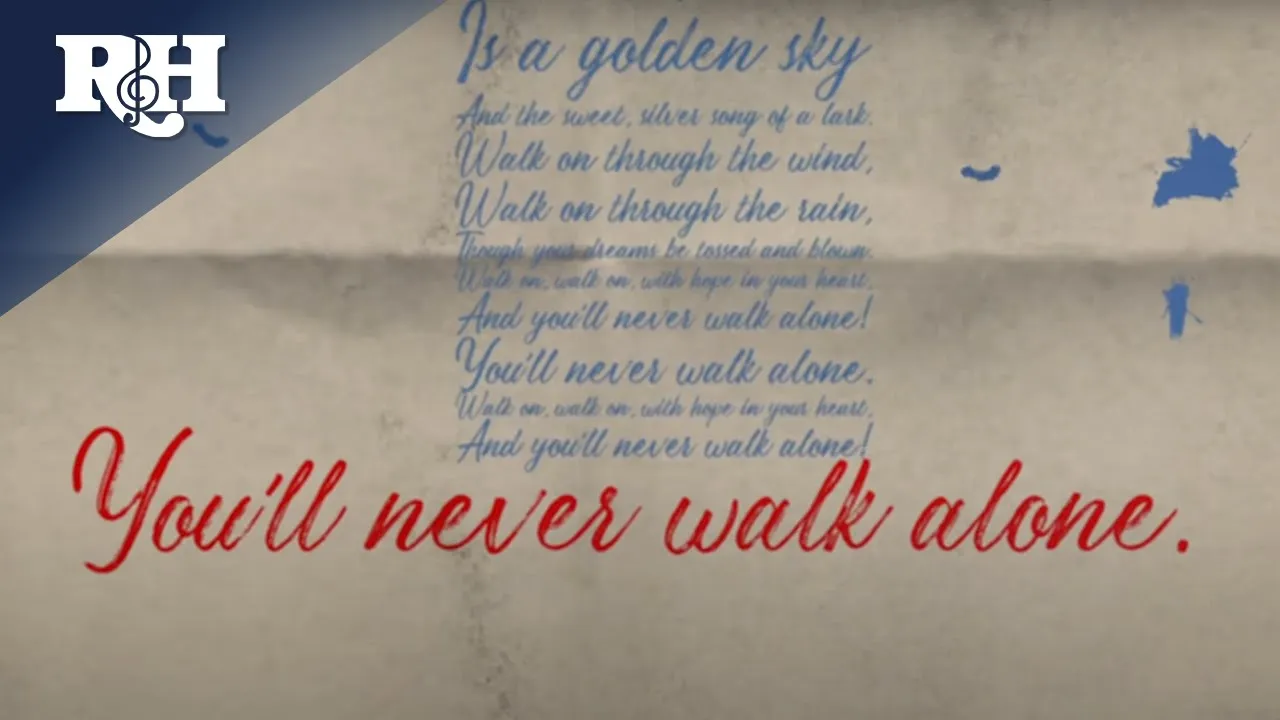
It starts with a single, lonely scarf held high in the Kop. Then ten. Then ten thousand. By the time the first chorus of You'll Never Walk Alone hits, the sound is so thick you can practically feel it vibrating in your teeth.
Most people think of it as a soccer song. They associate it with Liverpool FC, the smell of damp grass at Anfield, and the sea of red jerseys. But it didn't start there. Not even close. Before it was a stadium anthem, it was a piece of musical theater written by two guys from New York who probably never saw a professional football match in their lives.
Oscar Hammerstein II and Richard Rodgers wrote it for their 1945 musical Carousel. It’s a heavy show. We’re talking about a story that deals with domestic abuse, robbery, and suicide. The song appears twice: once to comfort the protagonist after a tragedy, and again at a graduation ceremony. It was designed to be a gut-punch of hope in the middle of a miserable situation.
The Long Road from Broadway to the Kop
So, how does a Broadway ballad travel 3,000 miles to a rainy shipyard city in Northwest England?
Timing is everything. In the early 1960s, Liverpool was the center of the musical universe. Gerry Marsden, leader of Gerry and the Pacemakers, was looking for a follow-up to his early hits. He’d seen Carousel as a kid and loved the sentiment. Even though his producer, the legendary George Martin, was skeptical about a slow ballad, Marsden insisted.
It worked.
The song hit number one on the UK charts in October 1963. Back then, Anfield (and most English stadiums) had a PA system that played the Top 10 hits before kickoff. The crowd would sing along to everything from the Beatles to Cilla Black. But when You'll Never Walk Alone dropped out of the charts, the fans didn't stop singing. They kept going. They'd adopted it.
It’s easy to forget that the 60s were a transformative time for fan culture. This wasn't choreographed. There were no "karaoke" screens on the jumbotrons back then. It was organic. It was loud. It was theirs.
Why the Song Actually Works (The Musicology Bit)
There's a specific reason why this song, more than "Imagine" or "Hey Jude," works in a stadium. Honestly, it’s the structure.
Rodgers and Hammerstein were geniuses at building tension. The song starts in a low register. "When you walk through a storm, hold your head up high." It’s intimate. It’s a whisper. This allows a crowd of 50,000 people to find their pitch together.
As the lyrics move into "And don't be afraid of the dark," the melody starts to climb. By the time you reach "Walk on, walk on," the notes are soaring into a range that forces you to belt it out. You can't half-sing this song. You have to commit. That physical act of singing at the top of your lungs creates a communal oxytocin rush that few other anthems can match.
It’s also surprisingly slow. Most sports chants are fast, aggressive, and rhythmic. This is a prayer.
More Than Just Liverpool: A Global Phenomenon
If you go to a Borussia Dortmund game in Germany, you’ll hear it. If you’re at Celtic Park in Glasgow, you’ll hear it. It has spread to Feyenoord in the Netherlands, FC Tokyo in Japan, and even clubs in Australia.
But the connection to Liverpool remains the most profound because of the tragedy.
After the Hillsborough disaster in 1989, where 97 fans lost their lives due to negligence and overcrowding, You'll Never Walk Alone stopped being a victory song. It became a mourning song. It became a protest song. It was the anthem of a city that felt abandoned by the government and slandered by the press. When fans sang it in the years following the disaster, they weren't just cheering for a team; they were affirming their right to exist and their refusal to be forgotten.
Pink Floyd even used a recording of the Anfield crowd singing it at the end of their track "Fearless" on the 1971 album Meddle. They recognized the haunting, almost religious quality of the recording.
Common Misconceptions and Debates
There is an eternal debate between Celtic and Liverpool fans about who sang it first.
LFC fans point to the Gerry Marsden connection in '63. Celtic fans often argue they were singing it earlier, or that their version is more "pure." The reality? It doesn't matter. Both fanbases have used the song to define their identity. Celtic fans famously sang it during their 2003 UEFA Cup run, most notably against Liverpool themselves, in a moment that most spectators described as "spine-tingling."
Another weird fact: Frank Sinatra recorded it. So did Elvis Presley. So did Aretha Franklin.
While the Gerry and the Pacemakers version is the "standard" for stadiums, the song has a life in the Great American Songbook that exists completely outside of sports. It's one of the most covered tracks in history. Christine Johnson, who originated the role in the Broadway production, reportedly said she never expected it to become a "football song," but she loved that it gave the lyrics a second life.
The Emotional Physics of the Lyric
"Hold your head up high."
It's such a simple instruction. But in the context of a 2-0 deficit in a Champions League final (look at Istanbul 2005), it takes on a different meaning. It becomes a stubborn refusal to accept defeat.
The song doesn't promise a win. It doesn't say "we are the best" or "we will crush the enemy." It acknowledges the "storm" and the "wind and the rain." It’s a song about endurance. That’s why it resonates with working-class cities. Life is hard. The economy is tough. The weather is usually grey. But you aren't doing it alone.
Actionable Ways to Experience the Anthem
If you actually want to understand why this song matters, you can't just listen to it on Spotify. It's a living thing.
- Watch the 2005 Istanbul Version: Search for the halftime footage from the 2005 Champions League Final. Liverpool were losing 3-0 to AC Milan. The fans started singing. The players heard it in the locker room. The comeback that followed is arguably the greatest in sports history.
- Check the Lyrics of the Bridge: Most people mumble through the "lark" and "silver sky" parts. If you're going to sing it, learn the middle section. It’s where the hope actually lives.
- Visit a "Wall of Song": If you ever find yourself in Liverpool or Glasgow, stand outside the stadium about 15 minutes before kickoff. You don't even need a ticket. Hearing the sound bleed through the corrugated metal of the stands is a visceral experience.
- Explore the Carousel Original: Listen to the 1945 original cast recording. It's much slower and more operatic. It helps you appreciate the raw, punk-rock energy that football fans brought to a formal theater piece.
You'll Never Walk Alone isn't just a piece of music anymore. It’s a social contract. It’s a promise made between the people in the stands and the people on the pitch that regardless of the scoreline, the connection remains. In an era where sports is increasingly dominated by billion-dollar TV deals and corporate branding, this 80-year-old show tune is one of the few things that still feels entirely human.
Don't just listen to the melody. Pay attention to the silence right after the song ends, just before the whistle blows. That's where the power is.



