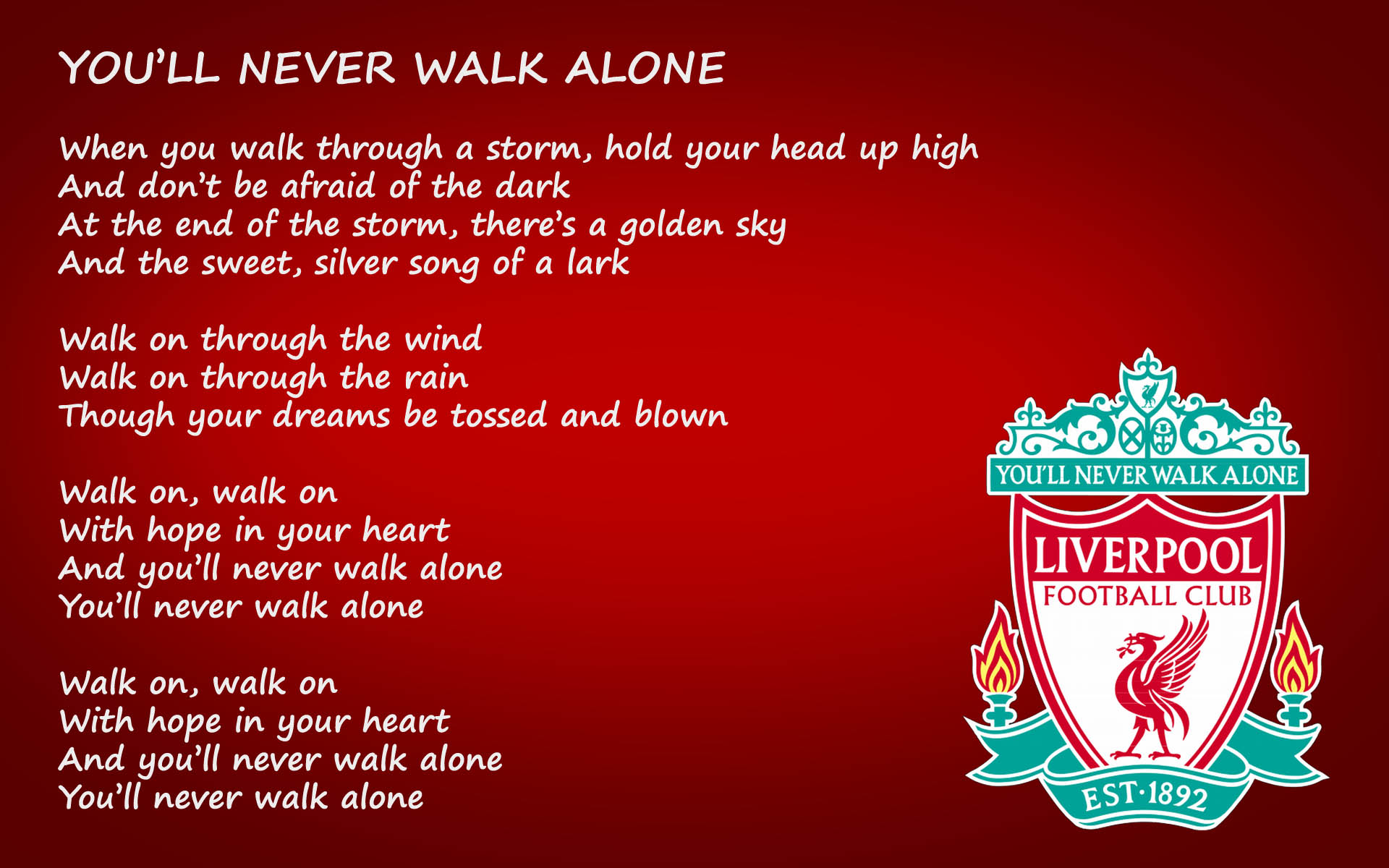
You’ve heard it. Even if you aren’t a football fan or a musical theater geek, you know the swell of the strings and that soaring, defiant promise that nobody has to face the dark by themselves. It’s a song that feels like it has existed forever, like a hymn found in the rafters of an old cathedral, but the truth is a bit more Hollywood—and a lot more interesting. You'll Never Walk Alone wasn't born in a stadium. It was born on a stage in 1945, a year when the world was desperately looking for a reason to breathe again.
The song is a bit of a chameleon. To some, it’s the sound of Anfield on a cold Tuesday night in Liverpool. To others, it’s a funeral standard or a graduation march. It’s rare for a piece of music to survive eighty years without losing its edge, but this one did it by being unapologetically emotional. It doesn't ask you to be happy; it asks you to keep walking.
From Carousel to the Kop: The Origins of a Giant
Back in 1945, Oscar Hammerstein II and Richard Rodgers were the undisputed kings of Broadway. They were working on Carousel, a musical that is, frankly, pretty dark. The plot involves a carnival barker who commits suicide to avoid capture after a failed robbery. Not exactly "feel-good" material on paper. You'll Never Walk Alone is sung twice in the show: once to comfort the protagonist's widow after his death, and again at a graduation ceremony at the very end.
It was a wartime hit. People in New York were losing sons and husbands across the ocean, and when Christine Johnson sang those lyrics about walking through a storm, it hit a nerve that hasn't stopped throbbing since.
Then came the 1960s.
In Liverpool, a band called Gerry and the Pacemakers decided to cover it. Gerry Marsden, the frontman, had a certain way of phrasing the lyrics that stripped away the operatic drama and replaced it with a Scouse grit. It hit number one in the UK in 1963. Legend has it that the DJ at Anfield, Liverpool FC’s home ground, used to play the top ten hits before kickoff. When the song eventually fell out of the top ten, the fans—who had fallen in love with the melody—kept singing it anyway.
They just didn't stop.
Why this song? Why Liverpool?
It's a question musicologists and sports historians argue about constantly. Some say it's the simple rhythm. Others point to the Celtic influence in Liverpool’s culture, a city built on shipping and struggle. Honestly? It’s probably simpler. The lyrics are about persistence. For a city that has seen massive industrial decline, political marginalization, and the tragedy of Hillsborough, the song became a shield.
When you see 50,000 people holding scarves above their heads, it isn't about the music anymore. It’s a collective vow. It’s the sound of a community refusing to be ignored.
The Global Spread: More Than Just Football
While Liverpool FC is the most famous custodian of the anthem, they don't own it. Not even close. You’ll hear it at Celtic Park in Glasgow, where the fans sing it with a ferocity that rivals the English. You’ll hear it in Germany, specifically at Borussia Dortmund’s Westfalenstadion.
I remember watching a match between Liverpool and Dortmund in 2016. Both sets of fans sang it together. It was deafening. It was one of those moments where the sport feels secondary to the sheer human weight of the noise.
But it goes beyond the pitch.
- Elvis Presley recorded a version that sounds like a gospel plea.
- Aretha Franklin turned it into a soulful masterpiece.
- Pink Floyd famously sampled the Anfield crowd singing it at the end of their track "Fearless" on the Medal album.
- Judy Garland sang it with a vulnerability that makes the Broadway version sound like a nursery rhyme.
There is a specific technical reason why it works for crowds. The song starts in a relatively low register. It’s easy to mumble. But as the "storm" passes in the lyrics, the melody climbs. By the time you get to "Walk on, walk on," the notes are high enough that you have to shout-sing them to hit them. It forces a physical release of breath and volume.
The Science of the "Skin-Glow" Moment
Neuroscientists have actually looked into why certain songs give us "the chills"—a phenomenon called frisson. You'll Never Walk Alone is a textbook example of a frisson-triggering composition. It uses appoggiaturas—notes that clash slightly with the harmony before resolving.
When Gerry Marsden’s version hits that final crescendo, your brain releases dopamine. It’s the same chemical reward you get from food or, well, winning a football match. When you multiply that by a crowd of thousands, you get a psychological feedback loop. It’s not just "liking" a song; it’s a physical event.
Misconceptions and the "Fair Use" of Emotion
One thing people often get wrong is the idea that the song is purely "sad." If you look at the lyrics, they are actually quite dark for the first half. You have "the dark," "the storm," and "dreams being tossed and blown." It’s a song about the reality of failure.
It’s also not "just a Liverpool song." While the club has it on their crest, the Rodgers and Hammerstein estate has always been very clear about its universal appeal. It has been used in countless civil rights marches and memorial services. During the COVID-19 lockdowns, Captain Tom Moore’s version (recorded with Michael Ball) hit number one in the UK, proving that even in a digital age, we still reach for this specific 80-year-old melody when things get scary.
The Anatomy of the Lyrics: A Breakdown
Let's look at why the writing works so well. Hammerstein wasn't just a songwriter; he was a dramatist.
- The Weather Metaphor: "When you walk through a storm / Hold your head up high." It’s the most basic human struggle. We all understand weather. We all understand the physical act of looking up instead of down.
- The Golden Sky: "At the end of a storm / There's a golden sky / And the sweet silver song of a lark." This is the payoff. It’s poetic, sure, but it’s also rhythmic. The "s" sounds create a sibilance that feels like the wind dying down.
- The Command: "Walk on, walk on, with hope in your heart." This is the pivot. It’s no longer a description; it’s an instruction.
It is a very clever piece of engineering. It moves from the individual ("You") to the universal experience of hope.
Actionable Takeaways for the Curious Listener
If you want to truly appreciate the depth of this anthem, don't just stick to the stadium recordings. You need to hear how it has evolved across different genres.
- Listen to the 1945 Original: Find a recording of the original Broadway cast. It’s slower and more operatic, which makes the lyrics feel more like a prayer than a shout.
- Compare the "Live" Versions: Watch the 1989 FA Cup Final version. It was played just weeks after the Hillsborough disaster. The emotion is raw and uncomfortable, but it explains everything you need to know about why this song matters to that city.
- Try the Nina Simone Version: She brings a jazz sensibility to it that changes the entire mood. It becomes less about a crowd and more about a singular woman’s journey.
- Check the History: If you're ever in Liverpool, visit the Hillsborough Memorial at Anfield. Seeing the lyrics carved into stone changes how you hear the melody.
The song persists because it acknowledges that life is often a mess. It doesn't promise that the storm will stop—it just promises that you won't be standing in the rain by yourself. In a world that feels increasingly fragmented, that’s a hell of a thing to hold onto.
To experience the full power of this anthem, seek out the 1963 Gerry and the Pacemakers version on high-quality audio, then immediately watch a video of a "full-voice" Anfield rendition from a Champions League night. Notice the difference between the studio polish and the communal roar. This contrast is where the song truly lives—somewhere between a piece of professional art and a living, breathing piece of human history.



