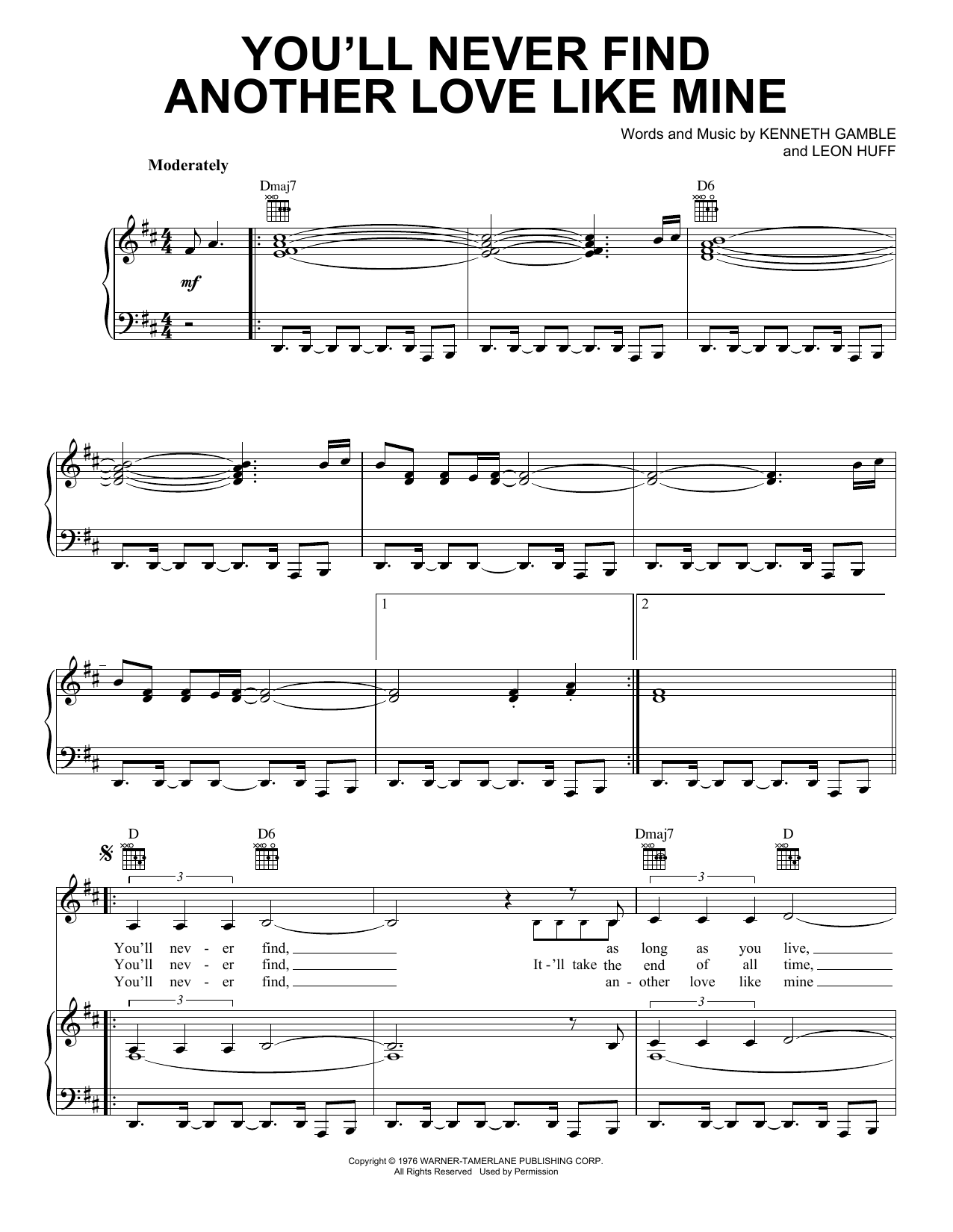
Lou Rawls had a voice like velvet dipped in bourbon. It was smooth, but it had this grit underneath that made you believe every single word he said. When he released "You’ll Never Find Another Love Like Mine" in 1976, it wasn’t just a disco-adjacent hit; it became the definitive anthem for the "you're gonna miss me when I'm gone" crowd. Honestly, if you've ever been through a breakup where you knew—just knew—the other person was making a massive mistake, these lyrics are your gospel.
It’s a cocky song. Let’s be real. It’s a man standing his ground, looking at a partner who is halfway out the door, and telling them they’re never going to find an upgrade. But the genius of the lyrics to You’ll Never Find Another Love Like Mine lies in the delivery. Lou doesn't sound bitter. He sounds certain. He sounds like a guy who’s already seen the future and knows exactly how it ends: with his ex lonely and searching for a spark he’s already taken with him.
The Gamble of Gamble and Huff
To understand why the song works, you have to look at the architects behind it. Kenneth Gamble and Leon Huff were the kings of the Philadelphia Soul sound. They didn't just write "catchy" songs; they wrote emotional blueprints. By the mid-70s, the "Philly Soul" movement was defined by lush strings, driving percussion, and a sophisticated approach to R&B that felt more grown-up than what was coming out of Motown at the time.
Gamble and Huff knew exactly what they were doing when they handed these lyrics to Lou. He’d been in the business for years, floating between jazz, blues, and gospel, but he hadn't had that "monster" crossover hit in a while. They gave him a mid-tempo groove that sat perfectly between a slow dance and a disco floor-filler.
The opening line sets the entire stage: "You'll never find, as long as you live / Someone who loves you tender like I do."
It’s a bold claim. It’s almost a curse, isn't it? He’s basically telling her that her entire future—the "as long as you live" part—is already peaked. Everything from here on out is a downgrade. That’s a heavy vibe for a song that people dance to at weddings.
Why the Lyrics to You'll Never Find Another Love Like Mine Hit Differently
Most breakup songs are about begging. "Please don't go." "I can't live without you." This isn't that. This is a song about legacy.
When you look at the lyrics to You’ll Never Find Another Love Like Mine, you notice a recurring theme of "the search." Lou sings about how she’s going to go out and look for someone else. She’s going to try to find a replacement. But the lyrics suggest a loop. She’ll find someone, think it’s the one, and then realize the "tender" love is missing.
"You'll never find, no matter where you search / Someone who cares about you like I do."
There’s a specific kind of arrogance here that feels very human. We’ve all wanted to say this. Whether we actually believed it or were just trying to save face, the sentiment is universal. It’s the ultimate ego-protection mechanism. If I can convince myself that you’ll never find better than me, then your leaving doesn't mean I'm "not enough"—it means you're a fool.
The song doesn't use complex metaphors. It doesn't need them. It uses direct, declarative sentences. "I'm not bragging on myself, baby." Except, he totally is. That line is the ultimate "no offense, but..." of the 1970s. He follows it up by saying he's just the guy who knows where she's at. It’s psychological warfare set to a beautiful orchestral arrangement.
The Bridges and the Build-Up
One thing that often gets overlooked in the lyrics is the bridge. "Late in the midnight hour, baby / To find that love you need."
The "midnight hour" is a classic R&B trope. It represents the time of day when the distractions are gone. No friends, no music, no work. Just you and your thoughts. That’s when the regret hits. Lou is banking on that 2:00 AM realization. He knows that during the day, she might be fine. She might be out having fun. But when it’s late and the world is quiet, she’s going to realize the "another love" she found is a pale imitation.
Interestingly, the song was Lou’s only number-one R&B hit and reached number two on the Billboard Hot 100. It resonated because it captured a shift in the culture. The mid-70s were the era of the "Me Generation." People were focusing on self-actualization and personal happiness. In that context, a song about your own irreplaceable value was a perfect fit for the zeitgeist.
The Technical Brilliance of the Composition
Musically, the song is a masterclass. You’ve got the MFSB (Mother Father Sister Brother) house band providing that tight, polished backing. If you listen closely to the percussion, there's a constant, driving rhythm that keeps the song from feeling too much like a ballad. It has momentum.
The arrangement uses strings not just for "sweetness," but to build tension. When Lou sings "You're gonna miss my lovin'," the strings swell. They emphasize the scale of the loss he’s describing. It’s cinematic.
And then there's Lou’s voice. He had a four-octave range, but he stays mostly in that rich baritone pocket for this track. He doesn't need to scream to be heard. His authority comes from the resonance of his tone. When he says "You'll never find," it sounds like a factual statement, not a desperate plea.
Some critics at the time thought it was a bit too "easy listening." They were wrong. It’s a soul record with a pop coat of paint. It’s got more in common with a blues lament than a bubblegum pop song.
Comparing Lou's Version to the Covers
You know a song is good when everyone tries to take a crack at it. Michael Bublé did a version. So did John Holt and even The Dubs.
Bublé’s version is exactly what you’d expect: clean, big band, very "Vegas." It’s charming, but it lacks the weight of the original. When Bublé sings it, it feels like a flirtation. When Lou Rawls sings it, it feels like a warning.
The John Holt reggae version is actually a fascinating listen. It strips away the Philly strings and replaces them with a rocksteady beat. It changes the mood entirely. Suddenly, the lyrics feel more casual, almost like a "hey, your loss" shrug. It’s great, but it loses that dramatic "midnight hour" intensity that makes the original so haunting.
The Cultural Impact and the "Wedding Song" Irony
Isn't it funny how many people play this at weddings?
Think about the lyrics for a second. "You'll never find another love like mine." It’s literally a song about a breakup. It’s about someone leaving and the person left behind telling them they’re making a mistake. And yet, because it’s so smooth and the melody is so uplifting, people play it while they’re walking down the aisle or having their first dance.
Maybe they’re focusing on the "love like mine" part and ignoring the "you'll never find another" part. Or maybe, subconsciously, we all just want to believe that the love we have right now is so unique that it could never be replicated.
The song also saw a huge resurgence in the 90s and 2000s through movies and samples. It was famously used in the movie Casino during a scene that perfectly captured the glitz and the underlying tension of the era. It’s also been sampled in hip-hop, because that opening drum break and the lush strings are a producer’s dream.
Why We Still Listen
We live in a "swipe-right" culture now. Everything is replaceable. If a relationship doesn't work, you jump back on an app and find someone else.
The lyrics to You’ll Never Find Another Love Like Mine fly in the face of that modern disposable mindset. They argue for the "singular" love. The idea that some connections are so deep, so "tender," and so specific that they can't be swapped out for a newer model.
Lou Rawls was singing to someone who thought they could do better. He was telling them that they were trading a diamond for a rhinestone. In an age where we’re constantly told there are "plenty of fish in the sea," Lou reminds us that some fish are once-in-a-lifetime catches.
Honestly, the song is a bit of a power trip. But it’s a power trip we’ve all wanted to go on. Who hasn't wanted to say, "Good luck out there, you're gonna need it because nobody is ever going to love you the way I do"?
Misconceptions About the Meaning
Some people think the song is about a guy who is still in a relationship and just being romantic. "Hey honey, you'll never find another love like mine, right?"
If you look at the second verse, that theory falls apart.
"I'm not braggin' on myself, baby / But I'm the one who loves you / And there's no one else! No... one... else!"
He’s pleading his case. The song is an argument. He’s trying to convince her to stay by painting a bleak picture of her life without him. It’s dark if you think about it too long. He’s basically saying, "If you leave me, you’ll never be truly happy again."
That's heavy stuff for a Top 40 hit.
Actionable Takeaways for Music Fans
If you're looking to dive deeper into this track or the era that produced it, here are a few things you should actually do:
- Listen to the "Philadelphia International Records" Catalog: Don't just stop at Lou Rawls. Check out The O'Jays, Teddy Pendergrass, and Harold Melvin & the Blue Notes. You'll hear the same DNA—the same "Gamble and Huff" magic—that made "You'll Never Find Another Love Like Mine" such a hit.
- A/B Test the Mono vs. Stereo Mixes: If you can find an original vinyl pressing or a high-quality digital remaster, listen to the way the strings are panned. The stereo mix is incredibly wide, which adds to that "grand" feeling of the lyrics.
- Watch Lou Rawls Live: There’s a 1977 performance of this song that is absolutely electric. You can see the way he uses his hands and his eyes to sell the "authority" of the lyrics. It’s a lesson in stage presence.
- Read the Liner Notes on "All Things in Time": That's the album this song came from. It was a massive comeback for Lou, and the story of how he teamed up with Gamble and Huff is a great look at the business of 70s R&B.
The reality is, Lou Rawls gave us a gift with this song. He gave us a way to feel powerful even when we're being rejected. He turned heartbreak into a victory lap. And that’s why, no matter how many years pass, we’re still singing along to those lyrics. We all want to be the one that can't be replaced.



