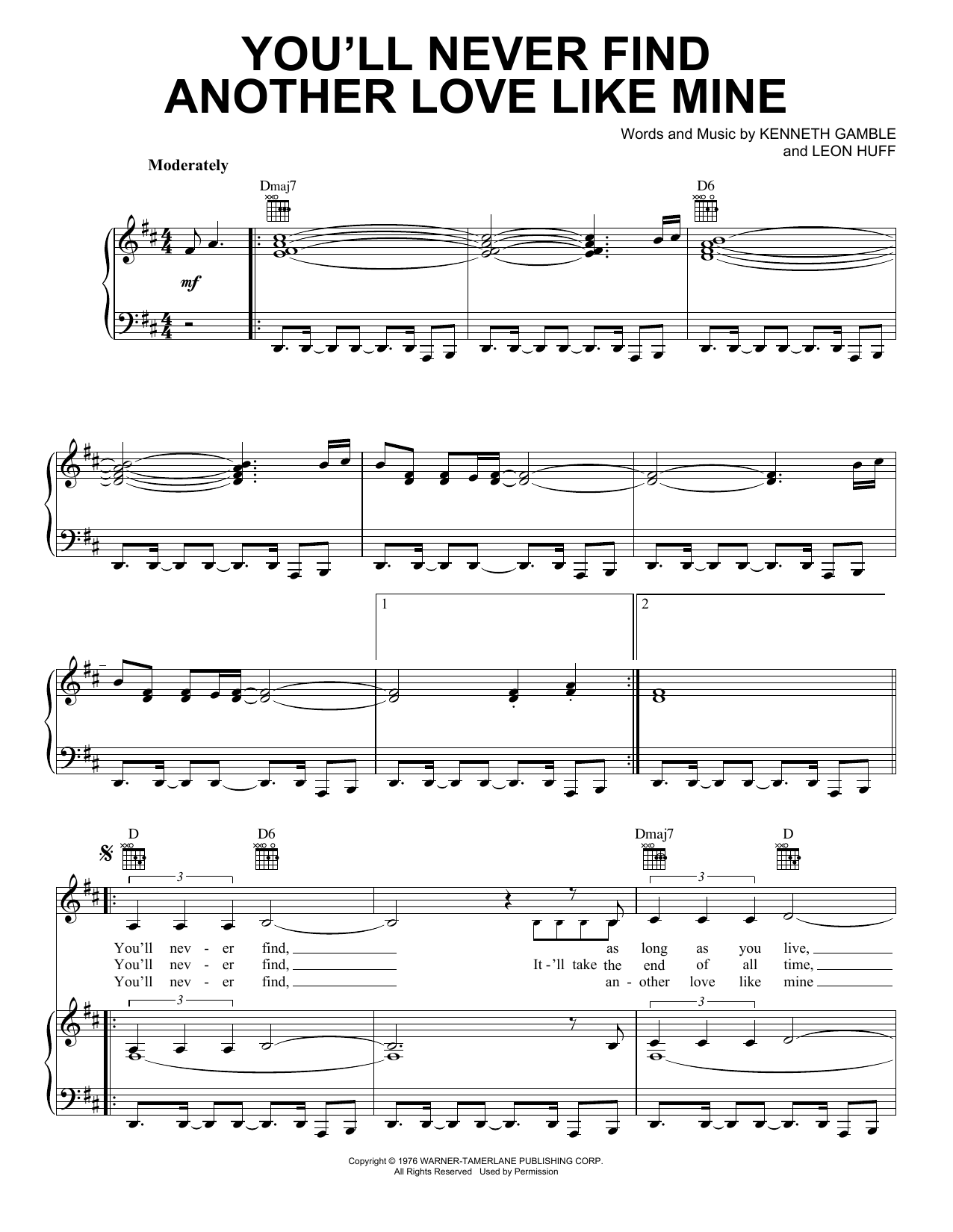
If you close your eyes and listen to those first four bars of the piano intro, you can almost feel the velvet. That's the thing about You'll Never Find Another Love Like Mine. It doesn't just start; it arrives. By the time Lou Rawls lets out that first "You'll never find," you aren't just listening to a song from 1976. You’re transported to a specific era of sophisticated, high-gloss soul that frankly hasn't been topped in fifty years.
Lou Rawls was fifty years old when this track hit the airwaves, which is kinda wild when you think about the youth-obsessed nature of the music industry. He wasn't some newcomer. He was a veteran who had already transitioned from gospel to jazz to blues. But it was this specific Gamble and Huff production that cemented him as the definitive voice of the "Philadelphia Soul" sound, even though he was a Chicago guy through and through.
It’s a song about a breakup, but it feels like a victory lap. That’s the magic trick.
The Gamble and Huff Connection
You can't talk about You'll Never Find Another Love Like Mine without talking about Sigma Sound Studios and the architects of the Philly Sound, Kenneth Gamble and Leon Huff. Before Lou signed with Philadelphia International Records, his career was in a bit of a weird spot. He was respected, sure, but he wasn't exactly burning up the charts.
Gamble and Huff changed that by wrapping his gravel-and-silk baritone in the most expensive-sounding arrangements imaginable. We're talking lush strings, a rhythmic "four-on-the-floor" beat that hinted at the disco explosion without being cheesy, and a bassline that carries the weight of the world.
The recording session itself is legendary among audiophiles. They used MFSB (Mother Father Sister Brother), the powerhouse house band for PIR. If you listen closely to the percussion, there's a subtle use of a shaker and a tambourine that keeps the tempo driving forward, even when the strings try to make it feel like a ballad. It’s that tension between the dance floor and the heartbreak that makes it stick.
Honestly, it shouldn't work. The lyrics are basically Lou Rawls telling an ex-lover that they are making a massive mistake and will never do better than him. In any other voice, that might sound arrogant or even bitter. But with Lou? It sounds like a factual observation. It's suave.
Why the Vocals Still Matter in 2026
Lou Rawls had a "built-in" reverb in his throat. That’s the only way to describe it. He was a baritone, but he had this incredible flexibility in his upper register that allowed him to ad-lib without losing the melody.
In You'll Never Find Another Love Like Mine, he does this thing where he repeats phrases—"You're gonna miss my lovin'," "You're gonna miss my lovin'"—and each time the inflection shifts just a tiny bit. It’s a masterclass in phrasing.
A lot of people don't realize that Lou grew up singing with Sam Cooke in the Teenage Kings of Harmony. You can hear that gospel foundation in the way he handles the climax of the song. He isn't screaming. He isn't over-singing like a contestant on a talent show. He’s controlled.
The Nuance of the Baritone: Most male pop stars today are tenors. They’re all hunting for those high notes. Lou Rawls proved that there is immense power in the lower frequencies. When he hits those low notes in the bridge, you feel it in your chest. It’s a groundedness that modern digital production often strips away.
The Chart Success and the Disco Context
Released in 1976 on the album All Things in Time, the song was a monster hit. It reached number two on the Billboard Hot 100 and spent two weeks at the top of the R&B charts. It even topped the Easy Listening chart. Think about that for a second. This was a song that played in the discos, played on the R&B stations, and played in your dentist's office. It had a universal appeal that is incredibly rare.
It’s often mislabeled as a "disco" song. While it has the tempo, it’s really the pinnacle of Sophisti-soul.
- It bridged the gap between the rougher soul of the 60s and the polished R&B of the 80s.
- It gave Lou Rawls his first and only million-selling single.
- It earned him a Grammy nomination, though he eventually won for the album itself.
If you look at the landscape of 1976, you had the Bee Gees starting to dominate and the emergence of punk in the UK. Amidst all that noise, this record felt like the "grown-up" in the room. It was sophisticated. It was for people who wore silk shirts and drank expensive scotch, but it was accessible enough for everyone else to hum along to.
The Lyrics: A Psychological Deep Dive
"You'll never find, as long as you live, someone who loves you tender like I do."
It’s a bold claim. Most breakup songs are about "please come back" or "I'm so hurt." Lou takes a different route. He’s telling her, "Go ahead. Try. You’ll be back, or you’ll be disappointed."
There is a psychological weight to the song. It taps into that universal fear we all have when leaving a relationship: Is this the best I'll ever get? Lou plays on that insecurity with total confidence. The genius of the songwriting (credited to Gamble and Huff) is that the music feels warm and inviting, which softens the "I told you so" nature of the lyrics.
Interestingly, Lou Rawls was known for his "raps"—those spoken-word intros he did during live shows. While the studio version of You'll Never Find Another Love Like Mine gets straight to the point, his live performances of the song often featured five-minute monologues about the nature of love and loss. He was a storyteller.
Legacy and Pop Culture Longevity
The song didn't die in the 70s. It has had a massive second life in movies and television. You’ve probably heard it in The Adventures of Priscilla, Queen of the Desert or Ice Age: Dawn of the Dinosaurs. It’s become the shorthand for "smooth" in Hollywood.
Sampling has also kept it alive. Artists have been pulling from that drum break and those string swells for decades. But no one can sample Lou’s "Whoa-oh-oh-oh-oh" and make it sound authentic. It’s too tied to his DNA.
The song also served as a blueprint for artists like Luther Vandross and later, Gregory Porter. It showed that you could be a "crooner" without losing your soul credentials. You could be pretty and gritty at the same time.
What Most People Get Wrong
People think Lou Rawls was just a "smooth" singer. That’s a bit of a disservice. Before this hit, he was a guy who survived a horrific car accident in 1958 that left him clinically dead for several minutes. He was in a coma for days. He had a perspective on life that most of his peers didn't.
When he sings about love and the passage of time, he isn't just reading lyrics. He’s someone who saw the other side and came back.
Another misconception? That the song is easy to sing. Go ahead, try it at karaoke. You’ll realize very quickly that the timing is incredibly difficult. Lou stays just slightly behind the beat, a jazz technique that creates a feeling of relaxation. If you sing it right on the beat, it sounds stiff. Lou makes it swing.
How to Truly Appreciate the Track Today
To get the most out of You'll Never Find Another Love Like Mine, you have to step away from the low-bitrate streaming versions if you can.
- Find the Vinyl: The original Philadelphia International pressings have a "warmth" in the mid-range that digital often flattens. The way the horns sit in the mix is much more apparent on an analog setup.
- Listen to the Instrumental: If you can find the backing track, listen to the complexity of the percussion. There are layers of rhythmic interplay that you usually miss because Lou’s voice is so magnetic.
- Compare to the Live Versions: Check out his 1977 performance at the On Broadway show. His "monologue" before the song starts gives the lyrics a completely different context.
Lou Rawls passed away in 2006, but this song is basically his eternal flame. It’s a reminder that truly great music doesn't need to shout to be heard. It just needs to be undeniable.
If you’re building a playlist of essential soul, this isn't just a suggestion; it’s the foundation. It represents a moment where production, performance, and songwriting hit a perfect "Golden Ratio." You won't find another song quite like it.
Next Steps for the Soul Enthusiast:
To understand the full scope of this sound, your next move should be exploring the rest of the All Things in Time album. Specifically, check out "Groovy People." It’s the B-side energy that shows how Lou and Gamble/Huff were experimenting with rhythm. After that, look into the 1970s work of The O'Jays and Teddy Pendergrass to see how the "Philly Sound" evolved after Lou's massive success. Comparing Pendergrass's raw power to Rawls's polished baritone gives you a full picture of what made that era of music so special.



