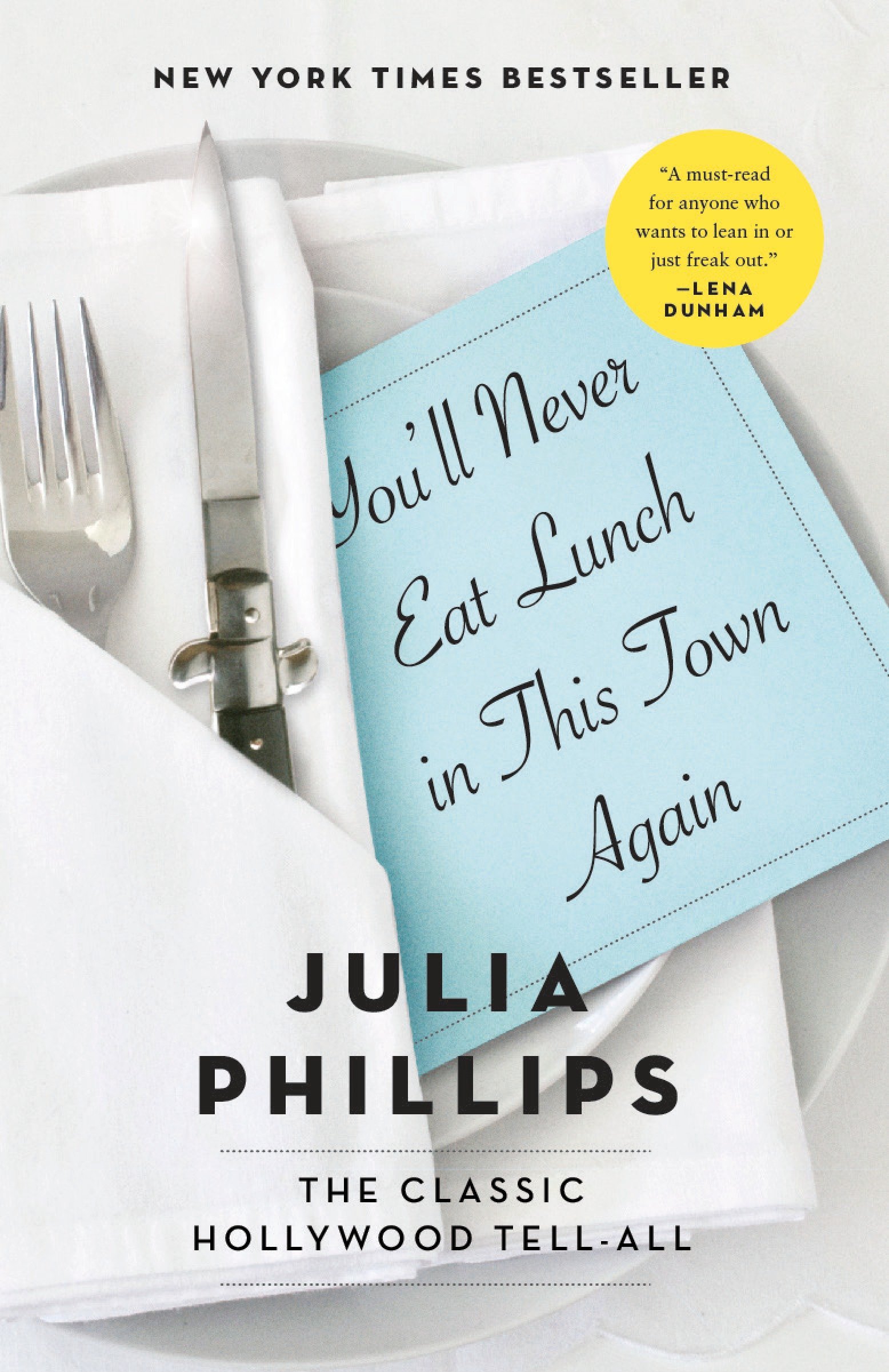
Hollywood is a town built on secrets, or at least it used to be before Julia Phillips decided to burn every bridge in sight. When her memoir You'll Never Eat Lunch in This Town Again hit bookstores in 1991, it wasn't just a bestseller. It was a tactical nuke. People forget how high she had climbed. Phillips wasn't some peripheral hanger-on; she was the first woman to win an Academy Award for Best Picture as a producer for The Sting. She was behind Taxi Driver and Close Encounters of the Third Kind. And then, fueled by a legendary amount of cocaine and a scorched-earth resentment toward the "boys' club," she told the truth. Or her version of it.
It’s messy.
If you pick up the book today, you're not just reading a memoir. You're reading a forensic report of an era when the New Hollywood of the 70s—that gritty, director-driven golden age—was curdling into the corporate, high-concept blockbuster machine of the 80s. Phillips saw it all. She saw the egos, the drug-fueled delusions, and the sheer pettiness of the men who ran the studios. She didn't use pseudonyms. She used names. Big ones. Goldie Hawn, Steven Spielberg, Warren Beatty, Michael Douglas. Nobody was safe from her acid-dipped pen.
The Producer Who Knew Too Much
The title itself became a prophecy. You'll Never Eat Lunch in This Town Again wasn't just a catchy phrase; it was the literal reality for Phillips after the book's release. She became a pariah. But why did it hit so hard?
Basically, Phillips broke the omertà. Hollywood thrives on a "we all know, but we don't say" culture. By detailing the specific ways moguls behaved in private meetings or the exact amount of blow being snorted in bathroom stalls, she violated the industry's most sacred code: discretion. She described the industry as a "vaseline-coated slide to oblivion." She portrayed icons not as artists, but as insecure, often cruel men obsessed with power and youth.
Her prose is frantic. It’s jittery. It reads like a long, breathless conversation at a bar where the person talking has had three too many espressos and a very long night. This wasn't the polished, ghostwritten fluff people were used to. It was raw. She admitted to her own failures, her own addictions, and her own descent into what she called "the zone." That self-deprecation gave her the license to tear everyone else down, too.
Why the Industry Hated It (and Why We Still Read It)
The backlash was instant and total. Producers like Sherry Lansing and icons like Spielberg were reportedly livid. They didn't just disagree with her facts; they hated the vulnerability she exposed.
Honestly, the book is a masterclass in the "unreliable narrator" who is nonetheless telling a profound truth. Was every anecdote 100% accurate? Probably not. Memory is a sieve, especially one filtered through 1970s narcotics. But the vibe was undeniably real. She captured the transition from the artistic freedom of the "Movie Brats" to the spreadsheets of the 80s.
The Famous Victims of the Phillips Pen
- Steven Spielberg: She portrayed him as a cold, tech-obsessed wunderkind who lacked soul. This was particularly stinging given their history on Close Encounters.
- Warren Beatty: Phillips didn't hold back on his legendary vanity, depicting him as a man constantly checking his reflection even while talking about "serious" art.
- Goldie Hawn: Described in ways that were far from the "America's Sweetheart" image the public adored.
She saw through the branding. That’s what made it dangerous. In a town where your brand is your currency, Phillips was a devaluator. She was the one pointing out that the emperor had no clothes and probably a deviated septum.
The Cocaine of it All
You can’t talk about You'll Never Eat Lunch in This Town Again without talking about the drugs. It’s the engine of the narrative. Phillips is terrifyingly honest about her $5,000-a-week habit. She describes the physical toll, the paranoia, and the way it warped the business of making movies.
In one of the book’s most famous sequences, she details the chaotic production of Close Encounters. It wasn't just about the aliens; it was about the ego clashes and the ballooning budgets. She was a woman in a man’s world, and she decided to out-tough, out-drink, and out-snort them all. But the price was her career. By the time the book came out, she was already on the fringes. The book was her way of saying, "If I'm going down, I'm taking the whole building with me."
A Legacy of Burned Bridges
Is it a good book? Yes. It’s brilliant. It’s also exhausting.
The influence of Phillips can be seen in every "tell-all" that followed. Without her, we don’t get the modern era of celebrity gossip or the gritty "behind the scenes" documentaries that are now standard. She pioneered the idea that the business of Hollywood is just as much of a movie as the ones on the screen.
But there’s a sadness to it.
Julia Phillips died in 2002, relatively young, at 57. She never really "ate lunch" in that town again in the way she once had. She became a writer of a different sort, a commentator on the very world that spat her out. Her follow-up book, Driving Under the Affluence, tried to capture the same lightning but lacked the scorched-earth impact of the first.
What People Get Wrong About Julia Phillips
Most people think she was just a bitter failure looking for a payday. That’s too simple. If you look at her early career, she was a visionary. She fought for Taxi Driver when no one wanted to make it. She understood the shift in American cinema before almost anyone else. Her bitterness didn't come from a lack of talent; it came from the realization that even at the very top—holding an Oscar—she was still an outsider because of her gender and her refusal to play nice.
Why You Should Read It in 2026
We live in an era of carefully managed social media presences. Every actor has a PR team of twenty people checking their tweets. Everything is "curated."
You'll Never Eat Lunch in This Town Again is the antidote to curation. It’s messy, loud, and offensive. It reminds us that movies are made by deeply flawed, often brilliant, often terrible people. It strips away the glamour and replaces it with something much more interesting: humanity.
If you’re a film student, a business major, or just someone who likes a good train wreck, this book is essential. It’s a roadmap of how power works. It shows how easily doors close and how hard it is to open them back up once you’ve insulted the gatekeepers.
Actionable Insights for the Modern Reader
If you're looking to dive into the world Julia Phillips described, or if you're navigating a high-stakes industry yourself, here’s how to process the legacy of this book:
- Study the New Hollywood Era: To really "get" the book, watch The Sting, Taxi Driver, and Close Encounters of the Third Kind first. See the brilliance she was part of before you read about the chaos.
- Understand the "Price of Truth": Use the Phillips story as a case study in whistleblowing. In any insular industry—tech, finance, entertainment—there is a massive personal cost to breaking the silence. Decide if you're willing to pay it before you speak.
- Read Between the Lines: When reading her accounts of stars like Beatty or Hawn, remember that Phillips was writing from a place of deep personal struggle. Contrast her accounts with other memoirs of the era, like Robert Evans’ The Kid Stays in the Picture, to get a 360-degree view of the madness.
- Recognize the Gender Dynamics: Pay attention to how Phillips describes being the only woman in the room. A lot of the "difficult" behavior she was criticized for was the exact same behavior her male peers were celebrated for as "mavericks."
- Look for the "Zone": Her description of the "zone"—that drug-induced state of false productivity—is a cautionary tale for anyone in a high-pressure creative field. It’s a reminder that burnout usually looks like "crushing it" right before the fall.
The book remains a jagged, uncomfortable masterpiece. It isn't a "nice" read, but it’s an honest one. In a world of PR-approved fluff, that alone makes it worth the time.



