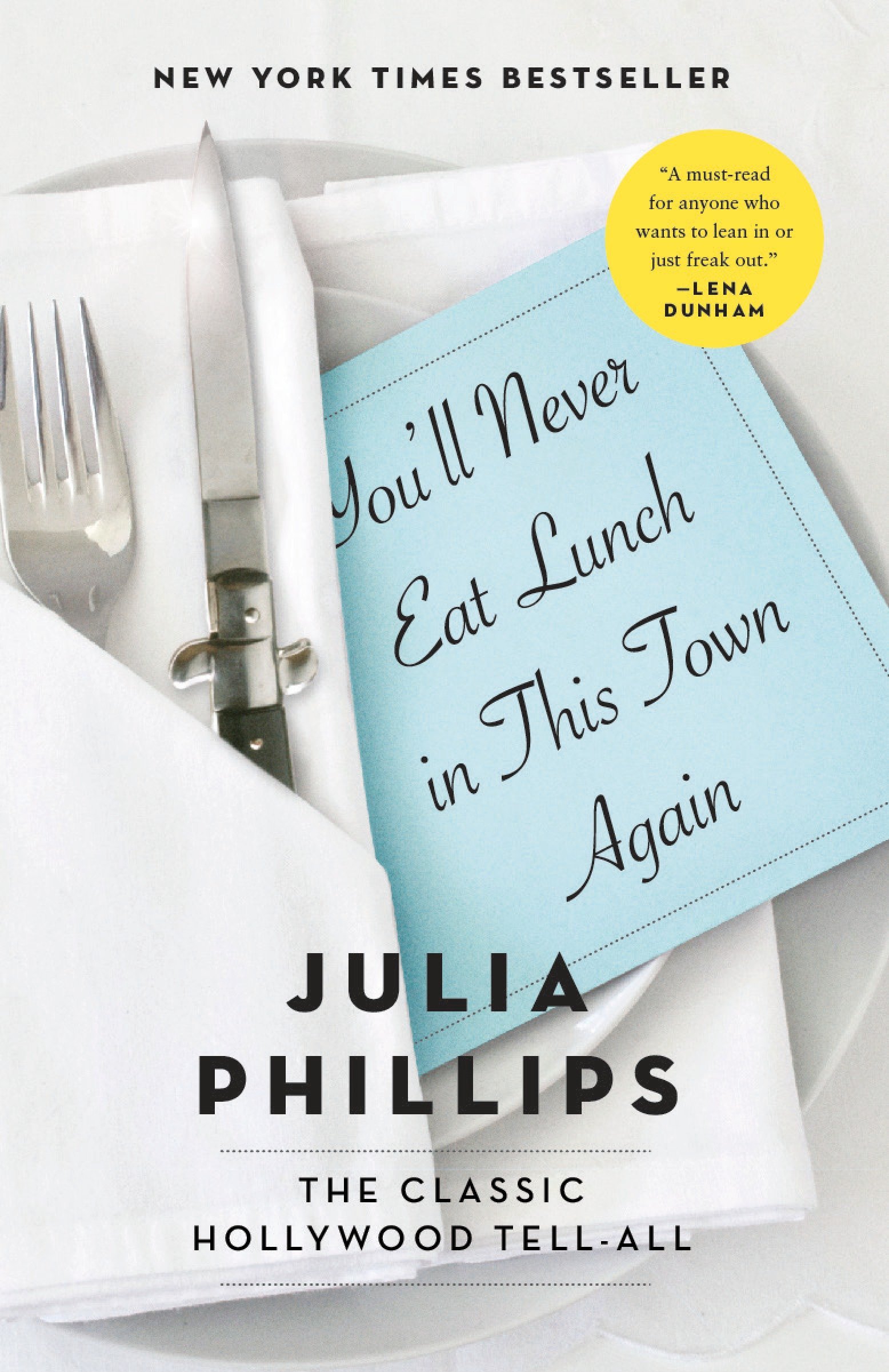
Julia Phillips was a pioneer. She was the first woman to win an Academy Award for Best Picture for The Sting. She helped bring Taxi Driver and Close Encounters of the Third Kind to life. But most people today don't remember her for the movies. They remember her for the bridge she burned with a high-octane flamethrower. When her memoir, You'll Never Eat Lunch in This Town Again, hit shelves in 1991, it didn't just ruffle feathers. It basically nuked the social hierarchy of Malibu and Beverly Hills.
It was a coke-fueled, brutally honest, and deeply cynical look behind the curtain. Hollywood hates a snitch. Phillips was the ultimate snitch.
She wrote about the "A-list" when they were still trying to maintain a facade of dignity. Honestly, the book reads like a fever dream of 1970s and 80s excess. It’s messy. It’s mean. It’s also arguably the most important piece of literature ever written about the film industry because it stopped pretending that movies were made by artists and admitted they were made by addicts, egomaniacs, and accountants.
The Book That Made Everyone Mad
You have to understand the context. In the early 90s, the "studio system" was still a very guarded fortress. There was no TMZ. There were no social media leaks. If a producer was a nightmare or an actor was high on set, the public generally didn't hear about it until decades later, if ever. Then came Phillips.
She didn't just name names; she described their hygiene, their drug habits, and their most pathetic insecurities. Warren Beatty? She had thoughts. Steven Spielberg? She had plenty to say about his ego. Goldie Hawn? Not a fan.
The title itself, You'll Never Eat Lunch in This Town Again, became a permanent part of the American lexicon. It’s a threat. It’s the ultimate Hollywood "blackball" warning. When she used it as her title, she was basically saying, "I’m already outside the tent, so I might as well set it on fire."
A Masterclass in Burning Bridges
What’s fascinating about the narrative is that Phillips doesn't paint herself as a hero. She’s a disaster. She chronicles her own descent into freebase cocaine addiction with a terrifying level of detachment. At one point, she’s spending thousands of dollars a week on drugs while trying to manage the production of some of the biggest films in history.
People were horrified. Not because of the drugs—everyone was doing drugs—but because she talked about it. In Hollywood, you can be a monster, but you can't be a loudmouth.
She described the "lunch" culture. Lunch wasn't about food. It was about power. It was about who sat where at Morton's or Spago. By the time the book was published, she was already persona non grata. The book just made the exile permanent.
Why We Are Still Obsessed with This Story
If you look at the industry today, the spirit of You'll Never Eat Lunch in This Town Again is everywhere. Every "blind item" on DeuxMoi or every tell-all documentary owes a debt to Julia Phillips. She broke the seal.
But there’s a nuance here that often gets missed. The book isn't just a gossip rag. It’s a tragedy. It’s about a brilliant woman who broke the glass ceiling and then realized the room she had entered was filled with people she despised.
- The Power Dynamics: Phillips exposed how movies actually get greenlit. It’s not about the script. It’s about who is sleeping with whom, who owes whom a favor, and who is terrified of losing their parking spot at the studio lot.
- The Gender Element: You can’t talk about this book without acknowledging that a man writing this would have been called "bold." Because she was a woman, she was called "hysterical" and "unstable." Both might have been true, but the double standard was glaring.
- The Cost of Truth: She never really "ate lunch" in that town again. Her career as a top-tier producer was effectively over. She became a professional pariah, living off the notoriety of the book until her death in 2002.
The Spielberg Rift
One of the most famous sections of the book involves her relationship with Steven Spielberg. They had worked together on Close Encounters. Phillips didn't hold back. She portrayed him as a man-child, obsessed with his own mythos.
When the book came out, Spielberg was reportedly furious. He wasn't the only one. David Geffen, Mike Ovitz—the titans of the era—were all caught in her crosshairs. Most people in Hollywood operate on a "you scratch my back, I'll scratch yours" policy. Phillips decided to use her nails to rip the skin off instead.
It’s actually kinda funny when you think about it. The very people she scorched were the ones who had the power to make her next movie. She knew exactly what she was doing. She chose the legacy of the book over the longevity of her career.
The Lasting Influence on Pop Culture
You’ll see references to this book in shows like Entourage or movies like The Player. It set the template for the "Hollywood Satire" genre. Except it wasn't satire. It was a primary source document.
The industry has changed, sure. It’s more corporate now. It’s less about individual producers like Phillips and more about "content silos" and "IP management." But the ego? The ego is exactly the same. The fear of being "out" is still the driving force behind every decision made on Sunset Boulevard.
Actually, the modern version of "never eating lunch in this town" is being canceled on X or losing a deal with a streaming giant. The stakes are different, but the social execution is the same. Phillips was just the first person to volunteer for the guillotine.
What the Critics Got Wrong
At the time, many critics dismissed the book as the ramblings of a bitter woman. They said it was too long, too self-indulgent, and too mean-spirited.
They missed the point.
The book needed to be self-indulgent. It was a confession. It was a 500-page suicide note for a career that she had already sabotaged. When you read it now, the prose is sharp. It’s rhythmic. It has a specific "New Hollywood" energy that you can’t fake. It’s the literary equivalent of a 2:00 AM conversation in a dark bar where someone finally starts telling the truth.
Actionable Insights for the Modern Reader
If you're interested in the history of cinema or just the psychology of power, You'll Never Eat Lunch in This Town Again is required reading. But don't just read it for the dirt. Look for the underlying mechanics of how industries protect themselves.
- Analyze the "Gatekeeper" Mentality: Notice how Phillips describes the people who decide what stories get told. It's rarely about the quality of the art. It's about risk mitigation and ego stroking.
- Understand the Price of Transparency: Phillips' life after the book is a cautionary tale. Telling the truth has a cost. If you're going to burn a bridge, make sure you're comfortable standing on the other side of the river alone.
- Look for the Patterns: Compare her descriptions of 1970s Hollywood to the modern era. You'll find that while the technology changes, the "types" of people—the shark, the sycophant, the dreamer—never do.
- Read Between the Lines: Pay attention to what she doesn't say about certain figures. In a book this honest, silence is often just as loud as the shouting.
Julia Phillips took the "Golden Age" of the 70s and stripped away the glamour. She reminded everyone that the movies we love are often birthed in environments that are incredibly toxic. It’s a messy, uncomfortable, and essential read. If you want to understand why Hollywood is the way it is, you have to look at the wreckage she left behind.
The industry tried to forget her. They failed. Every time a new tell-all drops or a celebrity scandal breaks, the ghost of Julia Phillips is there, laughing over a very expensive, very tense lunch.



