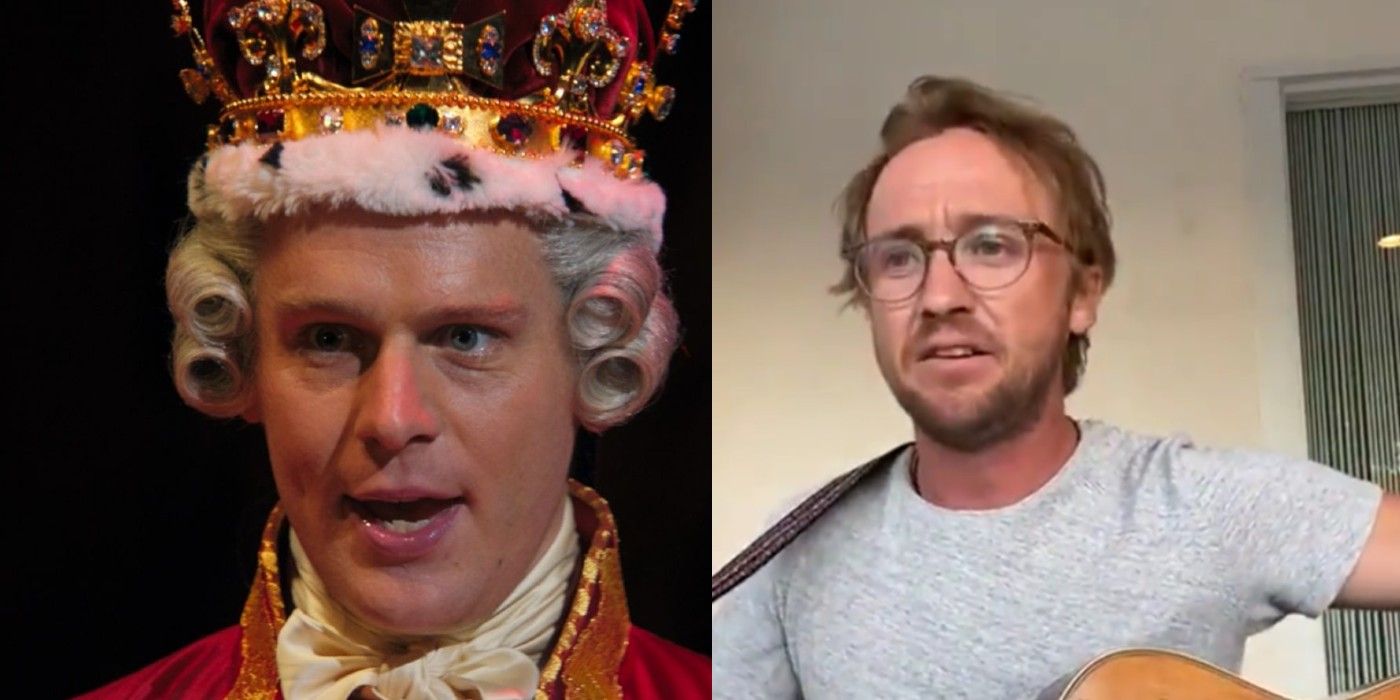
Everyone remembers where they were when they first heard that harpsichord. It starts with a bouncy, almost jaunty little riff that feels like it belongs in a sunny 1960s pop hit by the Beatles or the Monkees. Then, out walks a guy in a massive crown and a velvet cape, looking absolutely ridiculous and terrifying all at once. If you’ve seen the show or listened to the cast recording, you know exactly what I’m talking about. The king george song hamilton fans obsess over—officially titled "You'll Be Back"—is a weird, brilliant piece of musical theater that shouldn't work, but it totally does.
Honestly, it’s a breakup song. That’s the joke. While the revolutionaries are singing about grit, poverty, and "the room where it happens," King George III is treating the entire American Revolution like a messy divorce. He’s the toxic ex who refuses to let go. He’s convinced that the colonies will crawl back to him because, in his mind, they’re nothing without him. It’s funny, sure. But if you look closer at what Lin-Manuel Miranda did here, there’s a lot of historical and musical layers that people usually miss.
The Britpop Secret Behind the King’s Madness
Lin-Manuel Miranda has been pretty open about his inspirations. He didn't want the King to sound like the rest of the cast. While Hamilton, Burr, and Angelica are rapping or singing R&B-infused melodies, George is stuck in a different era. He’s singing "British Invasion" pop. Think Daytripper or Penny Lane. It’s a deliberate choice. By giving the King this specific sound, Miranda highlights how out of touch the monarchy is with the changing world.
The King isn't part of the "new" sound of America. He’s the old guard.
Jonathan Groff, who originated the role on Broadway, brought a certain... spit-heavy intensity to it. You’ve probably seen the memes. But the character’s stillness is what makes him scary. Most of the characters in Hamilton are constantly moving. They’re "non-stop." George just stands there. He’s the center of his own universe, and he expects the world to rotate around him. When he sings about sending a "fully armed battalion to remind you of my love," it’s a jarring contrast between the upbeat melody and the literal threat of state-sponsored violence.
It’s dark. Like, really dark.
And that’s the brilliance of the king george song hamilton creates for the narrative. It provides a "breather" for the audience while simultaneously raising the stakes. You’re laughing at his "Da-da-da-da-da," but then he mentions killing your friends and family to prove his point. It’s the definition of a velvet glove hiding an iron fist.
Did the Real King George III Actually Care This Much?
History is a bit more complicated than a three-minute show tune. The real George III wasn't just some flamboyant loon sitting on a throne eating grapes. In 1776, he was actually quite popular in England, and he took the loss of the American colonies very personally. He viewed himself as a father figure to the empire. To him, the rebellion wasn't just a political disagreement; it was a betrayal of the natural order.
He really did think the colonies would fail.
British leadership at the time genuinely believed that the "rabble" in America couldn't govern themselves. They expected anarchy. In that sense, the song is historically accurate in its sentiment. When the King sings about the colonies being "overwhelmed" and "alone," he’s echoing the actual British propaganda of the late 18th century.
However, the "madness" we see in the later reprises—like "I Know Him"—refers to the King’s actual struggle with mental illness later in life. Most historians now believe he suffered from porphyria, a genetic blood disorder that can cause hallucinations and confusion, though some modern researchers suggest bipolar disorder. By the time the events of the late musical take place (the Adams administration), George was significantly declining.
The song captures that transition perfectly. It starts as smug arrogance and slowly devolves into confused observational humor as he watches the American experiment actually... work.
Why "You'll Be Back" is an Earworm You Can't Escape
Musically, the song is a masterpiece of "theming." In musical theater, we call this a recurring motif. George appears three times, and each time, the melody is essentially the same, but the context shifts.
- The First Appearance: Pure condescension. He's the jilted lover.
- The Second Appearance: Frustration. He’s annoyed that the "price of tea" isn't a high enough cost for the Americans to pay.
- The Third Appearance: Bewilderment. He can't believe George Washington is stepping down. "I wasn't aware that was something a person could do."
This last part is actually based on a real historical anecdote. When King George III heard that George Washington intended to resign his commission and return to his farm after the war, the King supposedly said, "If he does that, he will be the greatest man in the world."
It’s one of the few moments where the show’s King George displays a sliver of genuine awe, even if it's wrapped in his signature sarcasm.
The "Da-da-da-da-da" section is also a clever trick. It’s a "sing-along." It forces the audience to participate in the King’s world. You find yourself humming along to the tyrant. It’s a subtle way of showing how seductive power can be. You like him because he’s funny, even though he’s the antagonist. That’s a very human reaction to charisma, and Miranda uses it to keep the audience off-balance.
The Performance Evolution: Beyond Jonathan Groff
While Groff is the most famous King George, the role has been played by some absolute heavyweights. Brian d'Arcy James did it in the off-Broadway run. Andrew Rannells stepped in. Rory O’Malley was incredible. Taran Killam from SNL even took a turn in the crown.
Each actor brings something different to the king george song hamilton fans love.
- Groff played him with a "sociopathic toddler" energy.
- Rannells brought a high-camp, almost Mean Girls vibe.
- O'Malley leaned into the physical comedy of the heavy costume.
The role is actually very physically demanding. The crown is heavy. The cape is hot. The actor has to convey massive amounts of emotion while barely moving their torso. It’s all in the eyes, the mouth, and the occasional twitch of a shoulder. If you ever get the chance to see a local or touring production, watch the King’s feet. Usually, they’re perfectly still. It’s unnatural. It’s meant to be.
How to Analyze the Song Like a Pro
If you’re a student or just a theater nerd trying to explain why this song is good, look at the lyrics. Don't just listen to the tune.
"I will kill your friends and family to remind you of my love."
That is a classic "abuser" trope. The song is a textbook study in gaslighting. "You say our love is draining and you can't go on... You'll be back like before." He’s dismissing the colonies' grievances as a temper tantrum. He’s infantilizing an entire nation.
When you compare this to Hamilton’s "My Shot," the contrast is staggering. Hamilton is focused on the future, on "rising up," and on the "scrap" of his personality. George is focused on the past. He wants things to stay exactly as they were. This tension—between the relentless forward motion of the revolutionaries and the static, rigid tradition of the King—is the heartbeat of the entire first act.
Also, notice the use of the harpsichord. It’s an instrument that was already becoming "old-fashioned" by the end of the 1700s, replaced by the piano. Using it in the orchestration is another musical hint that George is a relic of a dying age.
Practical Takeaways for Hamilton Fans
So, what do you do with all this?
First, go back and listen to the song again, but ignore the vocals. Listen to the bassline. It’s incredibly funky for a "British" song. It shows that even the King’s music is being influenced by the soulful, hip-hop world of the rest of the show, whether he likes it or not.
Second, if you’re ever writing your own characters or stories, use "You'll Be Back" as a reference for how to write a villain who doesn't think they're a villain. George thinks he’s the hero. He thinks he’s saving the Americans from themselves. That’s what makes him a great character.
Finally, appreciate the "spit." In the Disney+ filmed version, Groff’s spit is basically a supporting character. It’s gross, but it’s real. It shows the raw, unpolished nature of live theater. It’s a reminder that even the most "perfect" royal is just a human being with too much saliva and a fragile ego.
If you're looking to dive deeper into the technical side of the show, check out Hamilton: The Revolution (the "Hamiltome"). It has Lin-Manuel’s handwritten notes on the lyrics. You can see exactly where he crossed out lines to make the King sound more arrogant.
The next time "You’ll Be Back" comes on your shuffle, don't just sing along. Think about the fact that you're singing a love song written by a tyrant to a country that was currently shooting at his soldiers. It’s the most awkward, brilliant, and catchy history lesson ever written.
The real trick is realizing that the song isn't just about 1776. It’s about anyone who thinks they can own another person. It’s about the arrogance of power. And it’s about the fact that, eventually, the "Da-da-da-da-das" fade away, and you’re left alone on a stage, wondering where it all went wrong.
Next Steps for the Deep Dive:
- Compare the lyrics of "You'll Be Back" with the actual Declaration of Independence. You'll find that the "complaints" the King mentions are direct parodies of the grievances listed by Jefferson.
- Watch the Jonathan Groff performance specifically for his "blinkless" stare. It’s a masterclass in non-verbal character acting.
- Listen to 1960s Britpop (The Beatles' Revolver album is a good start) to hear the rhythmic DNA that Miranda stole—and I mean that in the best way possible—to create the King's signature sound.



