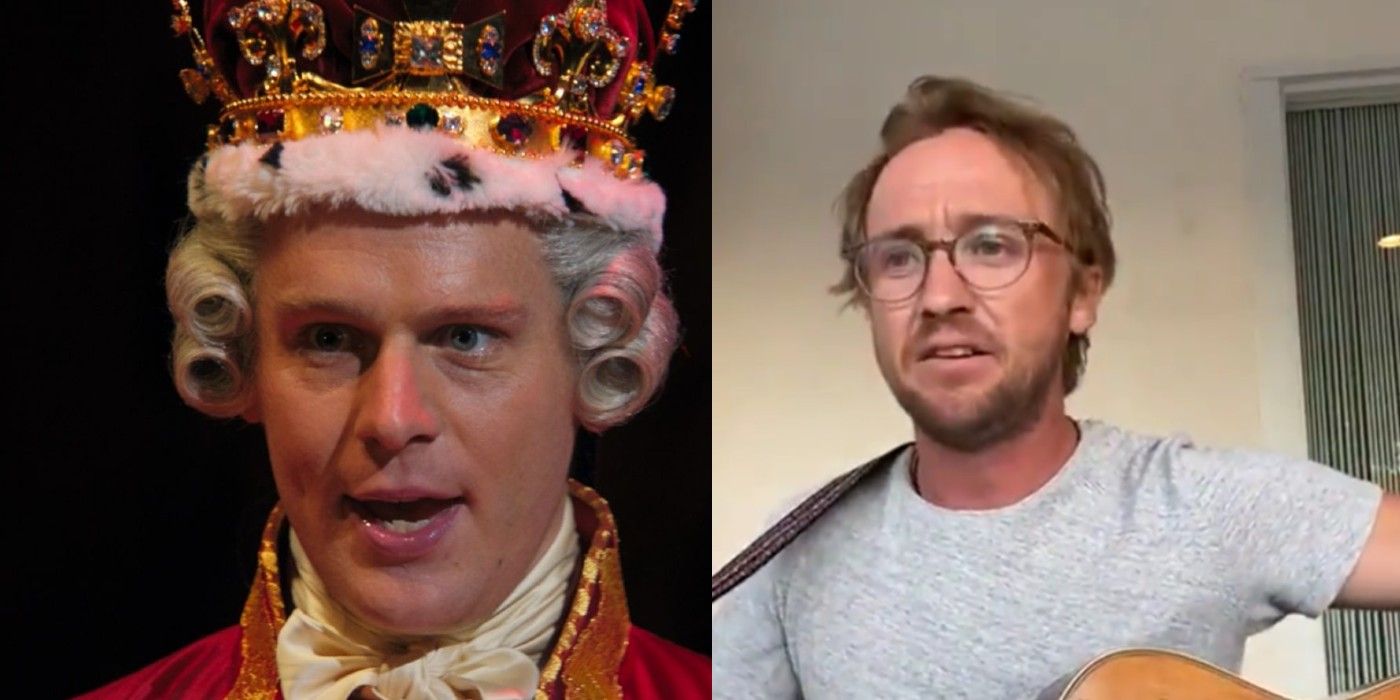
He walks out in a crown that looks like it weighs forty pounds. He’s wearing enough velvet to carpet a small apartment. Then, he starts singing a British invasion-style pop tune that sounds suspiciously like The Beatles met a harpsichord. Honestly, if you’ve seen the show or listened to the cast recording, you know exactly which Hamilton King George song we’re talking about. "You'll Be Back" is the moment where the heavy, fast-paced hip-hop of Alexander Hamilton’s life grinds to a halt to let a petulant monarch vent his frustrations.
It’s hilarious. It’s catchy. But there is a whole lot of history and musical theory hidden under that ermine cape that most casual listeners totally miss.
Lin-Manuel Miranda didn’t just write a funny song to give the audience a breather. He wrote a breakup letter from a jilted ex-boyfriend who happens to own an army. It’s a brilliant piece of character work that tells us more about the British perspective of 1776 than a dozen dry textbooks ever could.
The Secret Ingredient is 1960s Pop
Why does the Hamilton King George song sound so different from the rest of the show? Most of Hamilton is built on the bones of R&B, hip-hop, and soul. You’ve got the Biggie Smalls nods and the Destiny’s Child harmonies. Then King George III steps out and we’re suddenly in 1964 London.
Miranda has been very open about the fact that he drew inspiration from British Invasion bands. Think The Beatles. Think The Hollies. Specifically, he’s mentioned "Penny Lane" as a major touchstone. It has that jaunty, upbeat tempo that contrasts sharply with the actually-kind-of-terrifying lyrics about killing your friends and family to remind you of my love.
There’s a music theory term for this: "madrigalism" or word-painting. But in a broader sense, it’s just a clever use of juxtaposition. The melody is sweet. The lyrics are sociopathic. It creates this sense of "gaslighting" that perfectly mimics how the American colonies felt about the British Crown at the time. You aren't just hearing a song; you're hearing the musical embodiment of a toxic relationship.
Jonathan Groff, who originated the role on Broadway, famously brought a level of "spit-take" intensity to the performance. His wide-eyed, unblinking stare during the "Da-da-da-da-da" sections became an instant meme. It wasn't just about the singing. It was about the stillness. While everyone else in the show is moving at 100 miles per hour, George just stands there. He doesn't have to move. He’s the King.
What the History Books Say vs. The Lyrics
We often think of George III as the "Mad King." This is the version of history we get from movies like The Madness of King George. But in the Hamilton King George song, we see him before the full onset of his later mental health struggles. In 1776, he was a man who genuinely believed he was doing what was best for his "children" across the pond.
- The "Price of Tea" line: It’s a direct nod to the Boston Tea Party, but George frames it as a personal insult.
- The "Friend and Family" threat: This isn't just hyperbole. The Revolutionary War was, in many ways, a civil war. Families were split. George’s threat to "send a fully armed battalion to remind you of my love" reflects the actual British strategy of trying to intimidate the colonies back into submission through sheer force.
Historians like Andrew Roberts, who wrote The Last King of America, argue that George wasn't the tyrant the Declaration of Independence painted him to be. He was a constitutional monarch following the advice of his ministers. However, Miranda chooses the "jilted lover" angle because it fits the emotional core of the play. It makes the political personal.
Why the Song Recurs Three Times
You’ve probably noticed that George keeps coming back. "You'll Be Back" is followed by "What Comes Next?" after the American victory at Yorktown, and finally "I Know Him" when John Adams takes over.
- The First Appearance: Pure arrogance. He’s certain the rebellion is a phase.
- The Second Appearance: Confusion. He genuinely cannot wrap his head around how a ragtag army beat the world's superpower.
- The Third Appearance: Schaudenfreude. He’s delighted to see the Americans fighting amongst themselves.
This progression is vital. It shows the transition of the United Kingdom from an angry parent to a skeptical, slightly bitter neighbor.
The Performance Evolution: From Brian d'Arcy James to Andrew Rannells
While Jonathan Groff is the one most people see in their heads because of the Disney+ filmed version, he wasn't the first. Brian d'Arcy James played the King in the Off-Broadway run at The Public Theater. Each actor who has stepped into the stockings has brought something different.
Rannells brought a high-camp energy. Groff brought a terrifying, stoic madness. Taran Killam brought a bit of Saturday Night Live sketch comedy energy to the role.
The brilliance of the Hamilton King George song is that it is actor-proof. The writing is so strong that as long as the performer understands the "toxic ex" vibe, the audience will eat it up. It’s the only part of the show where the fourth wall is consistently poked. George looks at the audience. He judges them. He judges us.
Why We Can't Stop Humming the "Da-da-da-da-da"
It’s an earworm. There is no other way to put it.
The structure of the song relies on a classic AABA pop format. It feels familiar even the first time you hear it. By the time the "Da-da-da-da-da" section hits, your brain has already mapped out where the melody is going. This is a classic songwriting trick used by Max Martin and the Swedish pop machine, but applied to a 18th-century setting.
It serves as a palate cleanser. Hamilton is a dense show. There are thousands of words. The King George songs probably have the lowest word-per-minute count in the entire production. This is intentional. It gives the audience's brain a chance to rest and reset before diving back into the cabinet battles and the complex political maneuvering of the second act.
The Real-World Legacy of "You'll Be Back"
The song has taken on a life of its own outside the theater. It’s a staple at karaoke nights. It’s been covered by everyone from Jimmy Fallon to professional opera singers.
But its real impact is how it changed the "villain song" trope in musical theater. Usually, the villain song is dark, minor-key, and scary. Think "Be Prepared" from The Lion King or "Hellfire" from The Hunchback of Notre Dame. Miranda flipped that. He made the villain song the brightest, poppiest, most "up" song in the show.
That’s a sophisticated way of saying that evil doesn't always look like a monster. Sometimes, it looks like a guy in a fancy suit who thinks he knows what’s best for you.
Actionable Insights for Hamilton Fans
If you want to appreciate the Hamilton King George song on a deeper level next time you listen, try these three things:
- Listen to "Penny Lane" and "You'll Be Back" back-to-back. Pay attention to the bassline and the use of the piano. You’ll hear the DNA of the 1960s clearly.
- Watch the "spit." If you’re watching the filmed version on Disney+, look for the moment Jonathan Groff literally spits while singing. It wasn't a mistake; it's part of the raw, unhinged energy of the character.
- Read the lyrics to "I Know Him" separately. Look at how the King views the transfer of power. It’s a fascinating look at how a monarchy views a democracy—specifically the idea that a leader can just "step down" is hilarious to George.
To truly master the history behind the music, pick up a copy of Hamilton: The Revolution (often called the "Hamiltome"). It contains the full libretto and Miranda's footnotes, where he explains exactly why he chose certain rhymes and musical styles for the King. Understanding the intentionality behind the comedy makes the jokes land even harder.
Stop thinking of King George as just the "funny guy" and start seeing him as the mirror image of Hamilton’s ambition. While Hamilton is trying to build something from nothing, George is desperately trying to hold onto something that’s already slipping through his fingers. That tension is where the real magic of the song lives.



