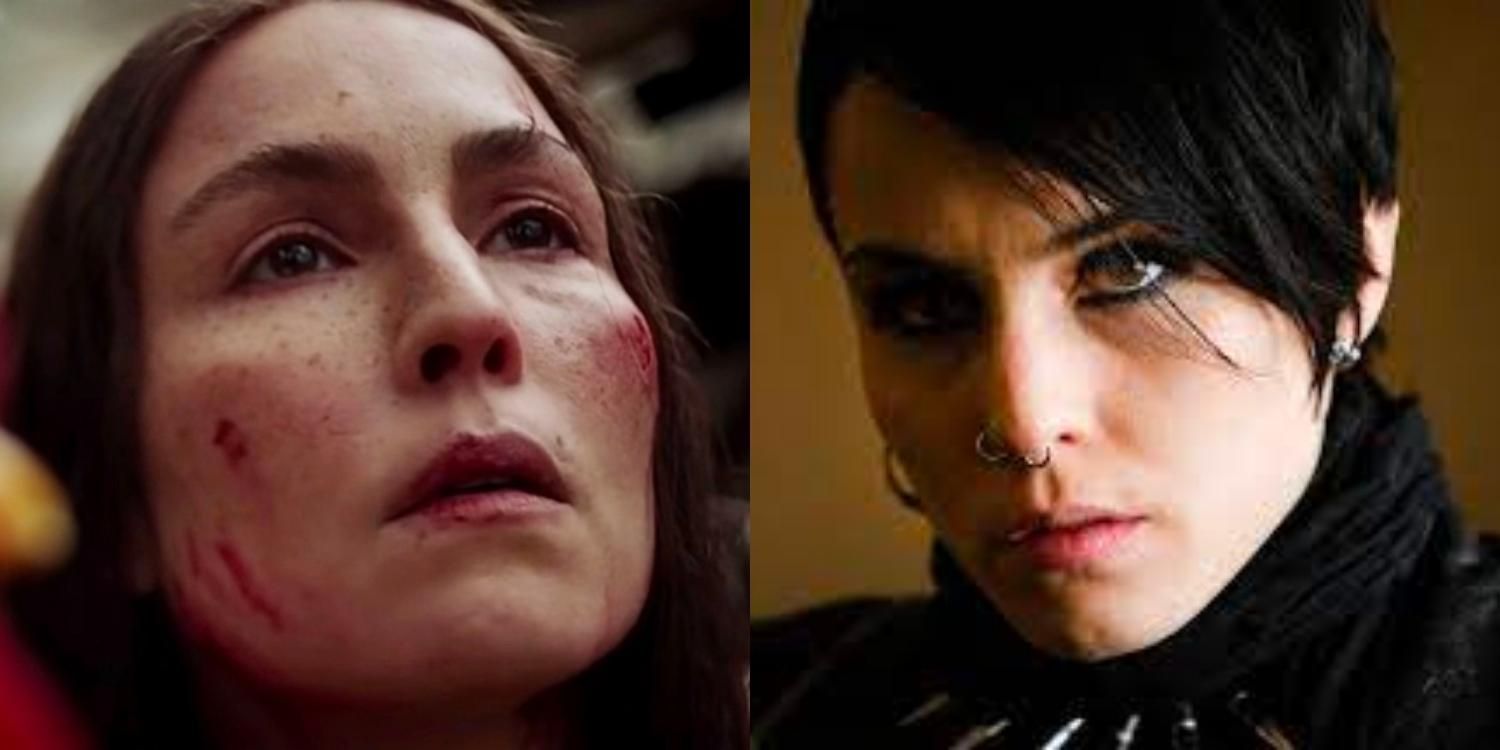
Some movies just stick to your ribs. They don't just end; they linger in the back of your brain like a half-remembered dream or a bruise you keep poking just to see if it still hurts. You Won't Be Alone, the 2022 feature debut from Australian-Macedonian director Goran Stolevski, is exactly that kind of film. Honestly, calling it a "horror movie" feels like a bit of a bait-and-switch, even though it features skin-stealing witches and enough gore to make a casual viewer squirm. It’s actually more of a visceral, blood-soaked meditation on what it means to be human.
You've probably seen the posters. Noomi Rapace looking intense in 19th-century peasant garb. But Rapace isn’t even the main character for most of the runtime. The "protagonist" is a shapeshifting entity, a young girl named Nevena who is stolen by an ancient, scarred witch known as Old Maid Maria. You might also find this connected article useful: The Bonnie Tyler Coma Clickbait and the Broken Economics of Nostalgia Touring.
It’s brutal. It’s beautiful. It’s unlike anything else in the folk horror subgenre.
The Language of the Body
The most striking thing about You Won't Be Alone isn't the scares. It’s the internal monologue. Nevena, having been raised in total isolation in a cave to hide from the witch, doesn't have language. Not real language, anyway. Her thoughts are expressed in a broken, poetic telepathy—fragmented observations about the "spit-world" and the "soft-flesh." As extensively documented in latest coverage by Vanity Fair, the results are notable.
Stolevski’s script doesn't bother with traditional exposition. You're dropped into this 19th-century Macedonian village and forced to catch up. The film uses a 1.37:1 aspect ratio, which feels claustrophobic, like you're trapped in the same narrow perspective as Nevena. It’s a bold choice. Most directors want to show off the sweeping mountains of the Balkans, but Stolevski keeps the camera tight on faces, hands, and dirt.
When Nevena accidentally kills a peasant woman and realizes she can inhabit her body by stuffing the woman's skin into her own chest, the movie shifts. We see Nevena experience the world through different lenses: a woman, a man, a child. She learns about desire, labor, and the crushing weight of social expectations. It’s a "fish out of water" story, but the water is blood and the fish is a terrified supernatural being.
Why Old Maid Maria is the Most Tragic Villain in Recent Memory
We have to talk about Maria. Played by Anamaria Marinca, she is a terrifying figure—burnt, scarred, and bitter. But as the film progresses, we realize she isn't just a monster for the sake of being a monster. She’s a product of the very world Nevena is trying to join.
Maria was once a woman. She was once a mother. The patriarchy of the village—a recurring theme that Stolevski handles with a heavy hand but a sharp eye—destroyed her. She was accused of witchcraft, set on fire, and left to rot. Her cruelty toward Nevena is a cycle of trauma. She wants a companion, but she only knows how to possess, not to love.
There’s a specific scene where Maria watches Nevena (in a male body) experiencing the freedom of being a man in that society. The jealousy on Maria’s face isn't just about Nevena; it's about the life Maria was never allowed to have. This isn't your standard jump-shout horror. This is E-E-A-T (Experience, Expertise, Authoritativeness, and Trustworthiness) in filmmaking—Stolevski clearly understands the cultural history of the region and the folklore he’s playing with. He isn't just making up "witch stuff." He’s tapping into the real-world history of "Wolf-Ogress" legends and the very real history of how marginalized women were treated in isolated agrarian communities.
Breaking Down the Skin-Stealing Hook
If you're coming to You Won't Be Alone for a slasher flick, you're going to be disappointed. Or maybe pleasantly surprised? The body-hopping is a vessel for exploring gender roles.
- The Female Experience: As a woman (the Noomi Rapace segment), Nevena learns the domestic grind. She learns that her body is a commodity.
- The Male Experience: As a man (the Boris Isakovic segment), she discovers a terrifying kind of freedom—the ability to speak, to lead, and to be violent without immediate repercussion.
- The Cycle of Life: By the time she inhabits a young girl again, she has a "knowing" that her peers lack.
The transition between these "lives" is handled with a dizzying, Terrence Malick-esque editing style. Lots of jump cuts. Lots of sunlight filtering through trees. It contrasts sharply with the moments of extreme body horror. One minute you’re looking at a beetle on a leaf, and the next, Nevena is clawing her way out of a fresh corpse. It’s jarring. It’s supposed to be.
The Sound Design and Atmosphere
You really need to watch this with a good sound system or headphones. The foley work is incredible. Every squelch, every rustle of the grass, every labored breath is amplified. Because Nevena barely speaks out loud, the world speaks for her.
Many critics compared the film to The Witch (2015), but honestly, that’s a lazy comparison. Robert Eggers’ work is about the rigidity of Puritanism. Stolevski’s film is much more fluid. It’s about the mutability of the soul. It’s queer-coded in ways that are subtle but undeniable—the idea that the "self" isn't tied to the "skin" we're born in.
There’s also the matter of the landscape. Filmed in the mountains of Serbia (substituting for Macedonia), the setting feels ancient. You get the sense that these mountains have seen a thousand Marias and a thousand Nevenas. The indifference of nature is a major player here. The world is beautiful, but it doesn't care if you live or die. It doesn't care if you're a witch or a mother. It just keeps spinning.
Addressing the "Boring" Allegations
Look, I'll be real with you. Some people hate this movie. They find the pacing glacial. They find the poetic narration pretentious. I get it. If you're looking for The Conjuring, this is going to feel like a chore.
But the "slowness" is the point. You have to sit in the dirt with Nevena. You have to feel the boredom of the village life to understand why she finds a simple thing like a bowl of milk or the touch of a lover so revolutionary. The film demands your attention. It’s not "second-screen" content. If you're scrolling TikTok while watching this, you’ll miss the subtle shifts in the actors' performances as they all try to play the same "soul" inhabiting different bodies.
Alice Englert and Carloto Cotta deserve flowers for how they mimic the twitchy, bird-like movements that Noomi Rapace established for the character. It’s a masterclass in ensemble acting where the actors never actually share a scene together but are playing the same person.
The Philosophical Core: Is Humanity Worth It?
Throughout You Won't Be Alone, Maria keeps trying to prove to Nevena that humans are garbage. She points out the cruelty, the cheating, the filth. And for a while, it seems like she’s right. We see a lot of ugliness.
But Nevena finds the "witch-light" in the mundane. She finds beauty in the way a mother holds a child, even if that mother is exhausted and miserable. She finds beauty in the physical sensation of the sun on her skin. This is the ultimate "insider-outsider" perspective.
The ending—which I won't spoil in detail—is one of the most cathartic moments in horror cinema. It isn't a "final girl" killing a monster. It’s a rejection of a cycle. It’s an assertion that even a life filled with pain and "spit" is better than a life lived in isolation and hate.
Practical Insights for the Aspiring Cinephile
If you're planning on diving into this, or if you've seen it and want to go deeper, here is how to actually engage with this kind of "elevated" horror:
- Watch the Short Film: Before this, Stolevski made a short called Would You Look at Her. It’s not horror, but it shows his obsession with the female experience in North Macedonia. It sets the stage for his thematic interests.
- Research Macedonian Folk Music: The score is haunting. Understanding the polyphonic singing traditions of the region adds a layer of depth to the atmosphere.
- Contextualize the "Old Maid": The figure of the witch in Eastern European folklore isn't just about magic; it’s a social category for women who "failed" to integrate into the family structure. Understanding that makes Maria’s pain much more tangible.
- Read the Subtitles Carefully: The translation of Nevena’s inner thoughts is meant to be ungrammatical. Don't let it frustrate you; let it wash over you like poetry.
You Won't Be Alone is a miracle of a movie. It’s a high-concept art film disguised as a midnight horror flick. It treats its audience like adults, assuming we can handle the sight of a flayed skin and the weight of a philosophical crisis at the same time.
If you want to understand where modern horror is going, you have to look at films like this. They are moving away from the "jump scare" and toward "dread and wonder." It’s a messy, bloody, gorgeous experience that reminds us that even when we are most afraid, or most different, we are part of the "spit-world" together.
How to Screen It Properly
To get the most out of the experience, watch it in the dark. Total silence. The 1.37:1 ratio means you'll have black bars on the sides of your widescreen TV—don't try to "zoom" it in. That's how it’s meant to be seen. The narrowness is part of Nevena's cage.
What to Watch Next
If this hit the spot, you'll want to check out November (2017), an Estonian film that’s even weirder and more folkloric. Or The Nightingale (2018) for more of that brutal, historical look at gender and violence. But honestly, nothing quite captures the specific "soul-shifting" energy of Stolevski’s work here. It stands on its own.
Next Steps for the Viewer:
- Locate a Stream: As of now, it's often available on Peacock or for rent on major platforms like Amazon and Apple.
- Focus on the Hands: Watch how the different actors use their hands. It’s the one constant "tell" of Nevena’s character across her different skins.
- Reflect on the Dialogue: Think about how the lack of "proper" language allows Nevena to see the world more clearly than the villagers who have words for everything.



