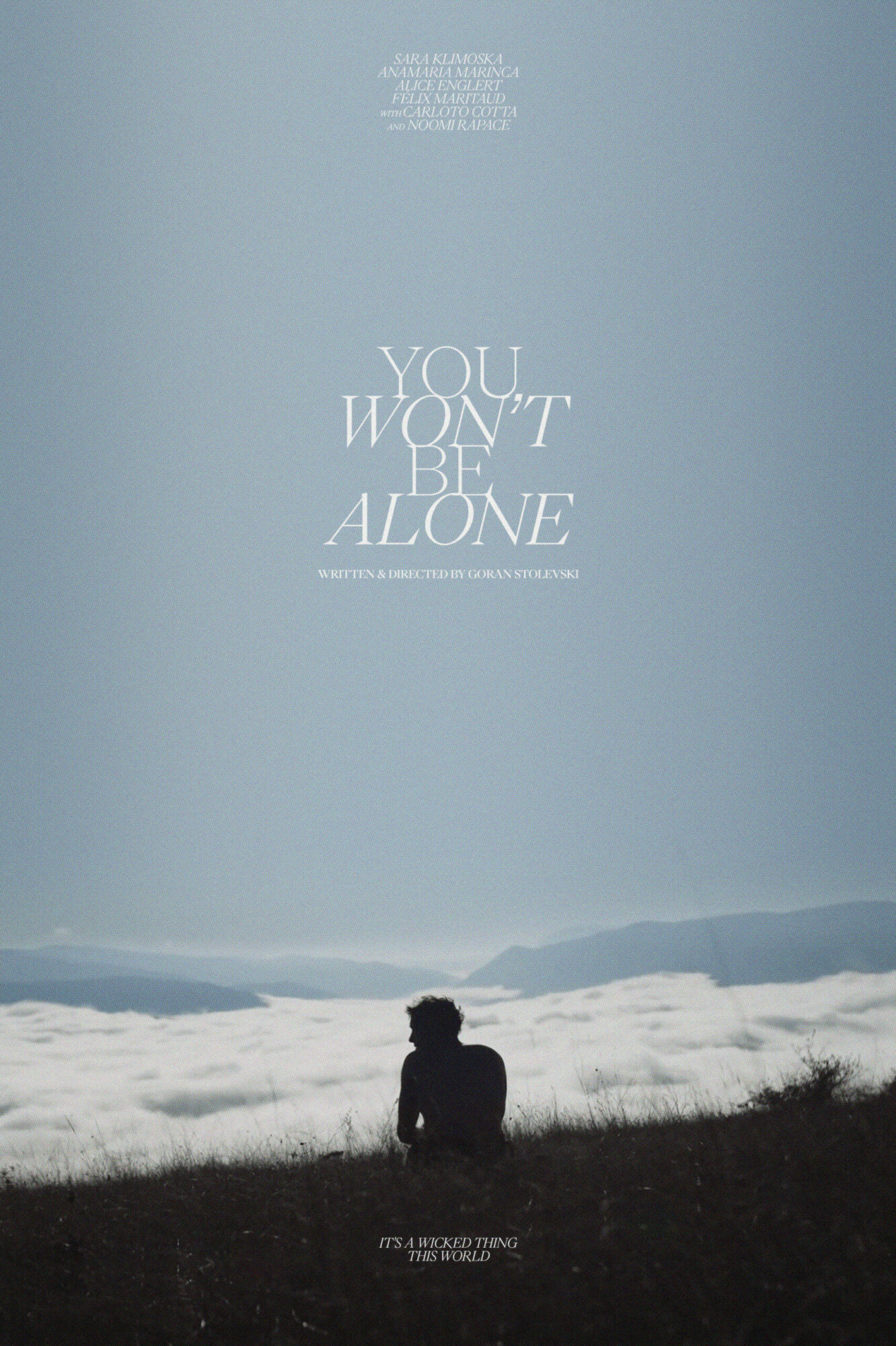
Goran Stolevski’s 2022 film You Won’t Be Alone isn’t exactly what you’d call a "popcorn flick." It's strange. It’s quiet. Honestly, it’s one of those movies that makes you feel like you’ve been submerged in a cold, mossy lake for two hours. Set in a 19th-century Macedonian mountain village, the story follows Nevena, a young girl who is turned into a "Wolf-Eatress" (a shape-shifting witch) by an ancient, scarred spirit known as Old Maid Maria.
But here’s the thing. While most horror movies are about the monster trying to kill people, You Won't Be Alone is about the monster trying to be people. It’s a sensory experience that tackles what it actually means to have a soul, told through the perspective of someone who has to literally tear others apart to understand them. It’s brutal. It’s also weirdly beautiful.
The Brutal Reality of the Wolf-Eatress Myth
In the film, the "Wolf-Eatress" isn't some sparkly supernatural creature. It’s a curse born of isolation. Nevena is raised in a cave to hide her from Maria, which means she grows up without language, without touch, and without any concept of how the world works. When Maria finally claims her, she doesn't give her a manual on how to be a witch. She just leaves her to rot in the world.
Nevena’s power is gruesome. She can take the form of any living thing—human or animal—by killing them and stuffing their "insides" into her own chest. It sounds like a slasher premise. Except, it’s played for existential dread rather than cheap jumpscares.
Why the shape-shifting matters
Most people watch this and get hung up on the gore. That's a mistake. The shape-shifting is a metaphor for the masks we wear. Nevena inhabits a young man, a mother, and even a child. Through these different "skins," she learns about the hierarchies of 19th-century village life. She sees how men are granted freedom but carry the weight of violence, and how women are burdened with labor but find connection in shared whispers.
It’s about the fundamental loneliness of being trapped in one body. Nevena is "alone" even when she’s surrounded by people because she can’t communicate her true self. She’s a mute observer in a world that would stone her if they knew what she was.
Stolevski’s Visual Language vs. Traditional Horror
If you go into this expecting The Conjuring, you’re going to be bored or confused. You Won't Be Alone uses a 4:3 aspect ratio, which makes everything feel cramped and intimate. It’s shot like a Terrence Malick film—lots of handheld camera movements, lingering shots of grass, insects, and sunlight filtering through trees.
The dialogue is sparse. Instead, we get Nevena’s internal monologue, which is a broken, poetic version of language she’s pieced together from her limited experiences. She calls the sun "the burning thing" and life "the itchy world." It’s raw. It’s almost childlike.
The role of Old Maid Maria
Old Maid Maria is the "villain," but she’s also the most tragic character. She was burned and exiled by her village decades ago. Her bitterness comes from a place of deep, unresolved trauma. She wants Nevena to hate humanity as much as she does.
When Nevena finds joy in simple things—like the taste of a plum or the feeling of a husband’s hand—Maria is there to ruin it. It’s a cycle of abuse. Maria was hurt, so she hurts Nevena. Nevena, however, resists. She wants to belong, even if it’s a lie.
What Most People Get Wrong About the Ending
There’s a lot of debate online about whether the ending of You Won't Be Alone is a triumph or a tragedy. No spoilers here, but the cycle of the Wolf-Eatress is notoriously hard to break. Some viewers think Nevena finds a way to coexist with her nature, while others see it as an inevitable slide into the same bitterness that consumed Maria.
The reality is probably somewhere in the middle. The film suggests that while we are shaped by our trauma, we aren't necessarily defined by it. You can be a "monster" and still choose kindness. Or at least, you can try.
Why You Should Watch It (Or Re-watch It)
This movie didn't burn up the box office. It's an indie film with subtitles and a lot of blood. But it’s stuck around in the cultural consciousness of horror fans because it refuses to be simple. It’s a movie that demands you pay attention to the way the wind hits the leaves and the way a character’s eyes change when they’re lying.
It’s a masterclass in "show, don't tell." You don't need a narrator to explain that the village is a patriarchal nightmare; you see it in the way the women hunch their shoulders when the men walk by. You don't need a jump-cut to know Maria is coming; you feel the atmosphere shift.
Actionable Insights for Fans of Folk Horror
If You Won't Be Alone resonated with you, there are specific ways to dive deeper into this subgenre and the themes it explores.
- Explore the "New Wave" of Folk Horror: If you liked the atmospheric dread here, look into The Witch (Robert Eggers) or Hagazussa. These films prioritize historical accuracy and psychological breakdown over traditional scares.
- Study Macedonian Folklore: The "Wolf-Eatress" isn't just a screen invention. Research Balkan folklore regarding vukodlak or shape-shifters to see how Stolevski played with and subverted these ancient myths.
- Analyze the Sensory Detail: Watch the film again, but pay attention only to the sound design. Notice how the sound of breathing or the crunch of snow is amplified. It’s a great way to understand how directors build "immersion" without using CGI.
- Look Into Goran Stolevski’s Other Work: His follow-up, Of an Age, is completely different (a queer romance), but it shares the same intense focus on longing and the human connection. It helps you see the "DNA" of the director's style.
The film is currently available on various streaming platforms like Peacock and for rent on Amazon. It’s best watched in a dark room, preferably alone, so you can really sit with the discomfort it creates. Just don't expect to feel "fine" when the credits roll.



