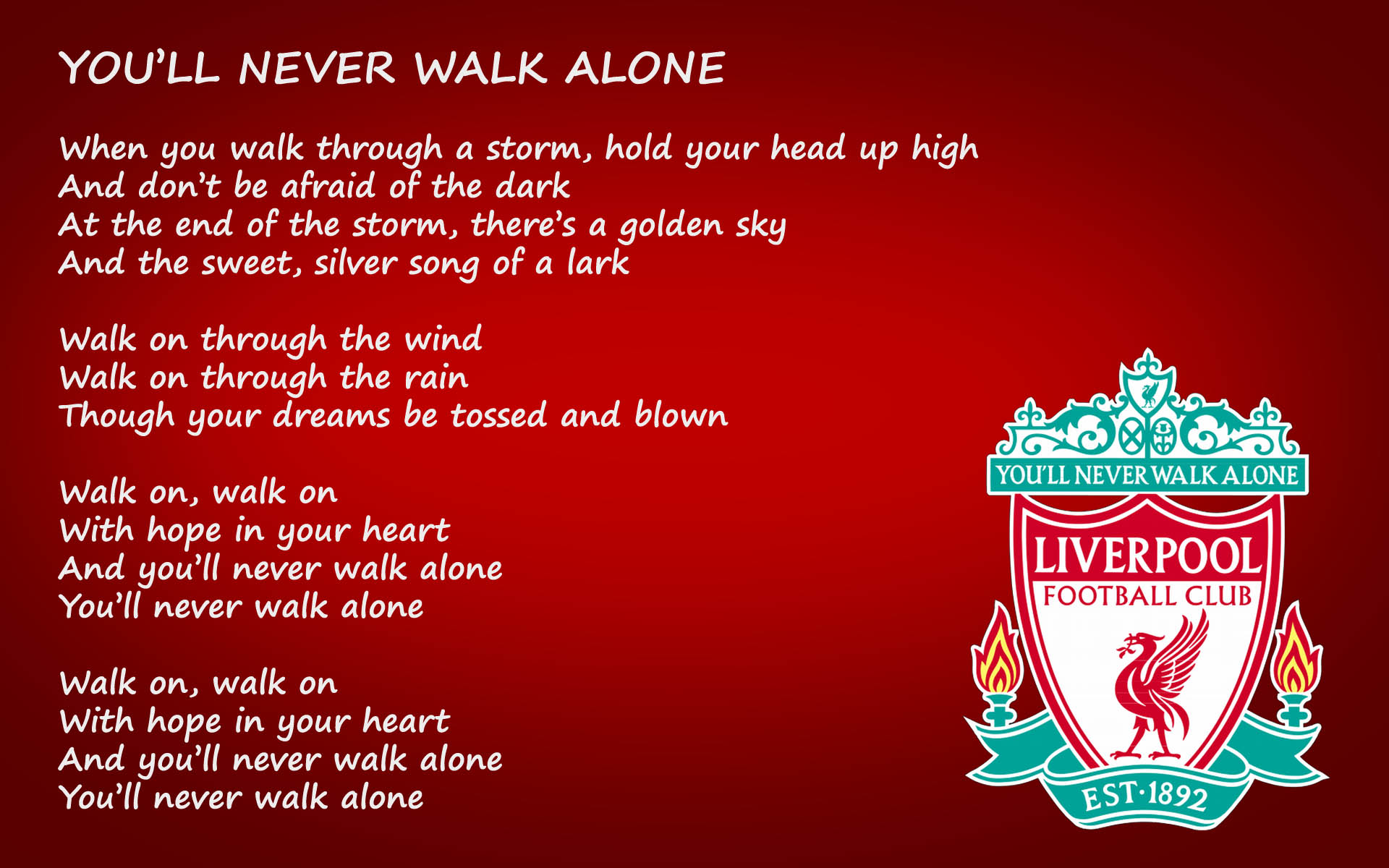
It starts with a storm. Most people think of Anfield, the swaying red scarves, and the booming voice of a stadium when they hear the you will never walk alone lyrics, but the song’s origins are actually much darker—and weirder—than a football match. It wasn't written for a trophy parade. It was written for a funeral. Or, more accurately, a scene of profound, gut-wrenching grief in a 1945 Broadway musical.
If you’ve ever felt that lump in your throat when the first lines kick in, there’s a biological reason for it. The song is a slow build. It’s designed to drag you from the "dark" into the "gold."
The Rodgers and Hammerstein DNA
Most folks don't realize that Richard Rodgers and Oscar Hammerstein II were basically the hit-making machines of the mid-20th century. They wrote Carousel. In the play, the character Nettie Fowler sings these words to her cousin Julie Jordan after Julie’s husband, Billy Bigelow, kills himself to avoid being captured by the police. Yeah. It’s heavy.
"Walk on through the wind. Walk on through the rain."
These aren't just poetic flourishes. They are literal instructions for survival. When the you will never walk alone lyrics were first performed by Christine Johnson on Broadway, the world was still reeling from World War II. The audience didn't just hear a song; they heard a lifeline. It reached out to war widows and grieving families who were quite literally walking through a storm of loss.
Honestly, the structure of the song is a masterpiece of tension and release. It begins in a lower register, almost a whisper, acknowledging the "dark" and the "storm." It’s moody. Then, it climbs. By the time you hit "Golden sky," the melody is soaring into a range that forces the singer to open up their chest. You can't sing this song timidly. It demands your lungs.
How Liverpool Stole a Broadway Hit
So, how did a Broadway showtune become the soul of Liverpool FC?
It’s basically all Gerry Marsden’s fault.
In 1963, Gerry and the Pacemakers—a Merseybeat band that was constantly competing with The Beatles—covered the track. Legend has it Gerry gave a copy of the record to Bill Shankly, the legendary Liverpool manager, during a pre-season bus trip. Shankly loved it. The local DJ at Anfield, Stuart Bateman, used to play the top ten hits of the week before kickoff. When "You'll Never Walk Alone" hit number one, the fans sang along.
Then it dropped out of the charts.
The fans didn't care. They kept singing it anyway.
It’s one of those rare moments where a brand or a "vibe" wasn't manufactured by a marketing team. It was organic. It was loud. It was Scouse. To this day, the you will never walk alone lyrics are etched into the Shankly Gates at Anfield. If you go there, you see people from Japan, Norway, and New York standing in front of those iron gates, whispering the words. It’s a secular hymn.
The Words That Broke Barriers
Let’s look at the actual text.
"When you walk through a storm, hold your head up high..."
It’s a command. It’s not "I hope you hold your head up." It’s "Do it."
"And don't be afraid of the dark."
The song acknowledges fear. That’s why it works. It doesn't pretend everything is fine. It admits the "wind" and "rain" are tossing your dreams. There’s a specific line—"Though your dreams be tossed and blown"—that resonates with anyone who has ever failed. And let's be real, that's everyone.
During the COVID-19 pandemic, the song saw a massive resurgence. It wasn't just about football anymore. In April 2020, radio stations across Europe played the song simultaneously at 8:45 AM. It was a moment of global solidarity. Captain Tom Moore, the UK veteran who raised millions for the NHS, even released a version. It hit number one. The man was 99 years old.
Think about that. A 99-year-old man singing lyrics written in 1945, originally meant for a fictional widow in Maine, helping a modern world survive a respiratory virus. The longevity is insane.
Misconceptions: It’s Not Just a "Sports Song"
People often pigeonhole these lyrics. They think it's just for the Kop or maybe Celtic fans (who also claim it as their own, leading to a decades-long friendly-ish debate).
But look at the artists who have covered it:
- Elvis Presley (The King brought a gospel soul to it).
- Aretha Franklin (She turned it into a 10-minute church experience).
- Pink Floyd (They literally sampled the Anfield crowd in their song "Fearless").
- Frank Sinatra (He kept it classy and orchestral).
- Lana Del Rey (She did a haunting, acapella version for a documentary).
Each of these artists found something different in the you will never walk alone lyrics. Elvis found the religion. Aretha found the struggle. Lana found the melancholy.
The complexity lies in the "Walk on" refrain. Repeating those two words over and over creates a hypnotic effect. It’s a mantra. It’s the musical equivalent of putting one foot in front of the other when you really just want to lie down and quit.
The Hillsborough Connection
You cannot talk about this song without talking about April 15, 1989.
After the Hillsborough disaster, where 97 Liverpool fans lost their lives due to gross negligence and stadium overcrowding, the song changed. It wasn't just a pre-game ritual anymore. It became a tool for justice.
In the years of legal battles that followed, the you will never walk alone lyrics served as a rallying cry for the families. It was sung at funerals, at vigils, and eventually, at the memorial services where the truth was finally acknowledged. When you hear a crowd sing it now, there is a weight behind it that didn't exist in 1963. It’s a promise to the dead as much as it is a boost for the living.
Why it Beats Other Anthems
Most sports anthems are aggressive. They are about winning, crushing the enemy, or being the best. "We Are The Champions" is great, but it’s a bit arrogant, isn't it? It’s about the trophy.
"You'll Never Walk Alone" is about the journey. It’s about the "sweet silver song of a lark" that comes after the storm. It’s about the hope in your heart. It’s a vulnerable song. Singing it is an admission that you need other people. You’re admitting that you can’t walk alone.
In a world that prizes "rugged individualism" and "grinding," there is something deeply rebellious about standing in a crowd of 50,000 people and admitting you need companionship.
Common Lyrical Mistakes
Actually, people mess up the words all the time.
- They say "the" storm instead of "a" storm.
- They forget the "At the end of a storm" line and jump straight to the "Walk on."
- They miss the "tossed and blown" part, which is arguably the most poetic bit.
The actual sequence is: Storm -> Head High -> No Fear of Dark -> End of Storm -> Gold Sky -> Sweet Silver Song of a Lark -> Walk On -> Hope in Heart.
It’s a perfect narrative arc in under three minutes.
The Actionable Power of the Song
If you’re looking to use this song or its message in your own life, don’t just treat it as background noise. There is a reason therapists and grief counselors sometimes point to these lyrics.
1. Acknowledge the Storm Don't bypass the pain. The song starts there. If you're going through a rough patch, name it. "The wind" and "the rain" are real.
2. Focus on the "Lark" The song promises a "sweet silver song" at the end. In psychology, this is called "positive reappraisal." It’s the ability to find a silver lining not by ignoring the bad, but by looking past it.
3. Find Your "Crowd" Whether it’s a literal stadium, a group of friends, or a community online, the core message is that isolation is the enemy. Reach out.
4. The "Walk On" Principle Sometimes the only thing you can do is keep moving. You don't have to run. You don't have to sprint. You just have to walk on with hope in your heart.
The you will never walk alone lyrics have survived for over 80 years because they tap into a fundamental human truth: life is hard, but it’s slightly less hard when we’re shouting into the wind together. Whether you're a football fan or just someone trying to get through a Tuesday, these words are a reminder that the storm eventually runs out of rain.
Walk on.
Next Steps for Music History Buffs:
- Listen to the 1945 Original Cast Recording: Compare the operatic style of Christine Johnson to the pop-rock version by Gerry and the Pacemakers to see how the song’s "soul" shifted.
- Watch the "Fearless" Live Footage: Search for the Pink Floyd track where they layered the sounds of the Liverpool Kop over David Gilmour’s guitar work.
- Read the Full Script of Carousel: Understanding the context of Billy Bigelow’s death makes the lyrics hit about ten times harder.
The enduring legacy of the song isn't in the notes; it's in the people who refuse to let the silence take over. It’s a piece of history that you can carry in your pocket, ready for the next time the sky turns gray.



