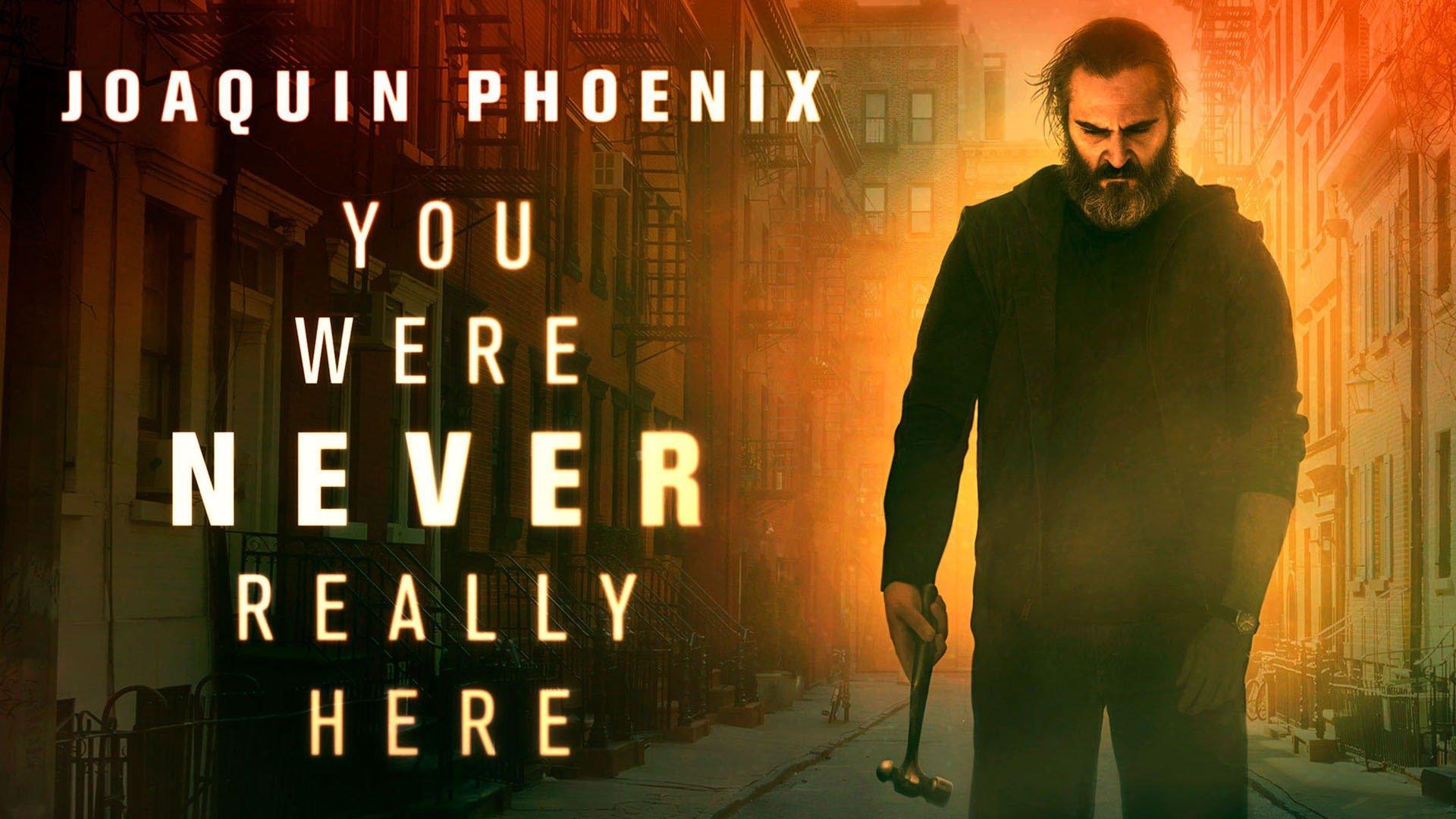
It is a movie about a man with a hammer, but honestly, it’s not an action flick. When You Were Never Really There premiered at Cannes in 2017, it received a seven-minute standing ovation, and for good reason. Director Lynne Ramsay didn't just adapt Jonathan Ames’s novella; she basically deconstructed the entire concept of the "hard-boiled hitman" and left us with a shivering, traumatized shell of a human being named Joe. Joaquin Phoenix plays him. He’s massive, bearded, and carries a ball-peen hammer like it’s a natural extension of his arm.
But here’s the thing. Most people go into this expecting John Wick or Taken. They want the catharsis of a guy "cleaning up the streets."
They don't get that. Instead, they get a sensory overload of trauma and flashing lights.
The Sound of PTSD in You Were Never Really There
The movie doesn’t explain Joe’s past through clunky dialogue or "as we can see" flashbacks that hold your hand. It uses sound. Jonny Greenwood’s score is jagged. It feels like a migraine. You've got these high-pitched synths clashing against the mundane sounds of a New York City diner or the rustle of a plastic bag. It’s uncomfortable.
Ramsay focuses on the small things. Joe counts down from some arbitrary number to keep himself grounded. He breathes into a bag. These aren't the cool quirks of a professional killer; they are the survival mechanisms of a man who is constantly drowning in his own memories. If you look closely at the scene where Joe is in the hotel, the editing is frantic. We see flashes of his childhood—a father’s belt, a suffocating closet—and his time in the military. It’s never a full story. It’s just enough to let you know he’s broken.
Most films treat trauma as a backstory. You Were Never Really There treats it as the protagonist.
Joe is a veteran and an ex-FBI agent. He specializes in rescuing trafficked girls. It’s a dark niche. He lives with his elderly mother in a house that feels like a tomb. He cleans her feet. He plays word games with her. Then he goes out and breaks skulls. This duality is what makes the film feel so grounded despite its stylized violence.
Why the Hammer Matters
Why a hammer? Because it’s personal. A gun is distant. A hammer is visceral. It’s a tool for building that Joe uses exclusively for destruction.
Interestingly, the movie actually skips most of the fights. We see the aftermath. We see Joe walking through a hallway on a grainy security camera, and bodies just drop. Ramsay is more interested in the psychological toll of the violence than the choreography of it. This is a huge departure from the source material. In Ames's book, the violence is much more explicit and traditional. Ramsay strips that away. She makes you focus on Joe’s face—that heavy, weary expression Phoenix wears like a mask.
The Nina Factor and the Subversion of the Rescue Mission
The plot kicks off when a politician hires Joe to find his daughter, Nina, who has been kidnapped into a high-end pedophilia ring. Standard thriller setup, right? Wrong.
In a typical movie, the "rescue" is the climax. Here, Joe finds Nina relatively early. The real horror starts afterward. The conspiracy goes higher than he expected, involving the Governor and a network of powerful men. But the movie doesn't turn into a political thriller. It stays tight on Joe and Nina.
There is a haunting scene where Joe is lying on the floor next to a dying man—one of the "bad guys" he just shot. Instead of a final quip or a moment of triumph, they hold hands. They sing a song together as the man bleeds out. It is one of the most bizarre and human moments in modern cinema. It suggests that Joe doesn't see himself as a hero. He sees himself as someone who belongs in the dark with the dying.
Visual Storytelling: The Power of Reflection
Look at the cinematography by Thomas Townend. There are so many shots of Joe through glass, in mirrors, or reflected in puddles. He’s a ghost. The title You Were Never Really There isn't just a cool phrase; it’s Joe’s reality. He is disconnected from the world.
- He moves through crowds unnoticed.
- He hides in plain sight.
- His existence is defined by his absence.
Even when he’s eating a chocolate bar or buying a green juice, he looks like he’s trying to remember how to be a person.
Comparing the Movie to the Novella
If you've read Jonathan Ames’s book, you know it’s a quick, punchy read. It’s noir. It’s gritty. It has a lot more internal monologue.
Ramsay’s film is almost silent by comparison. Joaquin Phoenix reportedly lost weight and then bulked up in a way that made him look "pillowy" and heavy rather than ripped like a superhero. He’s got a gut. He looks like a guy who eats junk food and doesn't sleep. The film also changes the ending significantly. The book is much darker, ending on a note of continued, cyclical violence. The movie offers a tiny, microscopic sliver of hope.
It’s about two people who have seen the worst of humanity deciding to keep moving.
"Joe, wake up," Nina says at the end. It’s a command. It’s a wake-up call for a man who has been sleepwalking through a nightmare for decades.
The "Art-House Action" Label
Critics often struggle to categorize this one. Is it a thriller? A character study? A horror movie?
It’s kinda all of them. It lacks the traditional "three-act structure" that Hollywood loves. It’s more like a series of vignettes. For some viewers, this is frustrating. They want the big showdown at the end. They want Joe to storm the Governor's mansion like Rambo.
But Joe isn't Rambo. He’s a guy who forgets his hammer. He’s a guy who cries. When he finally gets to the "big boss," the movie denies us a classic fight scene. Why? Because the cycle of violence is exhausting. By the time Joe reaches his target, the violence has already happened. He’s too late, and yet, he still has to find a way to live.
Performance and Pacing
Joaquin Phoenix won Best Actor at Cannes for this role, and honestly, he deserved it. He does so much with his back. Just the way he walks—shoulders hunched, head down—tells you everything about his mental state.
The pacing is deliberate. It’s only about 90 minutes long, which is refreshing in an era of three-hour epics. Every frame counts. There’s no fat on this movie.
Real-World Nuance: The Reality of Combat Trauma
While You Were Never Really There is a work of fiction, its depiction of PTSD is grounded in some very real psychological truths. Experts often point out that trauma isn't just "remembering" something bad; it's the inability to distinguish the past from the present.
When Joe sees the plastic wrap or hears the sound of a hammer, his brain isn't in a suburban kitchen; it’s back in the shipping container or the desert. The film captures this "fragmentation" of time perfectly.
- Joe’s flashbacks are intrusive.
- They are triggered by sensory inputs.
- They lead to dissociation (the feeling of not being "there").
This is why the film resonates with people who have experienced actual trauma. It doesn't look like a neat little flashback with a sepia filter. It looks like a glitch in reality.
What Most People Get Wrong About the Ending
A common complaint is that the ending feels "anti-climactic."
That’s the point.
If the movie ended with a massive gunfight, it would be saying that violence solves trauma. It would be saying that Joe "fixed" himself by killing the bad guys. But you can't kill your way out of PTSD. The ending is a quiet realization that Joe doesn't have to be the hammer anymore. He can just be Joe.
It’s not a "happily ever after." It’s a "maybe I’ll stay alive for another hour." In Joe’s world, that’s a massive victory.
How to Appreciate the Film on a Rewatch
If you’ve already seen it, go back and watch it again with a focus on the color red. Ramsay uses red to signal moments where Joe’s past is bleeding into his present. The jelly on a sandwich, the taillights of a car, the blood on a wall—it all blurs together.
Also, pay attention to the silence. Notice how long the camera lingers on Joe when he’s doing absolutely nothing. Those are the moments where the character is most "present," even though he’s trying to disappear.
Actionable Takeaways for Cinephiles
- Watch for the "Invisible" Edits: Notice how Ramsay cuts between Joe’s childhood and his adult life without transitions. It shows how his mind works.
- Listen to the Score Individually: Jonny Greenwood’s work here is a masterpiece of anxiety. Listening to it without the visuals helps you appreciate the sheer discordance of Joe's internal world.
- Compare with Taxi Driver: Many call this a modern Taxi Driver. Compare Travis Bickle’s descent into madness with Joe’s attempt to climb out of it. Travis wants to be a "hero" through violence; Joe is forced into violence and wants to escape it.
- Check out Lynne Ramsay’s other work: If you liked the visual style, watch We Need to Talk About Kevin. She has a specific way of using color and sound to depict psychological distress that is unmatched in modern directing.
The movie isn't interested in being a fun Saturday night watch. It's interested in being a visceral experience. It’s about the parts of ourselves we leave behind when we go through hell. Joe was never really there because he was still stuck in the past, but by the end, he’s finally starting to show up.
Stop looking for the plot and start looking at the man. That's where the real story is.



