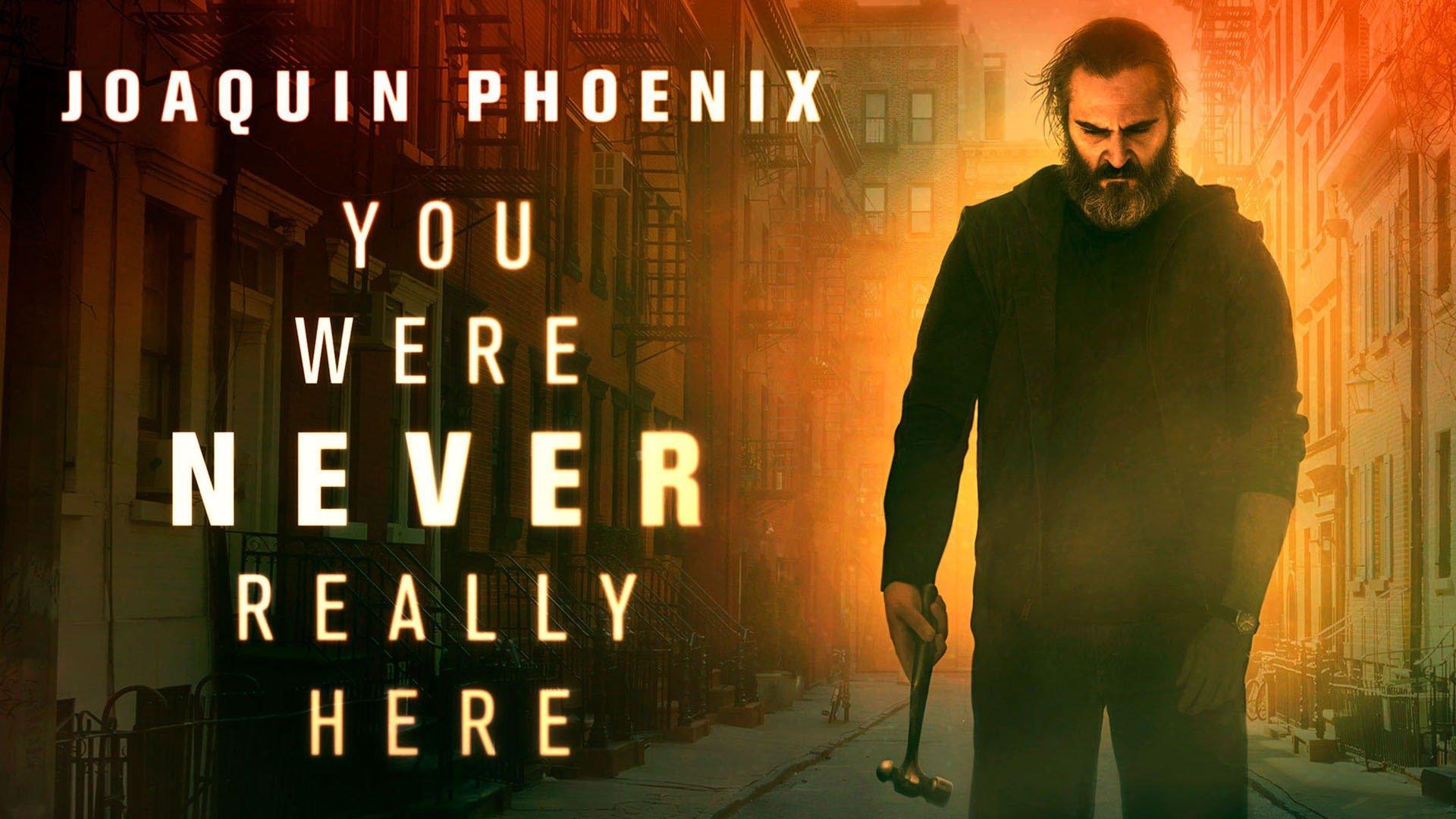
Joe is a ghost. He doesn't just look like one; he lives like one. In the 2017 film You Were Never Really Here, Joaquin Phoenix portrays a man who has essentially opted out of his own existence, existing only in the violent fringes of a world that failed him long ago. Honestly, if you walked past him on a New York City street, you wouldn’t look twice. That’s the point.
Most movies about "hitmen with a heart of gold" or "vicious vigilantes" follow a very specific, predictable rhythm. You know the drill. There’s a cool montage, some snappy dialogue, and a triumphant finale where the bad guys get what’s coming to them. Lynne Ramsay’s film tosses all of that into a woodchipper. It’s a lean, jagged 90 minutes that feels more like a fever dream than a standard thriller. People often compare it to Taxi Driver, and while the DNA is there, Joe isn't looking for a "rain that will wash all this scum off the streets." He’s just looking for a way to stop the noise in his own head.
The Trauma You Don't See
Joe is a veteran and a former federal agent. We know this not because of a long-winded backstory or a scene where he looks at old medals, but through quick, brutal flashes of memory. A desert. A shipping container full of bodies. A childhood defined by a hammer and a violent father. These aren't just "character traits." They are the bricks building the prison he lives in.
Joaquin Phoenix put on significant mass for this role, but he doesn't look like a bodybuilder. He looks like a heavy, battered tank that’s been through a dozen wars it wasn't supposed to survive. His body is a map of scars. When he’s not rescuing girls from sex trafficking rings, he’s living with his elderly mother in a house that feels stuck in the 1970s. These scenes are surprisingly tender, even funny. They’re the only moments where Joe seems tethered to reality. But even then, he’s practicing suffocating himself with a plastic bag to see if he can still feel the urge to survive. It’s dark stuff. Really dark.
Breaking the Action Movie Rules
If you go into You Were Never Really Here expecting a John Wick-style kill count, you’re going to be confused. Ramsay purposefully cuts away from the violence. We see the aftermath. We see Joe entering a building through a grainy black-and-white security camera feed. We see him swing his signature tool—a ball-peen hammer—and then we see the body on the floor.
Why do this? Because the movie isn't about the act of killing. It’s about the toll that killing takes on the human soul. Violence in this film is messy, quiet, and deeply unglamorous. There’s a scene where Joe is lying on a floor next to a dying man he just shot. Instead of a quip or a finishing blow, they end up holding hands and singing along to a song on the radio. It’s surreal. It’s heartbreaking. It’s one of the most human things I’ve ever seen in a movie about a professional killer.
The Power of Sound and Silence
Jonny Greenwood, the guitarist for Radiohead, did the score. If you haven't heard it, prepare your ears. It’s not a melodic, sweeping orchestra. It’s a dissonant, screeching, pulsing mess of electronics and strings that mimics Joe’s internal state. When Joe is overwhelmed, the music is overwhelming. When Joe is numb, the music drops out entirely.
Sound design is actually more important than dialogue here. Joe barely speaks. He grunts, he mutters, he whispers. But you hear everything else. The hum of a refrigerator. The crinkle of a candy wrapper. The wet thud of metal hitting bone. This sensory overload forces the audience into Joe’s headspace. You’re trapped there with him.
Nina and the Cycle of Violence
The plot kicks into high gear when Joe is hired to find Nina, the daughter of a Senator. She’s being held in a high-end brothel. This sounds like the setup for Taken, right? Wrong.
Ekaterina Samsonov plays Nina with a haunting, vacant stare that mirrors Joe’s. She isn't a "damsel" waiting to be saved so she can go back to her normal life. She’s a child who has seen things no one should ever see. When Joe finally reaches her, there is no big "hero" moment. The "rescue" is just two broken people realizing they might be the only ones who understand each other.
The film suggests that the corruption Joe fights isn't just a few "bad guys." It’s systemic. It’s baked into the politics and the very pavement of the city. When he realizes how deep the rot goes, Joe loses the one thing that was keeping him upright: the belief that his violence actually mattered.
That Ending (And What It Actually Means)
A lot of people walk away from the ending of You Were Never Really Here feeling a bit cheated. There’s a scene in a diner that plays with your expectations of what’s real and what’s a hallucination. Joe reaches a breaking point. He’s ready to check out.
But then, Nina speaks.
"Joe, it's a beautiful day."
It’s a simple line, but in the context of this relentlessly bleak movie, it’s a thunderclap. It’s a choice. They can stay in the darkness, or they can walk out into the sun, even if the sun feels fake. They don't "heal." They don't "get better." They just decide to keep going for one more day. That’s as close to a happy ending as a story like this can get.
How to Appreciate the Film Today
If you’re planning to watch or re-watch it, don’t look at your phone. Seriously. This is a movie that demands total immersion. If you miss a three-second flashback, you might miss the entire motivation for a later scene.
- Watch the eyes. Phoenix does more with his eyes than most actors do with a ten-page monologue.
- Listen for the "numbers." Joe counts to ground himself. It's a grounding technique used by people with PTSD.
- Notice the color red. It’s used sparingly but intentionally to signal when Joe is losing his grip on the "now."
The film is based on a novella by Jonathan Ames. If you’ve read the book, you’ll notice Ramsay changed the ending significantly. The book is more of a traditional noir. The movie is a tone poem about trauma. Both are great, but they’re doing very different things.
The Real-World Impact of On-Screen Trauma
Movies like this serve a purpose beyond entertainment. They challenge the way we consume violence. In most media, violence is a solution. In You Were Never Really Here, violence is a symptom. It’s a heavy, exhausting burden.
Psychologically, Joe represents a very real phenomenon: the "functioning" person with severe, untreated C-PTSD. His rituals—the bag over the head, the counting, the isolation—are desperate attempts to regulate a nervous system that is stuck in a permanent state of "fight or flight." By stripping away the "cool" factor of the hitman trope, the film forces us to look at the wreckage left behind by trauma.
It’s not an easy watch. It’s not a "fun" Friday night movie. But it is essential cinema. It’s a reminder that sometimes the people who seem the most invisible are the ones carrying the heaviest weight.
To really get the most out of this experience, pay attention to the silence between the screams. That’s where the real story lives. Go back and look at the scene where Joe cleans his mother's feet. It's the polar opposite of the violence he inflicts elsewhere, and it's the key to his entire character. He is a man who wants to be gentle but only knows how to be a weapon.
Next time you find yourself scrolling through a streaming service, don't look for something "comfortable." Look for something that moves you. Even if it moves you into a dark alleyway with a hammer in your hand.
Actionable Insights for Viewers:
- Analyze the Visual Storytelling: Watch the film a second time with the sound off for ten minutes. Notice how much Ramsay conveys through Joe's posture and the framing of his shadow rather than through action.
- Explore the Source Material: Read Jonathan Ames' novella to see how a "hard-boiled" narrative can be transformed into a psychological study.
- Compare the Scores: Listen to Jonny Greenwood’s work on Phantom Thread versus this film. It shows his incredible range in using music to define a protagonist's internal world.
- Study the Edit: Pay attention to the "match cuts" where a sound in the present triggers a visual from Joe's past. It's a masterclass in how to film memory.



