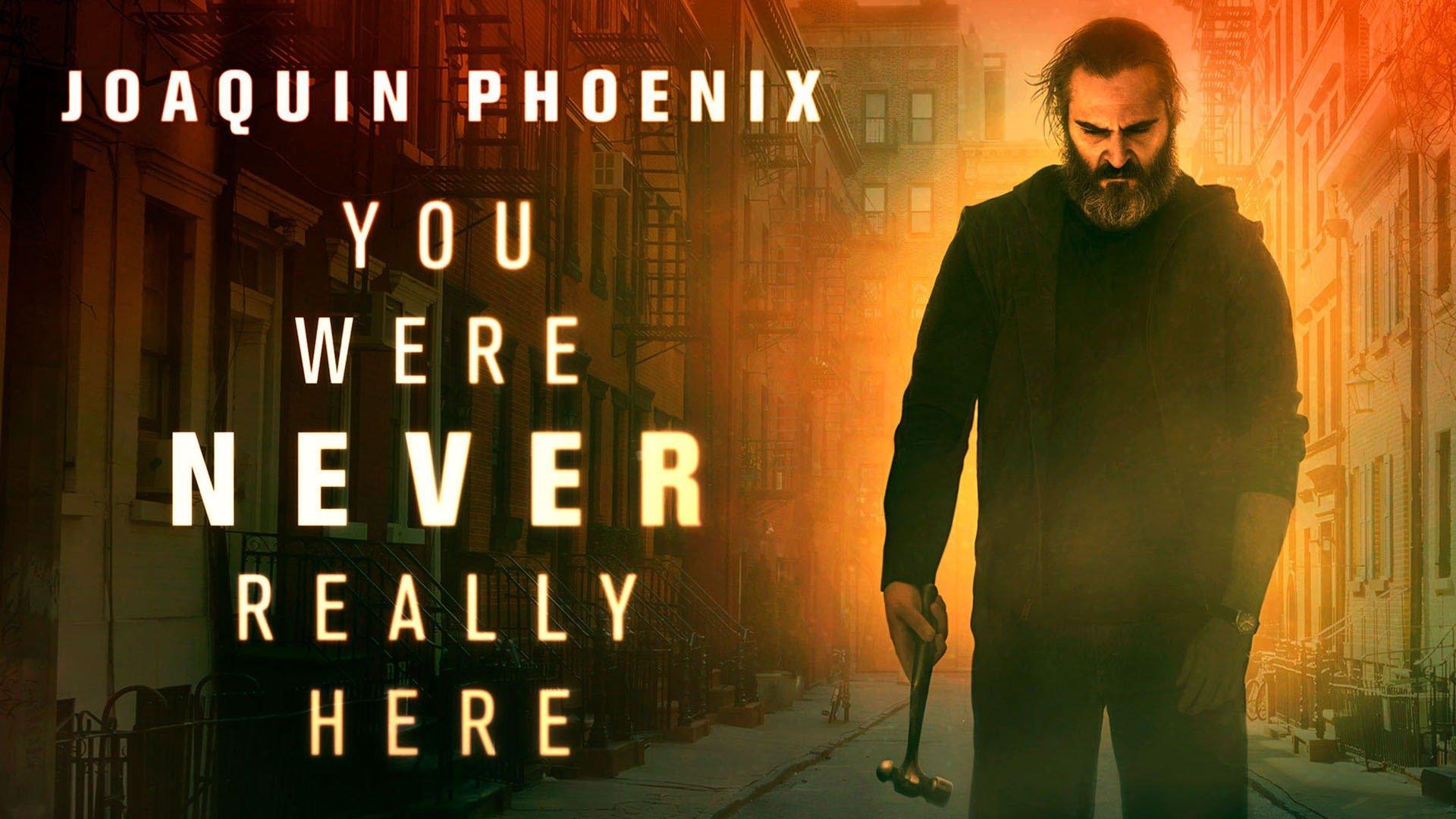
It starts with a plastic bag. Joe, played by a hulking, bearded Joaquin Phoenix, pulls it over his head, testing the limits of his own breath. It’s a suffocating image. Honestly, it’s the perfect metaphor for the entire film. Directed by Lynne Ramsay and based on the novella by Jonathan Ames, You Were Never Really Here isn't your standard "man with a gun" revenge flick. It’s something much weirder. Much more tactile. If you went into this expecting John Wick, you probably walked away confused, or maybe even a little annoyed.
Joe is a veteran and a former federal agent who now makes a living rescuing trafficked girls. He uses a ball-peen hammer. No flashy gunfights. Just blunt, ugly force. But the film isn't really about the violence itself; it’s about the vibration left over after the violence happens. It’s about the trauma that makes a person feel like a ghost in their own life.
The Lynne Ramsay Approach to Minimalism
Lynne Ramsay doesn't do "info-dumps." She doesn't like them. You won't find a scene where Joe sits down and explains his tragic backstory to a sympathetic bartender. Instead, we get flashes. A sensory overload of broken glass, a flickering light, the sound of a blade, or a quick, jagged memory of a desert floor. These are "PTSD shards."
The movie is remarkably short, clocking in at about 90 minutes. In an era where every blockbuster feels like a three-hour marathon, this brevity is a choice. It’s lean. It’s mean. It’s basically a panic attack caught on film. Ramsay worked closely with editor Joe Bini to strip the narrative down to its absolute essentials. They reportedly kept cutting and cutting until only the emotional core remained. This is why some people find the plot hard to follow on a first watch. You have to watch Joe’s face, not just the action.
Why the Hammer Matters
Why a hammer? It’s personal. A gun is distant. A hammer requires you to be close enough to feel the impact. For Joe, the violence is a job, but it's also a way to ground himself in a reality he feels detached from. There’s a specific scene—one of the most talked-about moments in modern cinema—where Joe confronts a dying hitman.
Instead of a final "cool" one-liner, they end up lying on the floor together, holding hands and humming a song. It’s surreal. It’s heartbreaking. It subverts every trope of the thriller genre. It reminds us that both men are just broken tools in a larger, much more corrupt machine.
Joaquin Phoenix and the Physicality of Trauma
Joaquin Phoenix didn't just play Joe; he transformed into a walking bruise. He gained significant weight for the role, looking more like a retired powerlifter who has let himself go than a sleek action hero. His back is a map of scars.
He’s heavy. You can feel his weight in every step.
Phoenix spent time researching PTSD and the specific behaviors of veterans who struggle with reintegration. He famously suggested many of the small, idiosyncratic movements Joe makes. Like the way he counts down or the way he interacts with his mother. The relationship between Joe and his mom (played by Judith Roberts) is the only light in the movie. It’s tender, funny, and deeply human. It makes the eventual descent into the film's third act even more devastating.
Jonny Greenwood’s Disorienting Score
You can't talk about You Were Never Really Here without talking about the music. Jonny Greenwood, the lead guitarist of Radiohead, composed the score. It’s not "background music." It’s an antagonist.
The score is a mix of driving, industrial synths and dissonant strings. It mimics the internal state of Joe’s mind. Sometimes the music is too loud, drowning out the dialogue, which is exactly how sensory processing issues feel for someone with severe trauma. In the scene where Joe navigates a high-end brothel, the music shifts to a weirdly upbeat, tinny pop song playing over the security cameras. The disconnect between the upbeat tune and the carnage we see on the grainy monitors is sickening. It’s brilliant filmmaking.
The Ending Explained (Sorta)
People always ask about the ending. Is it real? Is it a dream? After the climactic confrontation—which, notably, Joe arrives too late for—he and Nina (Ekaterina Samsonov) sit in a diner. Joe has a vision of himself committing suicide. Then, he snaps back to reality.
"Joe," Nina says. "It’s a beautiful day."
He looks at her, pauses, and says, "It is a beautiful day."
Is it a happy ending? Kinda. But not really. It’s more of an acceptance. Joe realizes he isn't a ghost. He’s here. He’s alive. And for the first time, he has someone else to live for who isn't a memory of the past. It’s a tiny, microscopic sliver of hope in a very dark room.
Why This Film Ranks So High for Cinephiles
Critics at festivals like Cannes (where it won Best Screenplay and Best Actor) flocked to this because it treats the audience like they're smart. It doesn't hold your hand.
- Visual Storytelling: Ramsay uses "associative editing." One image triggers the next based on feeling rather than logic.
- Subverting Masculinity: Joe is physically massive but emotionally fragile. He cries. He’s scared. He’s a far cry from the invincible heroes of the 80s and 90s.
- Sound Design: The film uses silence as effectively as it uses noise. The quiet moments in Joe’s house are filled with the hum of the refrigerator or the ticking of a clock, emphasizing his isolation.
Common Misconceptions About the Movie
A lot of people think this is a remake of Taxi Driver. I get it. Burnt-out vet, young girl in trouble, gritty New York setting. But Joe isn't Travis Bickle. Travis wanted to be a hero; Joe just wants to stop hurting. Travis was looking for a "rain to wash the streets"; Joe is just looking for a way to breathe.
Another misconception is that the movie is "too violent." Interestingly, most of the actual impact happens off-screen. We see the before and we see the after. Ramsay relies on our imagination to fill in the blanks, which is often much more terrifying than showing a fountain of fake blood. She trusts that the sound of a hammer hitting a wall is enough.
How to Actually Watch This Film
If you're going to watch You Were Never Really Here, do yourself a favor: put your phone away. Seriously. This is not a "second screen" movie. If you miss a three-second cut, you might miss a crucial piece of Joe’s history.
- Listen to the layers: Use headphones or a good soundbar. The audio layering is dense.
- Watch the background: There is a lot of environmental storytelling in the apartments and hallways Joe moves through.
- Read the book: Jonathan Ames’ novella is very different in tone—it’s more of a noir—but it provides a fascinating counterpoint to Ramsay’s dreamlike adaptation.
Practical Insights for Fans of the Genre
If you loved the vibe of this film, you should look into the "Neo-Noir" and "Elevated Thriller" subgenres. These films prioritize atmosphere and character psychology over traditional plot beats.
Movies like Drive (directed by Nicolas Winding Refn) or Blue Ruin (Jeremy Saulnier) share a similar DNA. They explore the cost of violence. They show that nobody walks away from a fight unchanged.
For those interested in the craft of filmmaking, study Lynne Ramsay's use of close-ups. She focuses on hands, textures, and objects. It’s a masterclass in how to build a world through details rather than wide shots. Joe’s world is small, cramped, and intense, and the cinematography reflects that perfectly.
The legacy of this film continues to grow because it feels honest. It doesn't glamorize the "hitman" lifestyle. It shows it for what it is: a lonely, dirty, and exhausting existence. But it also shows that even in that darkness, a person can find a reason to keep going.
Next Steps for Your Watchlist
To get the most out of this cinematic style, track down Lynne Ramsay's earlier work like Ratcatcher or We Need to Talk About Kevin. These films will help you recognize her specific visual language. If you're looking for the novella, the Jonathan Ames version is a quick, punchy read that offers a more linear take on Joe's mission. Lastly, listen to the soundtrack as a standalone experience; it’s a fascinating piece of experimental music that stands on its own even without the visuals.



