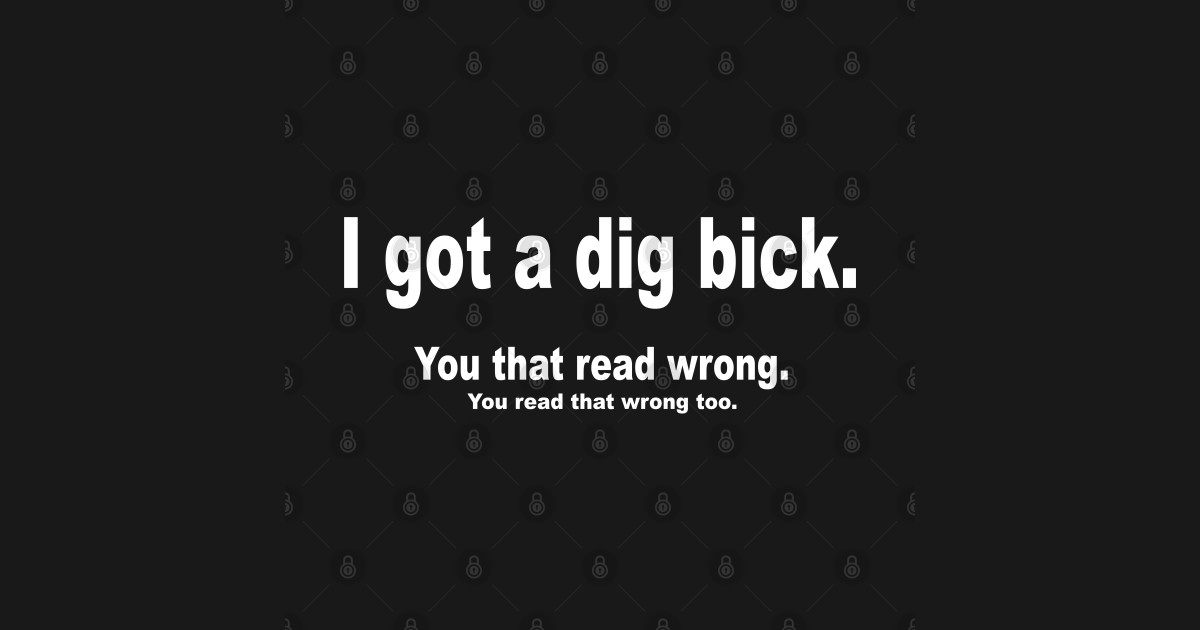
You probably just did it. Honestly, you probably didn't even notice. Your eyes scanned that title, your brain did a quick "copy-paste" of what it expected to see, and you moved right along. But look again. The phrase you this read wrong is intentionally jumbled. If you saw "You Read This Wrong," don't feel bad. You aren't "bad at reading." In fact, your brain is actually performing at a high level of efficiency. It’s a glitch, sure, but it’s a glitch born out of being a survival-oriented pattern recognition machine.
The "you this read wrong" phenomenon isn't just a silly internet meme or a parlor trick found on TikTok and Pinterest. It is a fundamental demonstration of how human cognition works.
We don't read letter by letter. We don't even really read word by word anymore once we reach a certain level of literacy. Instead, we skim. We predict. We fill in the gaps. This is what psychologists call "top-down processing," and it’s the reason you can navigate a busy street or read a blurry text message from your mom without crashing your car or losing your mind.
Why Your Brain Loves to Lie to You
Your brain is lazy. Well, maybe "efficient" is a kinder word. It consumes about 20% of your body's energy despite being only 2% of your weight. To save power, it takes shortcuts. When you see a familiar sentence structure, your brain doesn't bother processing every single character. It recognizes the "shape" of the sentence.
Because the words "you," "read," "this," and "wrong" are so commonly grouped together, your internal autocorrect simply overrides the visual input. It’s like your eyes sent a raw data file to your brain, and your brain replied, "I know what this is supposed to be, I'll take it from here."
Rayner et al. (2006) conducted extensive research on eye movements during reading. They found that experienced readers skip about 30% of the words in a text. We mostly land our eyes on "content words" (nouns and verbs) and skip "function words" (the, of, and). When you saw you this read wrong, your brain likely jumped from "you" to "read" to "wrong," completely ignoring the syntax error because it didn't fit the expected model.
The Typoglycemia Effect
You’ve probably seen that viral paragraph where all the middle letters of the words are scrambled, but you can still read it perfectly fine. It starts with something like, "It dseno't mttaer in waht oredr the ltteers in a wrod are..."
This is often called "Typoglycemia." While that sounds like a medical condition, it’s just a clever name for a cognitive quirk. Dr. Graham Rawlinson wrote his PhD thesis on this at Nottingham University back in 1976. He discovered that as long as the first and last letters of a word remain in place, the human mind can process the rest of the word as a whole "unit" rather than a sequence.
Applying this to you this read wrong, we see a similar effect at the sentence level. The "anchor" words—the start and the end—give us enough context to hallucinate the correct order in the middle.
The Role of Saccades and Fixations
Reading isn't a smooth glide. It’s a series of jumps. Your eyes make tiny, jerky movements called saccades. Between these jumps, your eyes pause for a fraction of a second; these are called fixations.
During a fixation, you’re only taking in a very small amount of sharp information. Everything in your peripheral vision is a bit of a blur. If the word "this" is in your peripheral while you're fixated on "you" or "read," your brain just guesses its position.
- You expect "read" to follow "you."
- You expect "this" to be the object.
- You expect "wrong" to be the modifier.
When the reality of the text—you this read wrong—clashes with your internal map, the internal map usually wins. It’s only when we slow down, perhaps by reading out loud or using a pointer, that we force the brain to stop predicting and start actually observing.
Proofreading is Actually Impossible (Sort Of)
This is why you can’t find your own typos. You know what you meant to write. When you proofread your own essay or email, you aren't actually reading the words on the screen. You're reading the words in your head while your eyes move across the screen for moral support.
Professional editors use tricks to break this cycle. Some read backward. Some change the font to something ugly like Comic Sans to "shock" the brain into paying attention. When the visual input looks "weird" or "new," the brain can't rely on its old patterns, and the "you this read wrong" effect disappears.
Cognitive Load and Stress
It gets worse when you're tired. High cognitive load—basically when your brain is juggling too many things—makes you even more prone to these mistakes. If you're scrolling through social media at 11:00 PM, your brain is in "power save mode." It’s going to take every shortcut available.
This is why misinformation spreads so easily. We read the headline we expect to see, not necessarily the one that is written. We see a few keywords that trigger an emotional response, and our brain fills in the narrative. The you this read wrong trick is a harmless version of a much larger psychological vulnerability.
Practical Ways to Sharpen Your Perception
If you find yourself falling for these linguistic traps too often, or if you're a writer who keeps missing glaring errors, you need to disrupt your pattern recognition.
- Change the Medium: If you wrote it on a computer, print it out. The physical tactile shift forces a different type of attention.
- Read Aloud: This engages the auditory processing center of the brain. You will hear the mistake "you this read wrong" even if your eyes refused to see it.
- The "Backward" Technique: Start at the last sentence and read to the first. This destroys the narrative flow and forces you to treat each sentence as an isolated unit of data.
- Invert the Colors: Swapping to dark mode or high-contrast mode can sometimes be enough of a "visual jolt" to make your brain stop skimming.
It is fascinating, really. We spend our whole lives trying to be "accurate," but our biology is built for "fast." Evolution didn't care if you could spot a typo in a blog post; it cared if you could see the slight movement of a predator in the tall grass without having to analyze every single blade.
So, the next time you see a post titled you this read wrong and you realize you fell for it, don't be annoyed. Take it as a sign that your brain is working exactly as it should—optimizing for speed, scanning for meaning, and keeping you moving through a world that is far too full of information to ever process completely.
The trick isn't to stop your brain from taking shortcuts. You can't. The trick is knowing when those shortcuts are happening so you can choose when to slow down and actually look at the words on the page.



