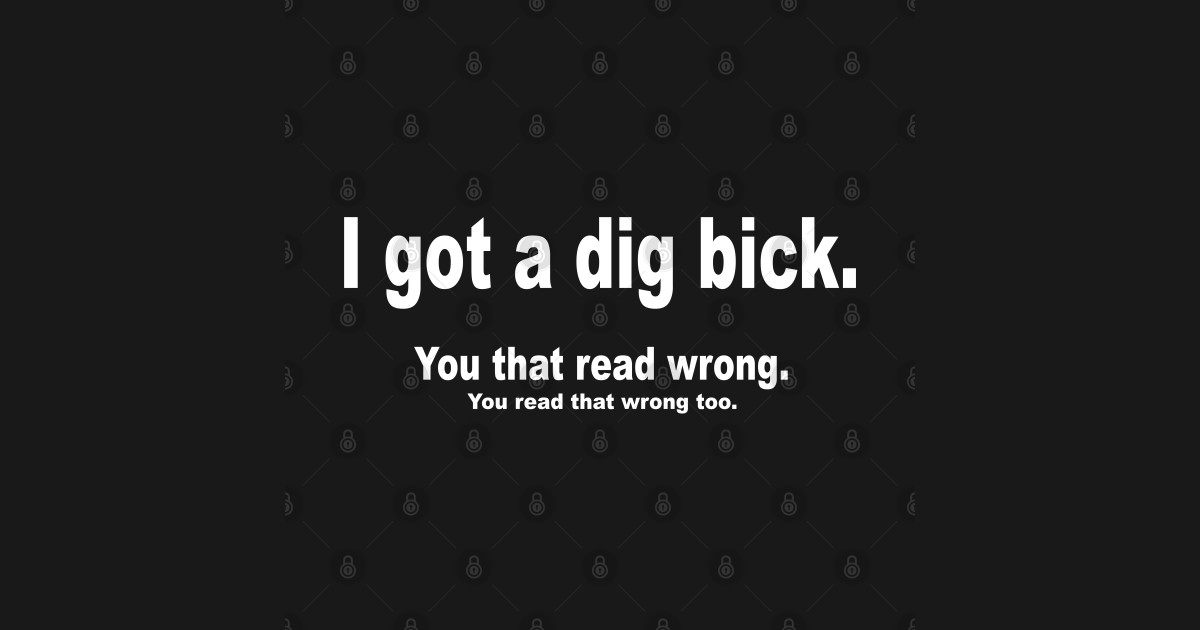
You just did it. Honestly, you probably didn't even notice. Your eyes scanned that title, and for a split second, your brain filled in the gaps with what it expected to see rather than what was actually printed on the screen. It's a classic case of you that read wrong.
Brain glitches are weird. We like to think of our eyes as high-definition cameras recording every pixel of reality, but they aren't. Not even close. Your brain is a prediction engine. It’s lazy. It’s efficient. It’s basically a massive biological shortcut machine that guesses what the next word is going to be before you’ve even fully processed the ink or the pixels. This isn't just a fun party trick or a meme from 2012; it’s a fundamental part of cognitive psychology called "top-down processing."
When you encounter a phrase like "you that read wrong," your internal autocorrect screams that it should be "you read that wrong." You’ve seen that specific sequence of words thousands of times in your life. Because the brain prioritizes speed over accuracy, it skips the literal visual input in favor of the expected pattern.
The Science Behind Why You That Read Wrong Happens
Let's get into the weeds of why this happens. It's mostly about the fovea. That’s the tiny part of your retina responsible for sharp, central vision. Everything outside that tiny spot is blurry. To compensate, your eyes do these rapid, jerky movements called saccades.
During a saccade, you are effectively blind.
To keep you from losing your mind, the brain stitches these snapshots together into a seamless movie. But it’s a movie with a lot of CGI. Dr. Rayner, a legendary researcher in eye movements at UC San Diego, spent decades proving that we only "fixate" on about 60% to 80% of the words in a sentence. We skip the "thes," the "ands," and the short connectors. We guess the rest based on context.
If the context is familiar, the guess is almost always right. Except when it isn't.
Predictive Coding and The Error Signal
Your brain works on a principle called the Bayesian Brain Hypothesis. Essentially, you carry around a mental model of the world. When new data comes in—like reading a sentence—your brain compares the data to the model. If there’s a small discrepancy, like a swapped word in "you that read wrong," the brain often just suppresses the "error signal" because it assumes the visual data is the mistake, not the model.
It’s an efficiency hack. If we had to manually process every single letter of every single word, reading a novel would take months. We trade precision for pace.
Why This Glitch Is Taking Over Social Media Again
You’ve seen the images. The ones with the "The The" hidden in a triangle, or the paragraphs where the middle letters of every word are scrambled but you can still read it perfectly fine. These aren't just for engagement bait; they tap into a very real psychological phenomenon known as Typoglycemia.
Actually, "Typoglycemia" isn't even a real medical term. It was a word coined on the internet around 2003 following a viral email that claimed to be from Cambridge University (it wasn't). However, the underlying science—that the order of letters doesn't matter as much as the first and last letter—is partially supported by the "Transposed Letter Effect."
People love these memes because they offer a rare moment of "meta-cognition." You’re thinking about how you’re thinking.
The Illusion of Continuity
Have you ever noticed that you can't see your own eyes move in a mirror? Try it. Look from your left eye to your right eye. You’ll never see the transition. This is called saccadic masking. Your brain simply deletes the "blur" frames.
The same thing happens when you read. If a word is slightly out of place, like "you that read wrong," your brain masks the "glitch" to keep the flow of information steady. It’s trying to be helpful, but it makes you look like you’re losing your grip on basic English.
Proofreading Is Humanly Impossible (Almost)
This is the bane of every professional writer's existence. You can read a draft fifty times and still miss a glaring "the the" or a swapped word. Why? Because you know what you meant to write.
When you proofread your own work, you aren't really reading. You're just verifying. Your brain is checking its internal map of the sentence against the page. Since the map is perfect, the brain tells you the page is perfect too.
How to Actually Catch These Errors
If you want to beat the "you that read wrong" effect in your own work, you have to break the brain's predictive cycle. Here are a few ways experts actually do it:
- Read Out Loud: This forces you to engage the auditory processing centers, which are slower and more methodical than your visual system.
- Change the Font: Swap your document to Comic Sans or something hideous. The "unfamiliarity" forces your brain out of autopilot.
- Read Backwards: Start at the last word and move to the first. This completely destroys the context, making it impossible for your brain to predict the next word.
- The Ruler Trick: Use a physical object to cover everything but the line you are currently reading.
The Role of Contextual Expectancy
Language is highly redundant. If I say "The cat sat on the...", your brain has already filled in "mat" before I finish the sentence. This is called cloze probability.
When the cloze probability is high, your eyes move faster. When it’s low—meaning the sentence goes somewhere unexpected—your eyes linger longer. "You that read wrong" has a high cloze probability for the corrected version, which is why your eyes just zoom right past the error.
Interestingly, some people are less prone to this. Dyslexic readers, for example, often have to process text more "bottom-up" (focusing on the letters and sounds) rather than "top-down" (focusing on the pattern). While this makes reading slower and more exhausting, it sometimes leads to catching details that "fluent" readers gloss over.
Complexity and Cognitive Load
Everything gets worse when you're tired.
Cognitive load is the amount of mental effort being used in the working memory. If you’re stressed, scrolling quickly on a phone, or distracted by a notification, your brain leans even harder on its predictive models. This is why you fall for "you that read wrong" more often on mobile devices than in a physical book. The environment is more chaotic, so the brain takes more shortcuts to save energy.
It’s also why phishing scams work. Scammers use slightly misspelled URLs or swapped words in emails because they know you're likely scanning, not reading.
The "Cambridge" Letter Myth vs. Reality
We have to be careful here. The viral post about letter order being irrelevant is a bit of an exaggeration. While you can read "Aoccdrnig to rscheearch," it becomes significantly harder as the words get longer or the sentences get more complex.
For instance, try this: "The pneunmnoia rseaerch was cmodpelted yseterdya." Compare that to: "The p-m-o-u-n-i-a r-e-s-e-a-r-c-h was c-o-m-p-l-e-t-e-d y-e-s-t-e-r-d-a-y."
The first one is a nightmare. The second one is slightly easier because the structure is simple. The "you that read wrong" effect works best with short, common words because those are the ones we’ve "over-learned" to the point of total automation.
Real-World Consequences of Reading It Wrong
It's not always just a funny meme. In 1872, a comma error in a tariff act cost the US government about $2 million (which is a fortune in today’s money). The law was supposed to exempt "fruit-plants, tropical and semi-tropical," but it was typed as "fruit, plants tropical and semi-tropical." That one little comma change meant all imported fruit became duty-free.
In medicine, "reading it wrong" can be fatal. Doctors and nurses are human. They suffer from the same predictive processing glitches as the rest of us. Look-alike, sound-alike (LASA) medications are a massive problem in healthcare. A clinician sees the first three letters of a drug name and their brain fills in the rest based on what they usually prescribe.
This is why modern hospitals use barcodes and double-verification systems. They know the human brain cannot be trusted to be a literal scanner.
Actionable Steps to Improve Your Visual Accuracy
You can't "cure" how your brain works, but you can build better habits to stop being fooled by your own biology.
Slow down your saccades. When you are reading something important—like a contract, a medical label, or an angry text to your ex—physically point at the words with your finger. This tactile connection anchors your eyes and prevents them from jumping ahead.
Vary your reading medium. If you've been staring at a screen for four hours, your "predictive error" rate is going to skyrocket. Print out the things that matter. The different texture and lighting (reflected light vs. emitted light) reset your brain’s attention span.
Recognize the "Glitch State." If you catch yourself falling for a "you that read wrong" meme, take it as a sign that you are currently in "autopilot mode." It’s a great internal diagnostic tool. If you're skipping words in a meme, you're likely skipping details in your work emails too.
Use technology as a backup. Since we know our brains are biased toward seeing what they expect, use text-to-speech tools. Hearing a computer voice read your writing back to you will immediately highlight swapped words or missing "thes" because the computer doesn't have a "prediction" of your intent. It only has the data.
Practice mindful reading. Stop the scroll. Pick a long-form article or a book and read it with the intention of noticing the sentence structure. It’s like a workout for your fovea. The more you practice "deep reading," the better you become at catching the subtle nuances that the "fast brain" wants to ignore.
Your brain is a masterpiece of evolution, but it's also a bit of a trickster. It wants to give you the gist of the world so you can survive, not the literal truth of the world so you can win a spelling bee. Understanding the "you that read wrong" phenomenon isn't just about catching typos; it's about realizing that our perception of reality is often just a very well-educated guess.