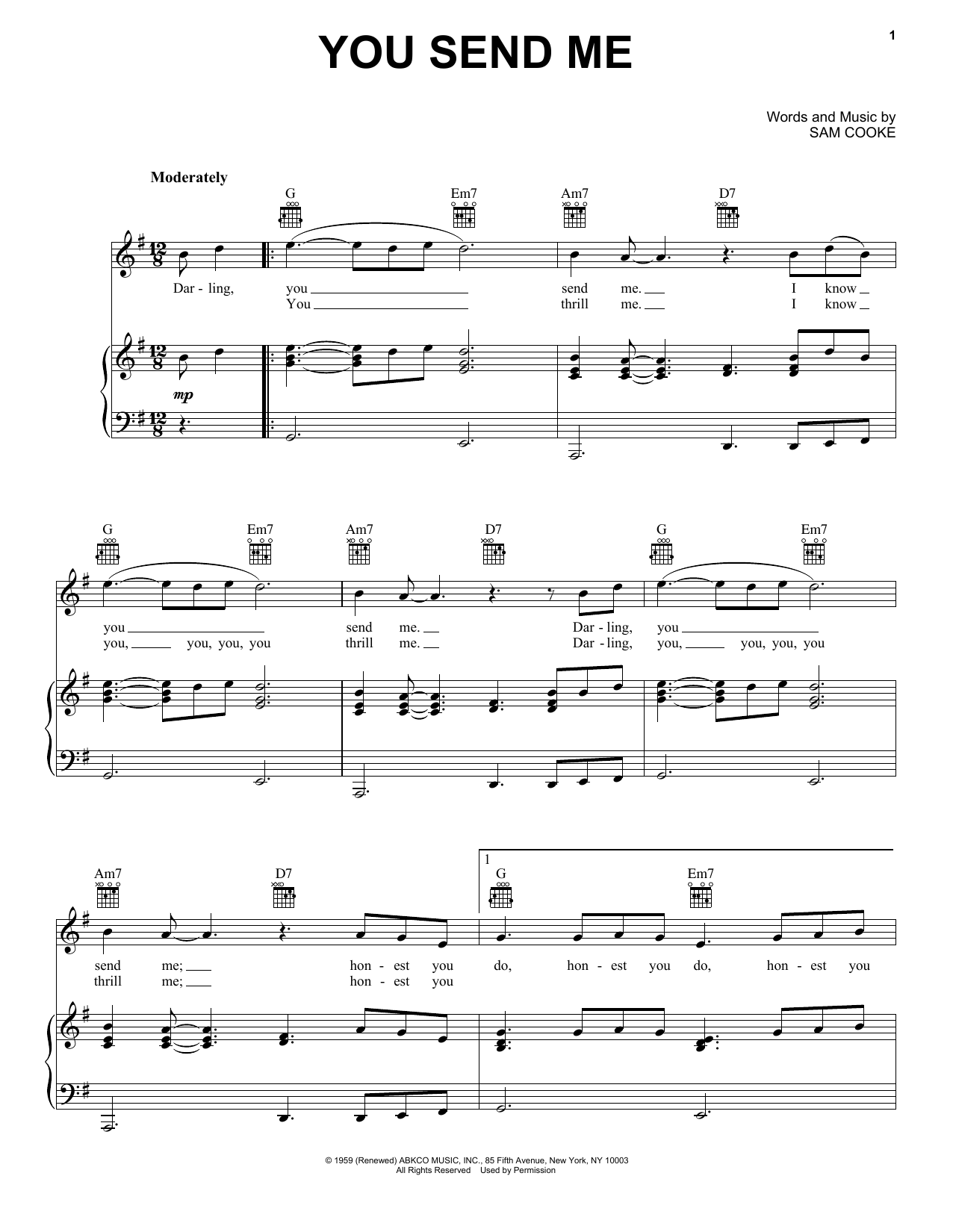
It’s just six notes. Honestly, that’s all it takes for You Send Me by Sam Cooke to hook you. That "Ooh-ooh-ooh-ooh-ooh-ooh" isn't just a melody; it's the sound of a tectonic shift in American music. If you’ve ever sat in a quiet room and let that record spin, you know it feels less like a song and more like a warm breeze.
But here’s the thing. In 1957, nobody was betting on Sam Cooke to become a pop deity. He was the "King of Gospel," the golden boy of the Soul Stirrers, and moving into secular music was seen as a betrayal. It was risky. It was scandalous. People genuinely thought he was throwing his career away for a few catchy hooks. Building on this idea, you can also read: Why the Grammys Had to Change the Rules for Best New Artist.
The Messy Reality Behind the Recording
The session for You Send Me by Sam Cooke wasn’t some high-budget, polished affair. It happened at Radio Recorders in Los Angeles. Bumps Blackwell, Sam’s producer at the time, actually wanted a much grittier sound. He wanted Sam to belt it out. Instead, Sam kept it light. He kept it airy.
The record label, Specialty Records, absolutely hated it. Art Rupe, the head of the label, famously walked into the session and was horrified to find white backup singers. He thought the sound was too "white," too pop, and a complete departure from the raw R&B he expected. He was so annoyed that he ended up letting Cooke and Blackwell out of their contract just to get rid of the record. Talk about a massive oversight. Keen Records picked it up, and the rest is history. Experts at Vanity Fair have also weighed in on this situation.
It’s funny how the biggest mistakes in music history often lead to the biggest hits. If Rupe had gotten his way, we might have had a loud, shouting version of this track that would have been forgotten by 1960. Instead, we got the blueprint for soul music.
Why the Song Structure Breaks All the Rules
Most pop songs of that era were trying so hard to be dramatic. They had big crescendos. They had crashing drums. You Send Me by Sam Cooke does the opposite. It’s almost startlingly simple.
The chord progression is a classic I-vi-ii-V (G, Em, Am, D7), which every guitar student learns in their first week. But it’s the phrasing that matters. Sam doesn't sing the lyrics; he floats them. When he says "honest you do," there’s a sincerity there that felt radical in 1957.
- The Tempo: It’s a lazy shuffle. It doesn't rush you.
- The Vocals: Pure silk. No grit, no gravel, just perfect intonation.
- The Backing: Those "oooh-wee-oooh" vocals from the backup singers (the Pied Pipers, mostly) gave it a dreamy, suburban feel that crossed racial lines in a way few songs had done before.
He was basically inventing a new genre on the fly. You can hear the DNA of this track in everything from Otis Redding to Leon Bridges. It's the "Cooke Method"—make it look easy, even when it’s technically impossible to replicate.
The Cultural Explosion of 1957
You have to understand the context. Segregation was the law of the land. Music charts were divided. Then comes this guy with a million-dollar smile and a voice like honey. You Send Me by Sam Cooke didn't just top the R&B charts; it hit Number 1 on the Billboard Hot 100. It stayed there for three weeks.
It was a crossover miracle.
White teenagers were buying it. Black families were playing it. It was one of the first times a Black artist had achieved that specific kind of "gentlemanly" pop stardom that wasn't a caricature. He wasn't playing a role; he was just Sam.
However, this success came at a price. The gospel community was furious. To them, Sam had sold his soul to the devil for pop success. They called him "The Devil’s Singer" for a while. It’s hard to imagine now, considering how wholesome the song sounds, but back then, singing about romance instead of Jesus was a line you didn't cross lightly.
The Mystery of the Songwriting Credit
Wait, who actually wrote it? If you look at the original 45rpm record, the credit goes to L.C. Cook—Sam's brother.
Why? Because Sam was still under contract with Specialty Records and didn't want the publisher to snatch the royalties. It was a business move. Sam was incredibly sharp when it came to the "business" side of show business, which was rare for artists in the 50s. He eventually regained his credits, but for years, the paperwork was a maze of pseudonyms and family names.
He knew his worth. That’s a recurring theme in Sam’s life. He wasn't just a singer; he was a mogul in the making. He started his own record label (SAR Records) and his own publishing company. He was looking at the long game while everyone else was looking at the next week's chart.
Why It Still Sounds Fresh in 2026
Modern production is loud. It’s compressed. It’s aggressive.
When you play You Send Me by Sam Cooke today, the first thing you notice is the "air" in the recording. You can hear the room. You can hear the slight vibration of the guitar strings. It feels human.
Music critics often talk about "timelessness" as a vague concept, but with Sam, it’s literal. He used a vocal technique called "melisma"—stretching one syllable over several notes—but he did it with such restraint that it never feels dated. Unlike the heavy vibrato of the 40s or the autotune of today, Sam’s voice just exists in this perfect middle ground.
Common Misconceptions
Some people think this was his first recording. It wasn't. He had years of experience with the Soul Stirrers. Others think it was a cover. Nope. It was an original, though it borrowed the "feeling" of older standards.
Another big one? That it was "easy" for him. If you listen to the alternate takes, you can hear him working. He was a perfectionist. He would do thirty takes just to get the "honest you do" to sound like he was whispering it in your ear.
Actionable Ways to Appreciate the Legacy
If you really want to understand the impact of this track, don't just stream it on a tinny phone speaker.
- Find the Mono Mix: The original mono version has a punch that the stereo "re-channeling" loses. The drums and vocals sit together much better.
- Compare it to the Gospel stuff: Listen to "Nearer to Thee" by the Soul Stirrers, then play You Send Me by Sam Cooke. You’ll hear the exact moment soul music was born. The phrasing is identical; only the subject matter changed.
- Read the Lyrics as Poetry: Without the music, the lyrics are almost like a haiku. "At first I thought it was infatuation / But woo, it's lasted so long." It’s simple, direct, and devastatingly effective.
- Watch the Live Performances: Seek out the footage from The Guy Mitchell Show. Seeing him perform it live shows you the charisma that the record only hints at.
Sam Cooke didn't just give us a love song. He gave us a template for the modern artist. He showed that you could be soulful without being loud, and commercial without losing your identity. You Send Me by Sam Cooke remains the high-water mark for American pop because it doesn't try too hard. It just is.
To truly master the history of soul, start with this track. Analyze the space between the notes. Notice the lack of ego in the performance. That's where the magic lives. It’s a masterclass in "less is more" that every songwriter today should be required to study.
Next Steps for Music Historians and Fans
- Deep Dive into SAR Records: Look up the artists Sam signed after he became a star. He was trying to build a Black-owned empire long before Motown became a household name.
- Track the Crossover: Study the Billboard charts from October to December 1957. Seeing the songs Sam knocked off the top spot—like Elvis Presley’s "Jailhouse Rock"—puts his achievement into a staggering perspective.
- Analyze the "Cooke Style": Pay attention to how he uses the "yodel" or the break in his voice. It's a technique he brought from gospel and used to inject emotion into pop lyrics.
The story of this song isn't just about a hit; it's about the courage to change your sound when the whole world is telling you to stay in your lane. Sam Cooke jumped lanes, and he took the rest of music history with him.



