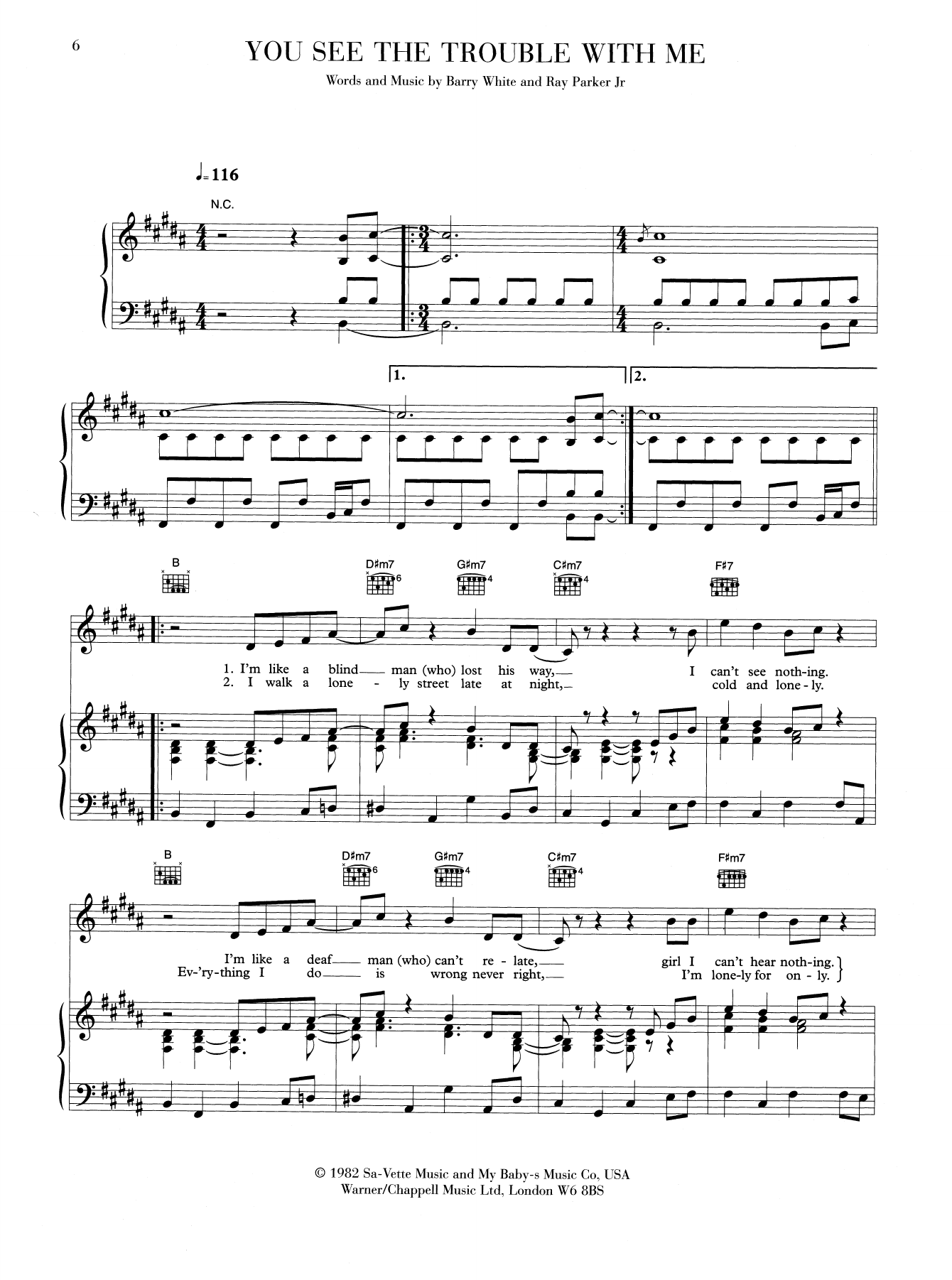
Barry White didn't just sing songs. He created atmospheres. When you drop the needle on a record like You See the Trouble with Me, you aren't just hearing a soul track from 1976. You’re stepping into a lush, orchestrated world built by a man who understood the architecture of a groove better than almost anyone else in the business.
It’s kind of wild to think about how this track specifically bridges the gap between the classic "Walrus of Love" era and the high-energy club culture that would eventually claim it decades later. Released in February 1976, it was the second single from the album Let the Music Play. While the title track of that album is a behemoth in its own right, "You See the Trouble with Me" has this specific, nervous energy. It’s a song about being utterly helpless in the face of love. Basically, it's Barry at his most vulnerable, even though that voice sounds like it could move mountains.
The Secret Sauce: Barry White and Ray Parker Jr.
Most people associate the name Ray Parker Jr. with the Ghostbusters theme. Honestly, that’s a tragedy. Long before he was asking who you’re gonna call, Parker was a session ace and a brilliant songwriter. He co-wrote "You See the Trouble with Me" with Barry White, and you can really feel that synergy in the rhythm section.
The song isn't just a wall of sound. It's built on a tight, walking bassline and a guitar scratch that keeps the momentum going even when the strings get heavy. White handled the production himself—because of course he did. He was a perfectionist. He and Gene Page, his legendary arranger, knew how to make a 40-piece orchestra sound like a single, breathing organism.
The lyrics are surprisingly desperate for a man who looked like he had it all figured out.
- "I'm like a blind man who lost his way."
- "I'm like a deaf man who can't relay."
- "I can't do nothin' without my baby."
It’s a portrait of total emotional dependency. In the mid-70s, soul music was often about bravado or smooth seduction, but here, White is admitting that he’s basically falling apart. That’s why it resonates. It’s real.
The 2000s Drama: Black Legend and the Sample War
Fast forward about 24 years. The year is 2000. Electronic music is dominating the UK and European charts. An Italian house duo called Black Legend (Enrico Ferrari and Ciro Sasso) decides to take a piece of Barry’s magic.
They initially sampled White’s original vocals for their track, also titled "You See the Trouble with Me." It was a massive club hit. There was just one problem: Barry White said no.
White was notoriously protective of his work. In a 2000 interview with NME, he was pretty blunt about it. He reportedly felt the track was "cheap" and lacked soul. He refused to clear the sample. Most artists would have given up, but Black Legend took a different route. They brought in British vocalist Elroy "Spoonface" Powell to do a "karaoke" re-recording of the vocals.
The result? The cover version hit Number 1 on the UK Singles Chart in June 2000. It’s one of those rare moments where a song becomes a definitive hit for two entirely different generations in two entirely different genres. Barry’s original version had peaked at Number 2 in the UK back in 1976. He was beaten to the top spot then, and then saw a house version of his own song take the crown years later. Kinda ironic, right?
Chart Success and Global Footprint
While it might not have been a massive pop crossover in the States—it peaked at number 14 on the Billboard Black Singles chart—the song was a titan internationally.
- United Kingdom: Peaked at #2 (1976)
- Germany: Peaked at #14
- Ireland: Peaked at #15
- Netherlands: Peaked at #19
The 2000 Black Legend version went even further, topping charts in Scotland and the UK, and hitting the top ten in places like Canada and France. It’s a testament to the songwriting. A good melody can survive any production style, whether it’s a 1970s soul orchestra or a 2000s drum machine.
How to Truly Appreciate the Track Today
If you really want to hear what made Barry White a genius, you have to listen to the Let the Music Play album version of You See the Trouble with Me. The single edits often cut out the "breathing room."
White was a master of the "long game." He liked to let the intro simmer. He wanted you to feel the tension before that deep, gravelly voice even entered the room. When you listen to it now, pay attention to the layering. The way the backing vocals (often the Love Unlimited trio) act as a soft cushion for his heavy baritone is a masterclass in vocal arrangement.
If you’re a DJ or a producer, look at the BPM. It sits right around 113-114 BPM. That’s a "sweet spot" for soul-disco. It’s fast enough to dance to, but slow enough to keep that heavy, romantic weight.
Actionable Next Steps
To get the most out of this classic, try these three things:
- Compare the Versions: Listen to the 1976 original and the 2000 Black Legend version back-to-back. Notice how Spoonface Powell tries to emulate White’s grit versus how White actually uses his chest voice. It’s a lesson in vocal texture.
- Check the Credits: Look into the work of Gene Page. If you like the orchestral swell of this track, Page is the architect you’ve been looking for. He worked on everything from Motown hits to Whitney Houston.
- High-Fidelity Listening: This isn't a song for cheap earbuds. If you can, find a high-quality FLAC or a clean vinyl pressing. The low-end frequencies in Barry's voice and the bass guitar are often lost in low-bitrate streams.
The "trouble" Barry was singing about might have been a woman, but for music fans, the only trouble is trying to find anyone else who could command a track with that much authority. Barry White remains the undisputed king of the soulful growl.



