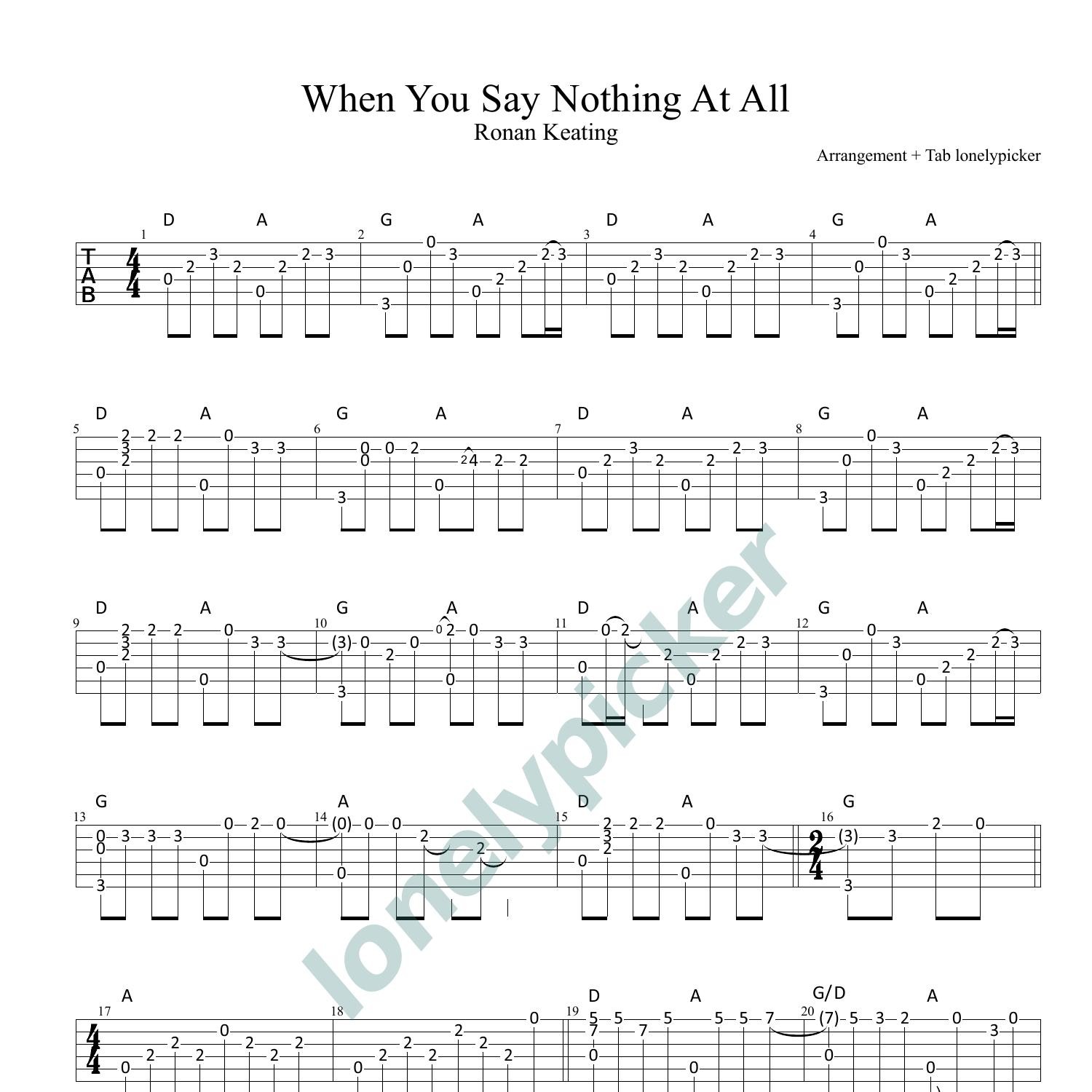
Music moves in cycles, but some songs just refuse to sit in the attic. You've probably heard it in a grocery store aisle or at a wedding where the slow dance feels a little too earnest. Most people know it as the song that made Ronan Keating a solo star in the late nineties, especially if you grew up watching Notting Hill on a loop. But the real story of you say it best when say nothing at all starts way before Julia Roberts and Hugh Grant shared a park bench. It’s a song about the heavy lifting of silence.
It’s weirdly rare for a song to hit #1 on the country charts and then, a decade later, dominate the pop charts in a completely different part of the world.
Keith Whitley was the first to breathe life into it. In 1988, he was the gold standard for neotraditional country music. He had this voice that sounded like it had been soaked in bourbon and heartbreak, yet it carried this incredible tenderness. When he recorded it, the track went straight to the top of the Billboard Hot Country Singles. Tragically, it was one of the last things he saw succeed before his death in 1989.
The Songwriters Who Caught Lightning in a Bottle
You can’t talk about this track without mentioning Paul Overstreet and Don Schlitz. Honestly, these two were the titans of Nashville songwriting in the eighties. Schlitz is the guy who wrote "The Gambler" for Kenny Rogers. That’s the kind of pedigree we’re dealing with.
The story goes that they were struggling to find an idea one day. They were just sitting there, tossing around lines, and one of them—history says it was Schlitz—noted that sometimes, the best way to say you love someone is to just shut up. It sounds like a joke, but in the context of a long-term relationship, it's a profound truth.
Why the lyrics work so well
The genius isn't in the complexity. It’s the simplicity.
- "The smile on your face lets me know that you need me."
- "A touch of your hand says you'll catch me if ever I fall."
These aren't metaphors about stars or oceans. They are tactile, physical observations. Most love songs try too hard to be poetic. They use big, sweeping words that nobody actually says in real life. This song focuses on the stuff that happens when the lights are low and the conversation has run dry. It’s about the comfort of not needing to fill the air with noise.
Ronan Keating and the Global Pop Explosion
Fast forward to 1999. Ronan Keating is the frontman of Boyzone, one of the biggest boy bands in the UK and Ireland. He’s looking to go solo. He records a cover of you say it best when say nothing at all for the Notting Hill soundtrack.
Suddenly, a country ballad from Nashville is the biggest pop song in Europe.
It hit number one in the UK, Ireland, and even New Zealand. Keating’s version stripped away some of the country twang and replaced it with a polished, acoustic pop production that fit the "Richard Curtis movie" aesthetic perfectly. For a whole generation of Gen X and Millennials in Europe, this isn't a country song. It’s a movie song. It’s the sound of a rainy London afternoon.
It’s actually kinda funny how the two versions exist in parallel universes. If you go to a dive bar in Kentucky, you’re hearing Keith Whitley. If you’re at a karaoke bar in Dublin, it’s Ronan Keating all the way.
The Power of Non-Verbal Communication (The Science Bit)
There’s a reason this song resonates beyond just a catchy melody. It taps into a fundamental human truth. Psychology actually backs this up. Dr. Albert Mehrabian, a researcher famous for his work on non-verbal communication, famously suggested that a huge chunk of our emotional messaging comes through facial expressions and tone rather than words.
While the "7%-38%-55% rule" is often misquoted (it specifically applies to feelings and attitudes), the core idea holds up: words can lie, but a look rarely does.
When the song talks about "the truth in your eyes," it’s tapping into our biological ability to read a partner's micro-expressions. We are hardwired to look for safety and validation in the people we love. Sometimes, talking actually gets in the way of that. Words can be misinterpreted. They can be clumsy. Silence, when it’s the right kind of silence, is incredibly efficient.
Why Some Fans Prefer the Allison Krauss Version
We have to talk about 1995. Before Keating, but after Whitley, Allison Krauss and Union Station covered it. If you want to hear the most haunting version of this song, this is the one.
Krauss brought a bluegrass sensibility to it. Her voice is high, clear, and almost ethereal. While Whitley’s version feels like a conversation between two people in a kitchen, Krauss’s version feels like a prayer. It won the CMA Single of the Year in 1995.
It’s a rare feat. One song, three different versions, three different decades, and all of them were massive hits. That doesn't happen unless the "bones" of the song are nearly perfect.
Misconceptions About the Meaning
A lot of people think the song is about a shy person. Or maybe someone who is literally mute.
That’s not it.
It’s actually about the limitation of language. It’s the realization that "I love you" is a phrase that has been used so many billions of times that it occasionally loses its edge. The song argues that the most "honest" communication happens through action and presence.
It’s about the vulnerability of being seen without a script. When you aren't talking, you can't hide behind jokes or sarcasm or cleverness. You’re just there. And if the person you’re with looks at you and sees everything they need—that’s the peak of intimacy.
The Production Differences: A Comparison
If you listen to the Whitley original, the production is very "late 80s Nashville." You’ve got that crystalline acoustic guitar and the soft swell of a pedal steel. It’s warm.
Keating’s version is brighter. The drums are more pronounced, even if they are soft. It has that late-90s "unplugged" feel that was everywhere back then.
Krauss’s version is the most "stripped." It relies on the incredible musicianship of Union Station. The fiddle and banjo aren't just background noise; they are part of the vocal performance.
The Legacy of the Song in 2026
Even now, you say it best when say nothing at all continues to be a staple. It’s a favorite for singing competitions like The Voice or American Idol. Why? Because it’s a "singer's song." There’s nowhere to hide in the verses. If you can’t convey emotion in the quiet moments of the track, the chorus won’t save you.
It has also become a meme in some circles—usually used ironically when someone is being particularly loud or annoying. But the irony only works because the original sentiment is so sincere.
Real-World Lessons from a 3-Minute Ballad
What can we actually take away from this?
- Active presence matters. In a world where we are constantly on our phones, just "being there" with a partner is a lost art. The song reminds us that eyes and hands are communication tools too.
- Simplicity wins. Whether you're writing a song or a business email, the most direct path to the truth is usually the best. Don't over-explain.
- Consistency over time. The fact that three different artists had hits with this proves that a good message is timeless. It doesn't need to be trendy to be effective.
Putting it into practice
If you're looking to improve your own relationships, maybe take a page out of the Overstreet/Schlitz playbook.
- Try a "silent dinner." No phones, just eating and being together. It’s awkward at first, then it’s revealing.
- Focus on small physical gestures. A hand on a shoulder or a specific look can communicate more support than a twenty-minute pep talk.
- Listen more than you speak. It’s an old cliché for a reason.
The song isn't an anthem for the quiet. It’s an anthem for the deeply connected. Whether you prefer the country soul of Keith Whitley or the pop sheen of Ronan Keating, the core message remains: some things are too important for words to handle.
Next time you're struggling to find the right thing to say to someone you love, maybe don't say anything at all. Just show up. That's usually enough.



