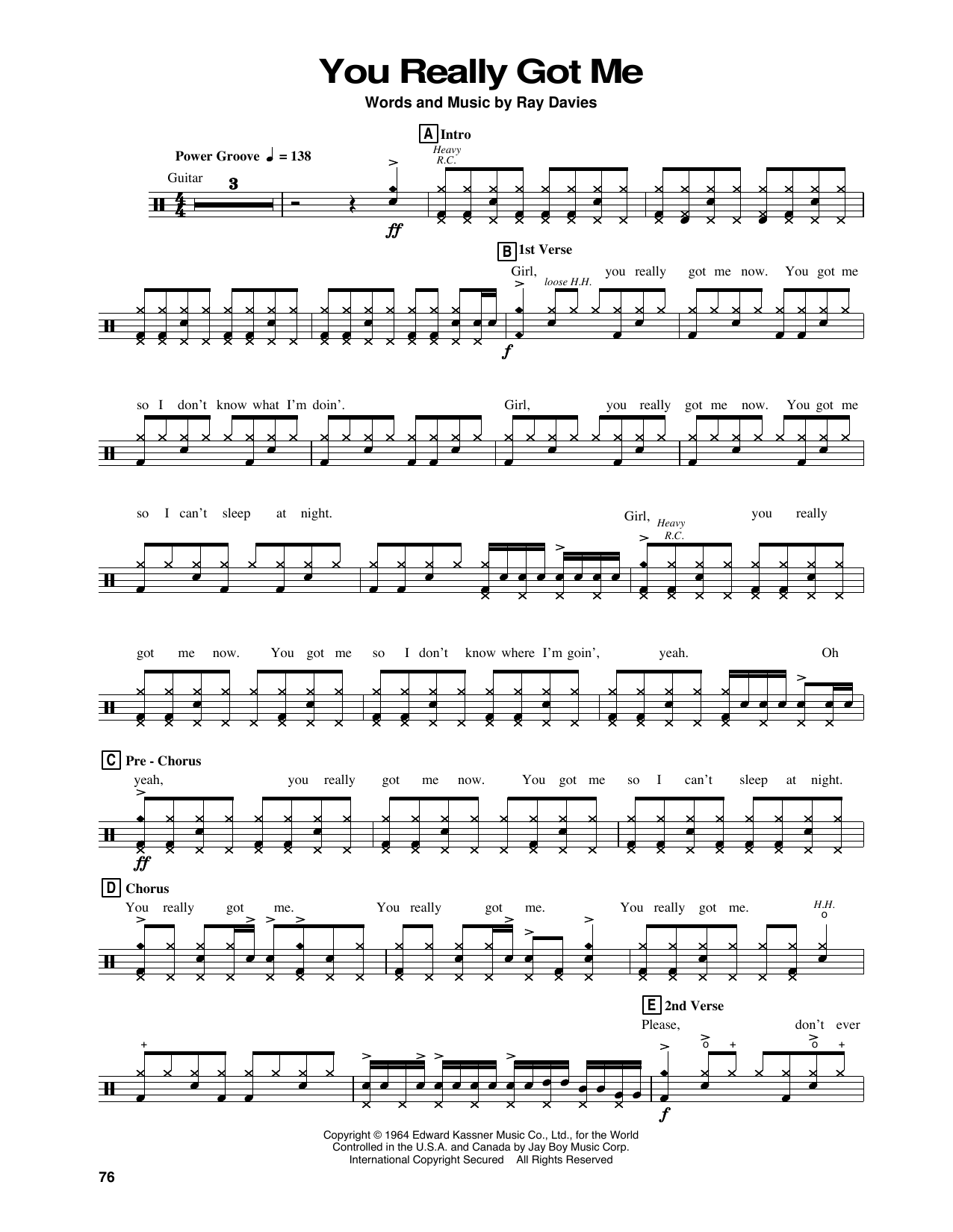
It was 1978. Rock and roll was feeling a little sluggish, a bit bloated from the prog-rock era and the glittery remnants of disco. Then, a needle dropped on a self-titled debut album from four guys out of Pasadena. The lead track wasn't even an original—it was a cover of a 1964 Kinks classic. But within three minutes, You Really Got Me Van Halen style had effectively deleted the previous decade of guitar playing.
Most people don't realize how much of a gamble this was. Covering a song that was already a monumental hit is usually a sign of a band running out of ideas. For Van Halen, it was a hostile takeover. Ted Templeman, the legendary producer who discovered them at the Starwood, knew they needed a calling card. He found it in Ray Davies’ riff, but he filtered it through Eddie Van Halen’s brown sound. The result was a sonic boom that still echoes in every Guitar Center in the world today.
The Brown Sound and the 1964 Connection
Ray Davies wrote the original riff on a piano. He wanted it to be jazzier, something more sophisticated. His brother Dave had other ideas, famously slashing his amp speaker with a razor blade to get that gritty, distorted growl. It was punk before punk existed. Fast forward to 1977, and Eddie Van Halen is sitting in Sunset Sound Recorders with a "Frankenstrat" he built himself for about $130.
Eddie didn't just play the riff. He electrified it.
He used a Variac—a variable transformer—to starve his Marshall amp of voltage. This is the secret sauce. By dropping the voltage, he could crank the volume to get maximum tube saturation without the amp actually exploding or becoming too loud to record. That "brown sound" is thick, warm, and deceptively simple. When you listen to You Really Got Me Van Halen, you aren't just hearing a guitar; you’re hearing a mechanical object being pushed to its absolute physical limit.
The recording process was notoriously fast. This wasn't a Steely Dan session where they spent weeks on a snare tone. It was captured mostly live. If you listen closely to the isolated tracks, you can hear the bleed. You can hear the room. Most importantly, you can hear the sheer arrogance of a band that knew they were better than everyone else on the Sunset Strip.
Why the Kinks Were Actually Terrified
There’s a long-standing story—honestly, it’s more of a rock legend that happens to be true—about Ray Davies’ reaction to the cover. When he first heard the Van Halen version, he was reportedly pissed off. Not because it was bad. He was mad because it was so much more powerful than his own.
The Kinks’ version is a masterpiece of nervous, adolescent energy. Van Halen’s version is a masterpiece of predatory confidence.
David Lee Roth’s vocals on this track are often overlooked because everyone is staring at Eddie’s fingers. But Roth brought a Vaudeville-meets-Macho-Man energy that the Kinks couldn't touch. His screams, those "whoops" and "ah-yeahs," weren't just filler. They were cues. He was the ringmaster. When the band hit that stop-start section before the solo, Roth’s "Oh!" acts like a starter pistol.
The Kinks eventually grew to love it, mostly because the royalties from the Van Halen version likely bought Ray Davies a few houses. But for a moment in 1978, the old guard was officially put on notice.
The Solo That Broke the Rules
We have to talk about the solo. It’s short. It’s concise. It’s devastating.
Before You Really Got Me Van Halen, guitar solos were mostly blues-based pentatonic scales played with a lot of feeling but perhaps less "flash" in terms of technical gymnastics. Eddie changed the geometry of the fretboard. He used two-handed tapping—a technique where the right hand hammers onto the strings—to create intervals that were previously impossible to play at that speed.
It wasn't just about speed, though. It was the "thump."
Eddie’s swing was unique. Most hard rock drummers and guitarists play "straight," meaning the notes are even. Van Halen had a shuffle. Alex Van Halen’s drumming on this track is essentially a high-speed jazz shuffle disguised as a heavy metal beat. If you try to play this song with a metronome and a robotic sense of timing, it sounds terrible. It needs to breathe. It needs to lean forward, almost like it’s about to fall over, before snapping back into place.
Production Secrets: Sunset Sound and Ted Templeman
Ted Templeman is the unsung hero here. He had worked with the Doobie Brothers and Montrose, so he knew how to capture "big" sounds. But Van Halen was different. They were loud. Like, "get the neighbors to call the cops" loud.
They recorded the debut album in about three weeks.
One of the coolest details about the production of You Really Got Me Van Halen is the panning. If you listen with headphones, the guitar is almost entirely in the left channel, with the reverb or "echo" of the guitar in the right. This was a trick to make the listener feel like they were standing in the room with the band. It creates a massive sense of space.
- The Amp: 1968 Marshall 100-watt Super Lead.
- The Guitar: The original "Frankenstrat" with a Gibson PAF humbucker screwed directly into the wood.
- The Mic: A combination of Shure SM57s and Sennheiser 421s.
The simplicity is what makes it work. There are no layers. There are no overdubbed rhythm guitars during the solo—something that was almost unheard of in the 70s. When Eddie goes into his lead, the bass and drums just keep pounding away. It leaves a "hole" in the sound that most producers would be afraid of. Templeman embraced it. It made the band sound like a hungry power trio plus a wild frontman, which is exactly what they were.
Impact on 80s Rock Culture
You can track the trajectory of the 1980s back to this specific song. Without it, you don't get Mötley Crüe, you don't get Ratt, and you certainly don't get the shredder movement of the mid-80s. Everyone wanted to be Eddie. Every kid in America bought a strip of masking tape and a can of spray paint to make their guitar look like his.
But they couldn't play like him.
The "You Really Got Me" cover proved that Van Halen wasn't a one-trick pony. They could take the DNA of the past and mutate it into something futuristic. It was the bridge between the classic rock of the 60s and the hair metal of the 80s.
Interestingly, the song almost didn't make the cut for the first single. The band wanted "Runnin' with the Devil" to be the lead. But the label felt the familiarity of the Kinks melody would get them on the radio faster. They were right. It shot up the charts and stayed there, becoming a staple of FM radio for the next fifty years.
Technical Nuances You Might Have Missed
If you’re a musician, you know that the "E" chord at the start of the riff isn't just an E. It’s a power chord, sure, but Eddie’s tuning was slightly "off" in a way that made it sound "on." He often tuned his B string slightly flat to compensate for the way the guitar's intonation worked when he pressed down hard.
It’s these little imperfections that make the track human.
The feedback at the beginning of the track? That wasn't a mistake. It was Eddie standing just close enough to his cabinets to get the strings vibrating. It’s a warning shot. It tells the listener: "Buckle up, because this is going to be loud."
Then there's the "pick slide." It’s one of the most famous sounds in rock history. Eddie drags his plectrum down the low E string, creating a growling, mechanical descent into the main riff. Thousands of guitarists have tried to mimic it, but few get the pressure and speed just right.
The Live Evolution
Van Halen played this song at almost every single concert they ever performed. From the backyard parties in Pasadena to the sold-out arenas in the 2010s. Over time, it evolved. In the early days, it was a raw, punk-energy blast. By the time they reached their peak in 1984, it had become a victory lap.
During the "Hagar era," the song stayed in the setlist. Even though Sammy Hagar has a completely different vocal range and style than Roth, the power of that riff was undeniable. It’s "guitar-proof." You can't mess it up if you play it with enough conviction.
Misconceptions About the Recording
One big myth is that Eddie used a lot of pedals.
Actually, for You Really Got Me Van Halen, the signal chain was incredibly short. He used an MXR Phase 90 (which you can hear subtly during the solo and parts of the riff) and an MXR Flanger. That’s basically it. The distortion came from the tubes, not a box on the floor. People spend thousands of dollars trying to replicate this sound with digital modeling today, and they still struggle to capture the "air" moving around those speakers.
Another misconception is that the song was a "sell-out" move.
Some critics at the time thought Van Halen was "bastardizing" a classic. Rolling Stone wasn't exactly kind to the band in the beginning. They didn't get it. They thought it was noise. It took years for the critical establishment to realize that Van Halen wasn't just making noise—they were redesigning the architecture of American music.
Actionable Insights for Fans and Musicians
If you want to truly appreciate or replicate the magic of this track, don't just look at the tabs. Focus on the following elements that actually define the song:
- Study the "Swing": Don't play the riff like a robot. Listen to Alex’s snare drum. It’s slightly behind the beat. That’s where the "groove" lives.
- The Power of the Variac: If you’re a gear head, understand that the "Brown Sound" is about voltage, not just gain. Lowering the power allows for a richer harmonic profile.
- The "One Mic" Philosophy: When recording your own tracks, try to capture the room. Over-processing a guitar takes the life out of it. Van Halen sounds huge because it sounds like a band in a room.
- Vocal Dynamics: Notice how Roth doesn't sing "at" the listener; he performs "for" them. His ad-libs are just as important as the lyrics.
The legacy of You Really Got Me Van Halen isn't just in the notes. It’s in the attitude. It taught a generation of musicians that you can respect the past while completely destroying it and building something better on top of the ruins. Whether you’re a casual listener or a die-hard shredder, that 1978 recording remains the gold standard for how to do a cover song right. It took a British invasion hit and turned it into an American anthem.



