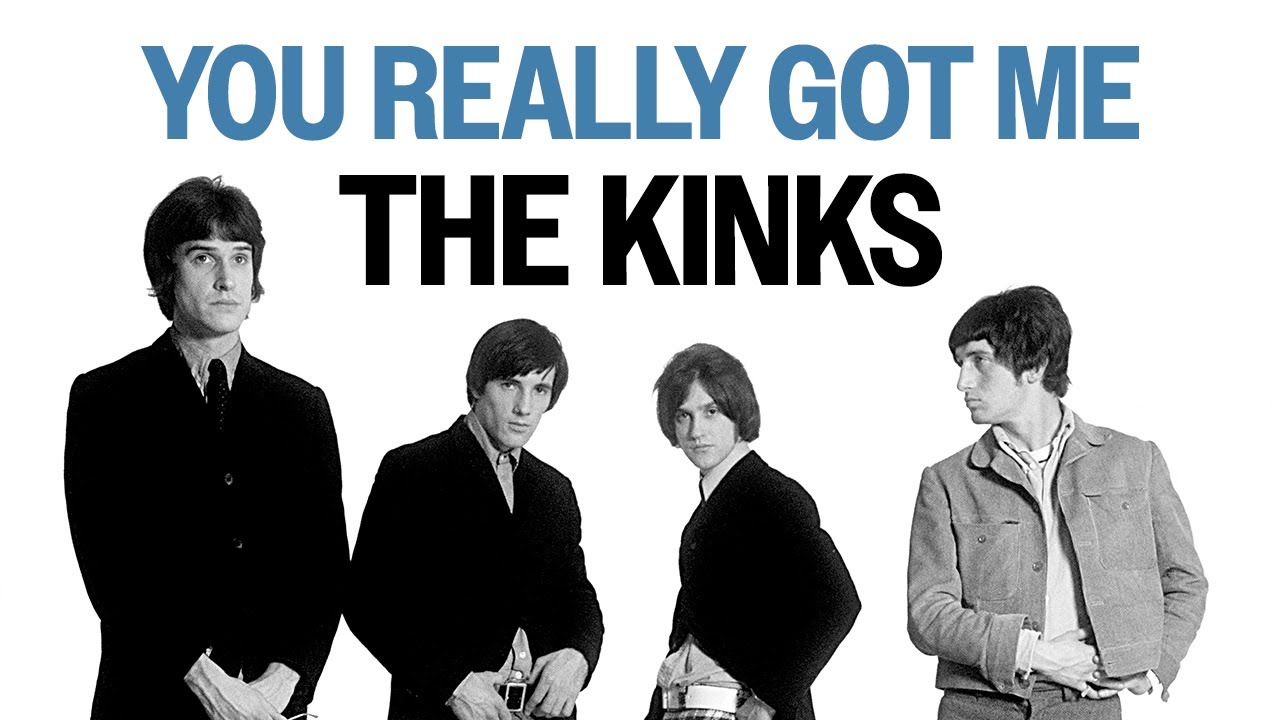
It started with a razor blade. Ray Davies was pissed off, his brother Dave was even more frustrated, and their little Elpico amplifier was about to become the most important victim in rock history. Most people think the heavy, distorted sound of the sixties came from expensive pedals or massive stacks. It didn't. It came from a kid in a North London living room slicing his speaker cone because he wanted a sound that "bit" back.
When You Really Got Me hit the airwaves in 1964, it wasn't just another British Invasion pop song. It was a mechanical failure turned into a masterpiece.
The Kinks weren't even supposed to be the "hard" band. They were art school kids and blues enthusiasts trying to find a lane between the Beatles' harmonies and the Stones' grit. But that two-chord riff? That changed the physics of the electric guitar. If you listen to the track today, it still feels raw. It’s jagged. It feels like it’s trying to punch its way out of the speakers. That’s because, in a very literal sense, it was.
The Secret Geometry of the Power Chord
Before we get into the "Van Halen vs. Kinks" debate that fuels every bar argument in history, we have to look at what You Really Got Me actually did to music theory. It popularized the power chord. Now, guitarists had been playing fifths for years—Link Wray was already making parents nervous with "Rumble" in 1958—but the Kinks took that structural foundation and gave it a repetitive, rhythmic violence.
The riff is simple: G to A. Then A to D. It’s a basic I-IV-V progression at its heart, but the way Dave Davies attacked those strings changed the "swing" of rock into a "stomp."
Most music historians, including Robert Christgau, point to this specific track as the bridge between traditional rhythm and blues and what we now call garage rock. Some even call it the first punk song. Why? Because it proved you didn't need to be a virtuoso. You just needed a grudge and a loud enough box. The distortion wasn't an effect; it was the lead instrument.
That "Green" Amplifier and the Razor Blade
Let’s talk about the Elpico. Dave Davies called it "Little Green." It was a tiny, cheap amp that he plugged into a larger Vox AC30. On its own, the Elpico sounded thin. But Dave took a razor blade and sliced the speaker paper in a series of radial cuts. He even poked it with knitting needles for good measure.
When he played through it, the torn paper vibrated erratically. This created a "fuzz" that no pedal at the time could replicate. Shel Talmy, the producer, knew they had something dangerous. Interestingly, the band actually recorded a "cleaner" version of You Really Got Me first at the insistence of their label, Pye Records. Ray Davies hated it. He supposedly told the label they wouldn't record anything else until they let them do it "the loud way."
They went to IBC Studios in London. They cranked the torn amp. They captured lightning.
The Jimmy Page Myth That Won't Die
You've heard it. Everyone’s uncle swears that Jimmy Page played the lead guitar on You Really Got Me. It’s one of those rock myths that has more lives than a cat.
Jimmy Page was a session musician at the time. He was in the studio for some Kinks sessions. He played rhythm guitar on "Bald Headed Woman" and "I've Been Driving on Bald Mountain." But the solo on You Really Got Me? That’s all Dave Davies.
Dave has been notoriously defensive about this for decades. In his autobiography, Kink, he describes the solo as a moment of pure, unadulterated teenage adrenaline. It’s messy. It’s frantic. It sounds exactly like a nineteen-year-old trying to tear his way out of a room. Jimmy Page himself has cleared this up in multiple interviews, including a famous one with Guitar Player magazine, where he explicitly credited Dave. Yet, the rumor persists because people find it hard to believe a teenager invented the blueprint for heavy metal in his bedroom.
1978: When Eddie Van Halen Reimagined the Beast
If the Kinks invented the riff, Van Halen gave it a jet engine.
When Van Halen released their debut album in 1978, their cover of You Really Got Me did something rare: it made the original feel like a vintage relic while honoring its soul. Eddie Van Halen didn't just play the riff; he used it as a launchpad for "brown sound" experimentation.
The syncopation changed. The Kinks’ version is a straight-ahead gallop. Van Halen’s version is a swing. It’s got that California swagger. Some purists hate it. Ray Davies famously had mixed feelings about it at first, though he later admitted the royalty checks were a nice consolation prize. The Van Halen version is why a whole generation of American kids thought the song was a new metal anthem rather than a British Invasion classic.
Why the Song Still Dominates Search and Playlists
There’s a reason this song appears in every "Top 500 Songs of All Time" list. It’s the "hook."
The lyrics are secondary. "Girl, you really got me goin' / You got me so I don't know what I'm doin'." It’s basic. It’s primal. It’s exactly what every frustrated person feels. But the brilliance lies in the call-and-response between the vocal and the guitar. The guitar isn't just accompanying Ray; it's talking back to him.
From a technical standpoint, the song is a masterclass in tension and release. The way the drums (played by Bobby Graham, not the band's regular drummer Mick Avory, according to session logs) stay slightly behind the beat creates a sense of "dragging" the listener into the groove.
Key Elements That Make It Unique:
- The "muffled" power chords in the intro.
- The sudden, chaotic scream before the solo.
- The use of a "tambourine" to keep the high-end frequency sharp against the muddy distortion.
- The sheer brevity. It’s two minutes and fourteen seconds. It doesn't overstay its welcome. It hits you and leaves.
The Cultural Ripple Effect
Without You Really Got Me, the timeline of music breaks.
Think about it. The Who heard that distortion and pushed it further with "I Can't Explain" (which Shel Talmy also produced, specifically trying to catch the Kinks' vibe). The Stooges built their entire career on that three-chord garage aesthetic. The Ramones basically took the You Really Got Me template and sped it up by 20%.
It's the DNA of the riff.
Honestly, it’s one of the few songs from the early sixties that doesn't sound "quaint." You put on early Beatles, and it sounds like a specific era. You put on You Really Got Me, and it still sounds like someone is about to break a window. That’s the power of intentional distortion.
How to Capture That Sound Today
If you're a musician trying to recreate the magic of the original track, don't go out and buy a $3,000 Axe-FX rig. You’re missing the point. The Kinks' sound was about limitations.
To get that 1964 grit, you need a small tube amp pushed to its breaking point. You need a guitar with P-90 pickups or vintage-voiced humbuckers. But mostly, you need to understand that the "fuzz" isn't supposed to be smooth. It should be "spitty."
In the modern digital workspace, you can use "bit-crushing" or "saturation" plugins, but nothing beats the physical reality of a speaker moving air it wasn't designed to move. Some modern boutique pedal makers, like JHS or EarthQuaker Devices, have tried to clone the "Little Green" sound, but Dave Davies would tell you to just grab a knife and get to work on your own gear. (Maybe don't actually do that to your expensive gear, though.)
The Legacy of the Davies Brothers' Chaos
The relationship between Ray and Dave Davies is legendary for its volatility. They fought on stage. They fought in the studio. They fought in the press.
You Really Got Me is the sound of that friction. It’s a brotherly argument set to music. Ray wrote the song on a piano, originally imagining it as a sort of jazz-infused blues number. Dave was the one who insisted on the guitar-driven aggression. That tug-of-war—between Ray’s melodic sensibilities and Dave’s raw power—is what gave the Kinks their identity.
They weren't "nice" like the Beatles. They weren't "cool" like the Stones. They were "The Kinks." They were weird, they were loud, and they were first.
Actionable Steps for Music Fans and Guitarists
If you want to truly appreciate the impact of this track, do these three things this week:
- A/B the Versions: Listen to the 1964 Kinks original on high-quality headphones, then immediately jump to Van Halen’s 1978 cover. Note the difference in the "swing." The Kinks are on the beat; Van Halen is "behind" it.
- Explore the "Kinked" Discography: Don't stop at the hits. Listen to "All Day and All of the Night" and "Till the End of the Day" to see how they refined the power chord formula they invented.
- Analyze the Production: If you’re a producer, look up Shel Talmy’s engineering notes. He used very few microphones, often just one on the kit and one on the amp. It proves that "big" sounds come from the performance, not the number of tracks in your DAW.
The song remains a staple because it taps into a fundamental human truth: sometimes you just need to make a lot of noise to feel heard. Whether it’s 1964 or 2026, that riff isn't going anywhere. It’s the foundational stone of the temple of rock. If you haven't turned it up until your own speakers start to rattle, you haven't really heard it yet.



