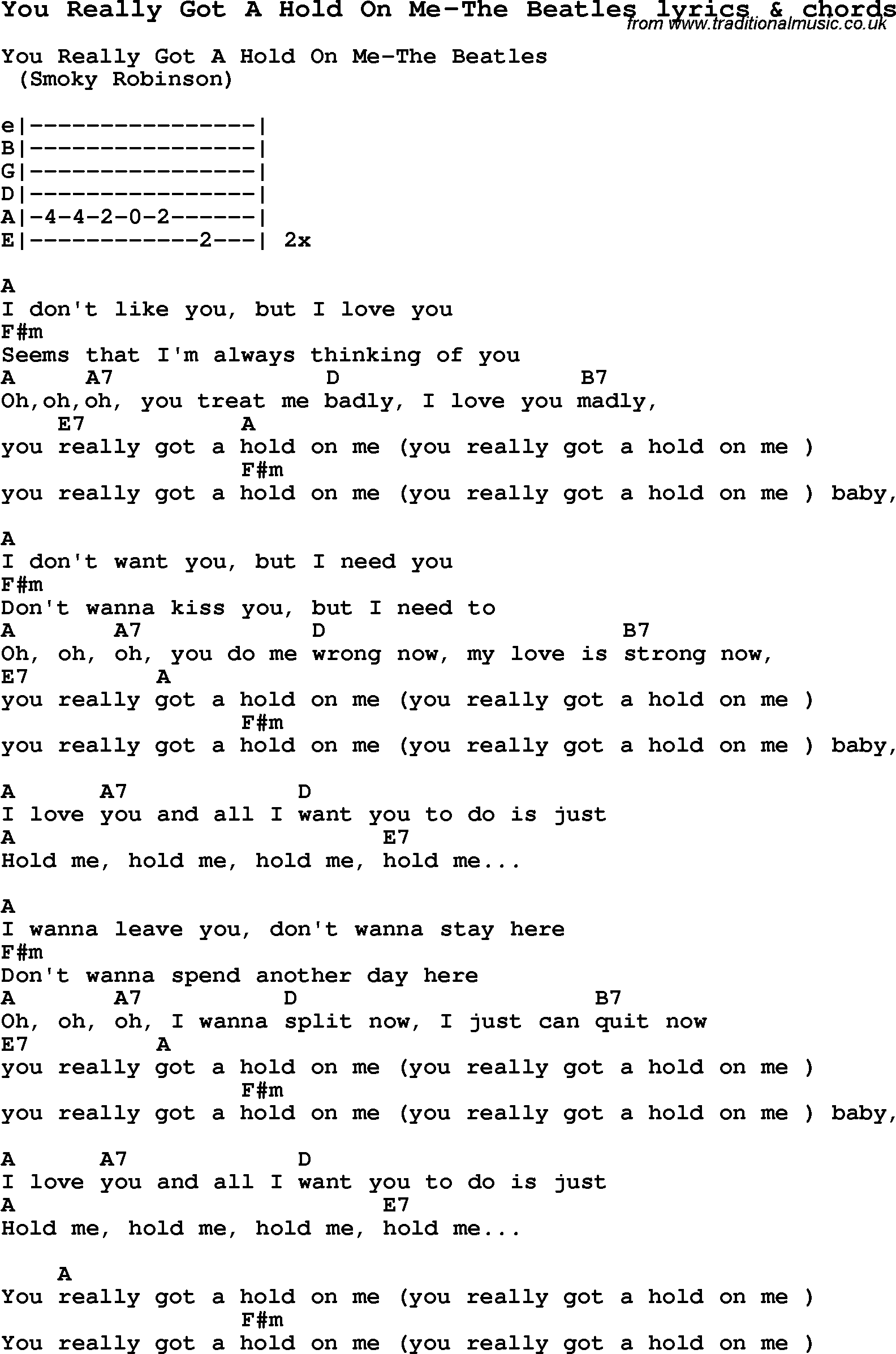
It’s the middle of the night in 1962. Smokey Robinson is lying in a hotel bed in New York City, frustrated. He isn’t there to write a hit; he’s there on business for Motown. But he can’t sleep. Instead, he’s got this Sam Cooke song, "Bring It On Home to Me," looping in his brain like a broken record. He loves the grit of it. He loves the push and pull of a man who knows he’s being treated like dirt but just can’t walk away.
Smokey starts humming. He grabs a pen. He isn’t trying to be poetic or "important." He’s just trying to capture that specific, agonizing feeling of being addicted to a person who is probably bad for your health. By the time the sun came up, the You Really Got a Hold on Me lyrics were born.
The song didn't just become a hit for The Miracles. It became a blueprint. It’s the track that basically convinced the world that Berry Gordy’s "Hitsville U.S.A." was more than just a local Detroit fad. It was soul music with a brain and a broken heart.
The Push-Pull Tension in the Verse
If you look at the opening lines, Smokey does something brilliant. He doesn't start with "I love you." He starts with a complaint. "I don't like you, but I love you." Right there, in the first ten seconds, he defines the entire concept of a toxic relationship before we even had a word for it. It’s honest.
Most love songs in the early sixties were sugary. They were about holding hands at the malt shop or crying at the prom. Smokey went darker. He talks about being "brought to your knees" and being "treated bad." Honestly, the You Really Got a Hold on Me lyrics are kind of a bummer if you actually read them without the upbeat, soulful tempo of the music.
The brilliance lies in the contradiction. The music makes you want to snap your fingers, but the words are a confession of weakness. You’ve got Smokey—one of the smoothest voices in history—admitting he has zero control over his own emotions. He’s telling this woman that he wants to leave her, but he’s "not able." It’s a desperate sentiment wrapped in a velvet melody.
Why the "Tighten Up" Ad-Lib Matters
When they went into the studio to record this, it wasn't supposed to be the "A-side." It was actually the "B-side" to a song called "Happy Landing." But the magic happened during the session. If you listen closely to the recording, you hear that raw, call-and-response energy between Smokey and the rest of The Miracles (Bobby Rogers, Ronnie White, Claudette Rogers Robinson, and Pete Moore).
The way they echo "You treat me bad!" isn't just backup singing. It’s a Greek chorus. They are confirming his misery. Bobby Rogers’ gritty co-lead vocal provides the perfect scratchy contrast to Smokey’s high, pure tenor. That grit is what makes the line "I love you and I want you to/Tighten up that hold on me" feel so visceral.
He isn't asking for a hug. He’s asking to be consumed.
The Beatles and the British Invasion Connection
You can’t talk about this song without talking about John Lennon. In 1963, The Beatles were the biggest thing on the planet, and they were obsessed with Motown. They didn't just like the music; they studied it like a textbook. When it came time to record their second album, With The Beatles, they chose to cover this track.
It’s one of the few times a cover actually rivals the original in terms of emotional weight. Lennon took the You Really Got a Hold on Me lyrics and injected them with a different kind of desperation. While Smokey sounded smooth and resigned, Lennon sounded like he was physically screaming for help.
- Lennon’s vocal delivery on "I love you and I want you to" is famously strained.
- George Harrison and Paul McCartney handled the harmonies, trying to mimic the Miracles' soulful blend but adding a Liverpudlian rock-and-roll edge.
- The Beatles' version helped introduce Motown to a massive white audience in the UK and America, bridging a gap that was still very much a chasm in 1963.
It’s a weirdly full-circle moment. An African-American songwriter in Detroit gets inspired by a gospel-influenced singer like Sam Cooke, then a bunch of kids from Liverpool hear that song and sell it back to the world. That’s how the DNA of pop music works. It’s all a conversation.
A Technical Look at the Songwriting
Smokey Robinson is often called the "Poet Laureate of Soul," and for good reason. Bob Dylan famously called him America's "greatest living poet." You see it in the structure here.
Most songs of that era followed a very strict AABA structure. Smokey plays with that. The chorus is short—almost a chant. "You really got a hold on me." It’s repeated over and over until it feels like a mantra.
- The Internal Rhyme: Notice how he uses internal rhyme schemes like "I don't like you / but I love you." It’s simple, but it sticks.
- The Tempo Shift: The song feels like it’s dragging its feet, intentionally slow and "heavy," which mirrors the feeling of being trapped in a relationship.
- The Resolve: There is no resolution. The song doesn't end with them making up or him leaving. It ends with him begging her to "hold me, squeeze me."
It’s a cycle. A loop of affection and resentment.
The Misunderstood "Hold"
People often think this is a romantic song. They play it at weddings. They dedicate it to their partners.
But if you really sit with the You Really Got a Hold on Me lyrics, it’s actually about a lack of agency. "You do me wrong now / My love is strong now." He’s acknowledging that his love is independent of her behavior. That’s not necessarily a healthy romance; it’s an obsession. It’s the "hold" that’s the problem. The "hold" is a grip. It’s a cage.
Impact on the Motown Sound
Before this song, Motown was struggling to find its footing on the national charts. They had "Shop Around," which was a massive hit, but they needed something to prove they weren't a one-hit-wonder factory.
This track proved that Berry Gordy’s "Assembly Line" could produce art. It wasn't just catchy; it was deep. It had soul. It had the "Funk Brothers" (Motown’s legendary house band) providing a backing track that was sophisticated yet raw. Eddie Willis on guitar and Benny Benjamin on drums created a pocket that allowed Smokey to just float.
The success of the song—it hit the Top 10 on the Billboard Hot 100 and reached Number 1 on the R&B chart—gave Gordy the capital he needed to expand. Without the royalties from this single, we might not have the Supremes, the Temptations, or Marvin Gaye as we know them.
How to Truly Appreciate the Lyrics Today
If you want to get the most out of this song, don't just listen to the radio edit. Find a high-quality mono recording. The stereo mixes of the 60s often panned the vocals to one side and the instruments to the other, which ruins the intimacy.
In mono, Smokey’s voice sits right in the center of your skull. You can hear the slight catch in his throat when he sings the word "please."
- Listen for the Piano: The triplets on the piano are a direct nod to the gospel roots of soul music.
- Watch the Live Footage: There’s an old clip of The Miracles performing this on SCTV or Apollo where you can see the choreography. It’s tight, professional, and yet their faces show the pain of the lyrics.
- Compare the Covers: Check out the version by The Temptations or even the one by Cyndi Lauper. Every artist brings a different flavor of "agony" to the words.
Moving Forward With The Classics
Understanding the You Really Got a Hold on Me lyrics requires you to look past the "oldies" label. This isn't just a museum piece. It’s a living document of how humans have always struggled with the messiness of attraction.
If you're a songwriter, study the way Smokey uses simple words to convey complex feelings. He doesn't use big metaphors. He uses "like" and "love" and "stay" and "go."
For the casual listener, let the song be a reminder that it's okay for music to be uncomfortable. It’s okay for a love song to be about a love you wish you didn't have.
Next Steps for Music Lovers: To dive deeper into this era of songwriting, your next move should be listening to Smokey Robinson’s "The Tracks of My Tears" immediately followed by Sam Cooke’s "Bring It On Home to Me." This will allow you to hear the direct lineage of the "tortured soul" trope that Smokey perfected. Pay close attention to the way the backing vocals act as a second narrator in both tracks.



