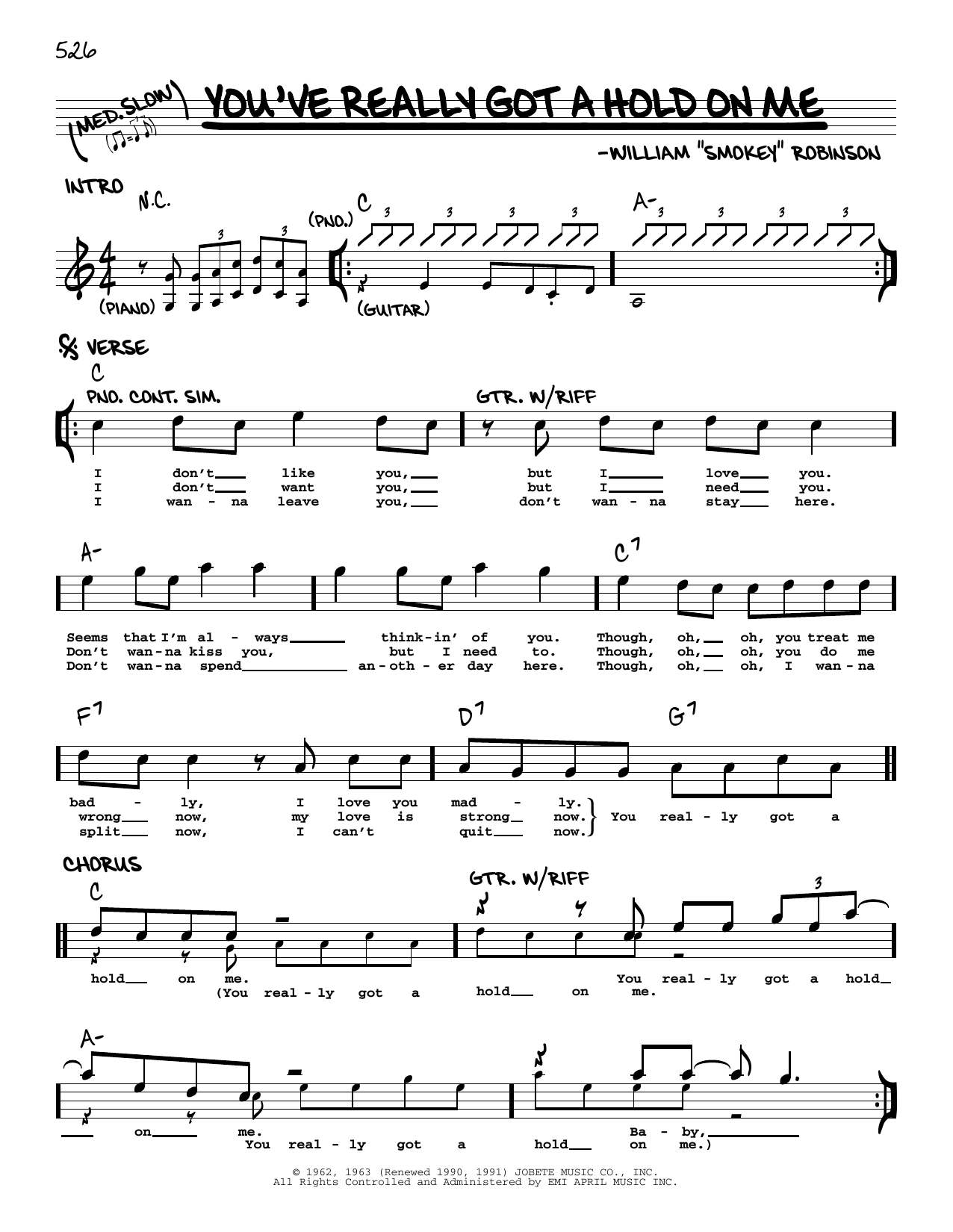
Smokey Robinson was driving. That’s how the story starts. He was headed to a Detroit record distributor, likely preoccupied with the million tiny fires a songwriter-producer has to put out when a label is still basically a startup. Then, a song came on the radio. It was "Bring It On Home to Me" by Sam Cooke. Smokey didn't just hear it; he felt it. The raw, gospel-drenched pleading of Cooke’s delivery hit him so hard he had to pull the car over. Right there, on the side of the road, the skeletal structure of You Really Got a Hold on Me began to take shape in his head.
It wasn't just a song. It was a lifeline.
By 1962, Berry Gordy’s Motown experiment was exciting but precarious. They had hits, sure, but they didn't have the sound fully codified yet. When Smokey Robinson & The Miracles walked into Studio A—the famous "Snakepit"—to record this track, they weren't just making a pop record. They were capturing the exact moment where rhythm and blues turned into the "Sound of Young America."
The Messy Brilliance of the Snakepit Session
Most people think of Motown as a polished assembly line. You’ve seen the photos: the Funk Brothers in sharp suits, the choreographed moves, the pristine mixing. But "You Really Got a Hold on Me" is actually kind of a glorious mess if you listen closely.
The recording took place in November 1962. It wasn't some high-budget affair. In fact, if you listen to the original mono master, there’s a distinct moment where the piano—played by Joe Hunter—seems to almost trip over itself. The vocal arrangement between Smokey and Bobby Rogers is tight, but it has this grainy, urgent quality that later Motown hits sometimes smoothed over.
Smokey’s lyrics are famously contradictory. "I don't like you, but I love you." It's the ultimate toxic relationship anthem before we had a word for that. He’s basically admitting he has no agency. He’s stuck. And the way his voice cracks—that high, silvery tenor—makes you believe he’s actually suffering.
Interestingly, the song was originally the B-side. Motown was pushing a track called "Happy Landing." But DJs, as they often did back then, flipped the record over. They heard that opening guitar riff and the "Waaa-oh-oh" harmony and knew Gordy had picked the wrong horse. By early 1963, it was a Top 10 hit on the Billboard Hot 100 and a number one R&B smash.
Why the Beatles Covered It (And Why It Matters)
You can't talk about "You Really Got a Hold on Me" without talking about the Fab Four. In 1963, the Beatles were obsessed with Motown. They were essentially a cover band of American R&B and girl groups at the time.
John Lennon took the lead vocal on their version for the With the Beatles album. It’s fascinating. While Smokey sounds wounded and desperate, Lennon sounds aggressive. He sounds annoyed that he’s in love.
But here is the factual nugget people miss: the Beatles' cover did more for Smokey Robinson’s bank account and Motown’s global reputation than almost any marketing campaign Berry Gordy could have dreamed up. It proved that Smokey’s songwriting wasn't just "race music" (the terrible industry term of the era). It was universal. It was sophisticated.
The Anatomy of the Hook
What makes it work? Why does it still get played at weddings and in grocery stores sixty years later?
Basically, it’s the tension.
The song is built on a "call and response" structure that stays true to Smokey’s Baptist church roots. When he sings "I want to leave you," and the Miracles shout back "Don't want to stay here," it creates a psychological tug-of-war.
- The Opening Riff: That descending piano and guitar line is instantly recognizable. It sets a mood of melancholy.
- The Harmony: Bobby Rogers didn't just sing backup; he tracked Smokey’s lead so closely they almost sound like one person with a fractured psyche.
- The Rhythm: It’s a 6/8 shuffle, a time signature that feels like a slow dance where someone is stepping on your toes but you don't want to let go.
The lyrics are surprisingly sparse. Smokey doesn't use big words. He uses "tight" and "grip" and "hold." He’s a poet, but he’s a poet of the gut.
The Song That Defined the "Smokey Sound"
Before this track, Smokey was writing catchy stuff like "Shop Around." It was cute. It was upbeat. But "You Really Got a Hold on Me" introduced the world to "The Poet Laureate of Soul."
Bob Dylan famously called Smokey America’s "greatest living poet." While some debate if Dylan actually said those exact words in a specific interview or if it’s a bit of rock and roll apocrypha, the sentiment stuck because it felt true. Smokey brought a level of emotional literacy to pop music that didn't really exist before him.
He wrote about the embarrassment of love. Most songs were about "I love you, baby." Smokey wrote about "I love you, baby, and it’s actually ruining my life."
The Financial Turning Point for Motown
Let’s get into the business side for a second, because that's where the real impact lies. In 1962, Motown was struggling with cash flow. Hits were coming, but the overhead of running a studio, a touring circuit (The Motortown Revue), and a distribution arm was eating every penny.
"You Really Got a Hold on Me" was a massive crossover success. It stayed on the charts for 18 weeks. That kind of longevity provided the "float" Motown needed to invest in other artists like Marvin Gaye and a young kid named Stevland Hardaway Judkins (Stevie Wonder).
Without the royalties from Smokey’s 1962-1963 run, the Motown we know today—the one with the velvet suits and the global empire—might have folded before it ever really took off.
Common Misconceptions About the Track
I see people all the time attributing the song to other artists first. No, it wasn't the Beatles. No, it wasn't The Temptations (though they did a great version later).
Another big one: people think it was recorded with a full orchestra. Nope. That’s just the Funk Brothers making a small room sound like a cathedral. The "strings" you think you hear are often just the way the vocal harmonies are stacked to create a shimmering wall of sound.
And honestly, some people think Smokey wrote it for someone else. He didn't. He wrote it for the Miracles, but he wrote it because he was chasing the ghost of Sam Cooke. He wanted that "sweet soul" feel, and he ended up creating something entirely new.
Actionable Takeaways for Music History Buffs
If you want to truly appreciate this track beyond just humming along, you’ve got to do a few things.
- Listen to the Mono Mix: Avoid the early stereo "re-channeling" where the vocals are panned hard to one side. It kills the power. Find the original mono version where the kick drum and Smokey’s voice are right in the center of your skull.
- Compare the "Live at the Apollo" Version: There is a 1963 live recording that shows just how much faster and more energetic the Miracles were in person compared to the "polite" studio versions.
- Study the Lyrics as Poetry: Read the lyrics without the music. Notice the lack of filler. Every line serves the central metaphor of being "held" against one's will.
- Track the Influence: Listen to "You Really Got a Hold on Me," then listen to any Amy Winehouse ballad or Leon Bridges track. You can hear the DNA of Smokey’s phrasing in almost every modern soul singer.
The song remains a masterclass in economy. It doesn't overstay its welcome. It clocks in at under three minutes and tells a complete story of human frailty. It reminds us that sometimes, the best art comes from being so moved by someone else's work—like Smokey was with Sam Cooke—that you have no choice but to pull over and start writing.
To fully grasp the evolution of the Motown sound, your next step should be listening to the 1962 Miracles album The Fabulous Miracles in its entirety. It captures the transition from the group's doo-wop roots into the sophisticated soul that would dominate the rest of the decade. Pay close attention to "A Love She Can Count On"—it’s the logical successor to "Hold on Me" and shows Smokey doubling down on his role as the label’s primary emotional architect.



