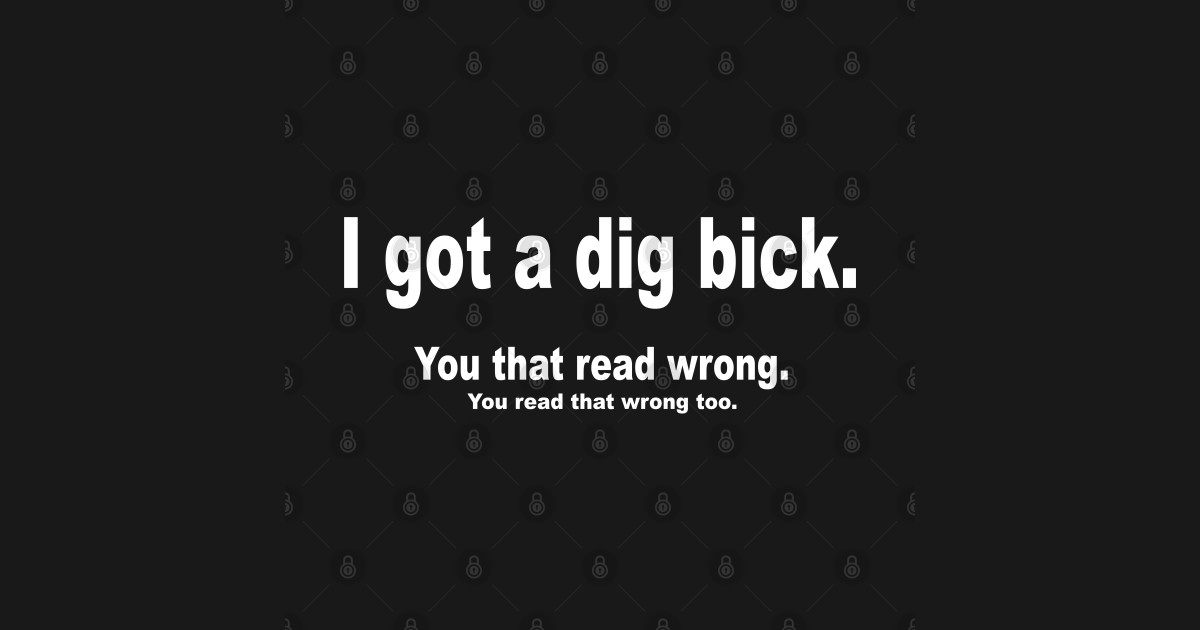
Your brain is a liar. It’s also incredibly efficient. Right now, as you look at the words on this screen, you aren't actually reading every single letter. You’re scanning. You're predicting. Your eyes are jumping across the line in little skips called saccades, and your brain is filling in the gaps based on what it expects to see. This is exactly why you read that wrong—whether it was a text from your boss that sounded way meaner than they intended, or that viral internet meme where the words are scrambled but you can still understand them perfectly.
It’s kinda wild when you think about it. For another view, check out: this related article.
Human beings are pattern-recognition machines. We have evolved to prioritize speed over accuracy because, back in the day, figuring out if a shape in the bushes was a tiger half a second faster meant the difference between life and death. In the modern world, that same shortcut-heavy processing leads to typos, misunderstood emails, and those embarrassing "wait, that's not what that said" moments.
The Science of Why You Read That Wrong
The technical term for this is "top-down processing." Instead of building a concept from the ground up—looking at the letter 'A', then 'P', then 'P', then 'L', then 'E'—your brain sees the context of a fruit bowl and just assumes "Apple." You’re not reading; you’re hallucinating a reality that makes sense. Related coverage on the subject has been provided by The Spruce.
Dr. Rayner, a pioneer in eye-tracking research at the University of Massachusetts, spent years proving that we only see about 7 to 9 letters in sharp focus at any given moment. Everything else in our peripheral vision is a blurry mess that our brain "paints" in. If the context suggests a certain word, that’s what you’ll see. Even if the word is actually something else entirely.
Honestly, we’re all just guessing.
Have you ever seen those paragraphs where the first and last letters of every word are correct, but the middle is a total disaster? You can still read it perfectly fine. This is known as "typoglycemia." It works because we don't read words letter-by-letter, but as a whole shape (a theory known as Word Superiority Effect). If the "shape" of the word matches what we expect, our internal editor just hits the "approve" button and moves on. We’re lazy. Our brains want to save calories, and processing every phoneme is metabolically expensive.
The Role of Expectation and Mood
Your emotional state is a huge factor in why you read that wrong. If you’re stressed, your brain is primed for threats. A neutral "We need to talk" becomes "You're fired." If you’re excited, you might skip over the "not" in "This is not a confirmation of your prize."
It’s called "expectancy bias."
We see what we want to see, or what we fear seeing. This is why proofreading your own work is basically impossible. Because you already know what you meant to write, your brain overlays that internal map onto the actual text on the page. You’ll look right at a double "the" and your mind will simply delete the second one to save you the trouble of noticing the mistake. You are literally blind to your own errors because your brain thinks it has already finished the task of understanding.
Famous Examples That Everyone Got Wrong
Culture is full of these "wait, what?" moments. Take the "Mandela Effect," for example. People swear they remember the Berenstain Bears being spelled with an "e" (Berenstein). They didn't just mishear it; they read the name on the covers of dozens of books and their brains "corrected" it to the more common "stein" suffix.
Then there’s the "Luke, I am your father" line from Star Wars. He never actually says that. The line is "No, I am your father." But because the brain wants a clean, self-contained sentence for a memory, it rewrites the script.
The Misreadings That Changed History
Misreading isn't just about memes or kids' books. It has real-world consequences. In 1945, during World War II, the Japanese word mokusatsu was used in a response to the Potsdam Declaration. It was intended to mean "withholding comment" or "taking time to think." However, it was translated by some as "to ignore with contempt." Many historians argue this specific linguistic misreading—this instance where someone read the intent wrong—contributed directly to the decision to use atomic weapons.
One word. Two vastly different meanings.
Digital Fatigue: Why It's Getting Worse
We are reading more than ever, but we are doing it worse. Scrolling through TikTok captions or "skimming" articles (maybe even this one!) trains the eye to look for keywords rather than syntax.
Basically, we’ve become "F-pattern" readers.
Studies by the Nielsen Norman Group show that people online tend to read in a shape that looks like the letter F. They read the top line, then halfway across the second line, then they just scan down the left side. You’re almost guaranteed to miss the nuance in the middle of a paragraph. If the "meat" of the argument is in the third sentence of a long block of text, there’s a high statistical probability you read that wrong—or didn't read it at all.
This digital exhaustion leads to "semantic satiation" too. That’s when you look at a word so many times it loses all meaning and starts to look like a weird collection of shapes. It happens when you're tired. It happens when you're over-caffeinated. It happens because your brain's neurons are firing so fast they stop communicating the "definition" and just report the "image."
How to Stop Being Tricked by Your Own Eyes
You can’t completely "fix" how your brain works, but you can throw a wrench in its shortcuts. If you’re doing something high-stakes—like signing a contract or sending a spicy email—you have to break the pattern-recognition loop.
One of the most effective ways to avoid a situation where you read that wrong is to change the font. Seriously. If you change a document from Arial to Comic Sans or a weird cursive font, your brain can't use its "map" of the text anymore. It’s forced to slow down and actually process the characters.
Another trick? Read it backward.
When you read from the last word to the first, you strip away the context. You aren't looking for a story anymore; you're looking at individual units of data. It’s the only way to catch those pesky double words or missing "nots."
The Power of Reading Aloud
Your ears are often smarter than your eyes. When you read aloud, you’re engaging a different part of the brain—the temporal lobe—which processes auditory information. If a sentence is clunky or a word is missing, your ears will catch the "rhythm" break that your eyes skipped over.
- Slow the hell down. If it’s important, it’s worth the extra four seconds.
- Use a physical guide. Use your finger or a pen to underline as you read. This forces your eyes to stay on the current word instead of jumping ahead.
- Take a break. If you’ve been looking at a screen for an hour, your "prediction engine" is in overdrive. Look at a distant object for 20 seconds to reset your focus.
- Change the medium. Print it out. Something about the tactile nature of paper and the way light reflects off it (instead of being projected from a screen) changes how we process information.
The Actionable Bottom Line
The next time you realize you read that wrong, don't feel stupid. Your brain was just trying to be a high-performance machine. To fight back, you have to embrace being "inefficient."
Stop skimming. Change the font on your important drafts to something ugly so you’re forced to focus. Read your emails out loud before hitting send. Most importantly, acknowledge that your first impression of a text is often a "best guess" rather than a factual recording. By slowing down the input, you ensure the output actually matches reality.