It starts with a simple, almost skeletal violin melody. Then comes the voice. By the time the choir kicks in for the final chorus, most people are either reaching for a tissue or feeling like they could sprint up a mountain. Honestly, the You Raise Me Up song lyrics have become a sort of global emotional shorthand for resilience. It’s played at funerals. It’s played at weddings. It’s played at Olympic ceremonies. But if you think this was just another slickly produced pop hit designed in a lab, you’re actually pretty far off the mark.
The song’s history is weirder and more "accidental" than its polished radio presence suggests. Meanwhile, you can explore related stories here: The Media Anatomy of Celebrity Health Revelations: Quantifying the Clarkson Disclosure Function.
The Secret Irish-Norwegian DNA of the Lyrics
Most people associate the song with Josh Groban’s booming baritone or Westlife’s boy-band harmonies. However, the soul of the track belongs to a duo called Secret Garden. Rolf Løvland, the Norwegian composer, originally wrote the melody as an instrumental piece titled "Silent Story." He felt it had a spiritual weight that notes alone couldn't carry.
Enter Brendan Graham. To understand the complete picture, we recommend the excellent analysis by Entertainment Weekly.
Løvland reached out to the Irish novelist and songwriter after reading one of Graham's books. He didn't want a typical "I love you, baby" pop song. He wanted something that felt ancient. Graham sat down and penned the You Raise Me Up song lyrics in what was essentially a burst of inspiration that tapped into the "Celtic Soul" tradition.
The structure is intentionally simple. It doesn't use complex metaphors or high-concept poetry. It uses foundational imagery: sitting in silence, walking on stormy seas, standing on mountains. That’s why it works. It’s big. It’s broad. It’s deeply relatable because it doesn't get bogged down in the specific details of why you’re down—just the feeling of being lifted back up.
Is it a Religious Song?
This is the big debate. If you look at the lyrics, the word "God" never actually appears. Not once.
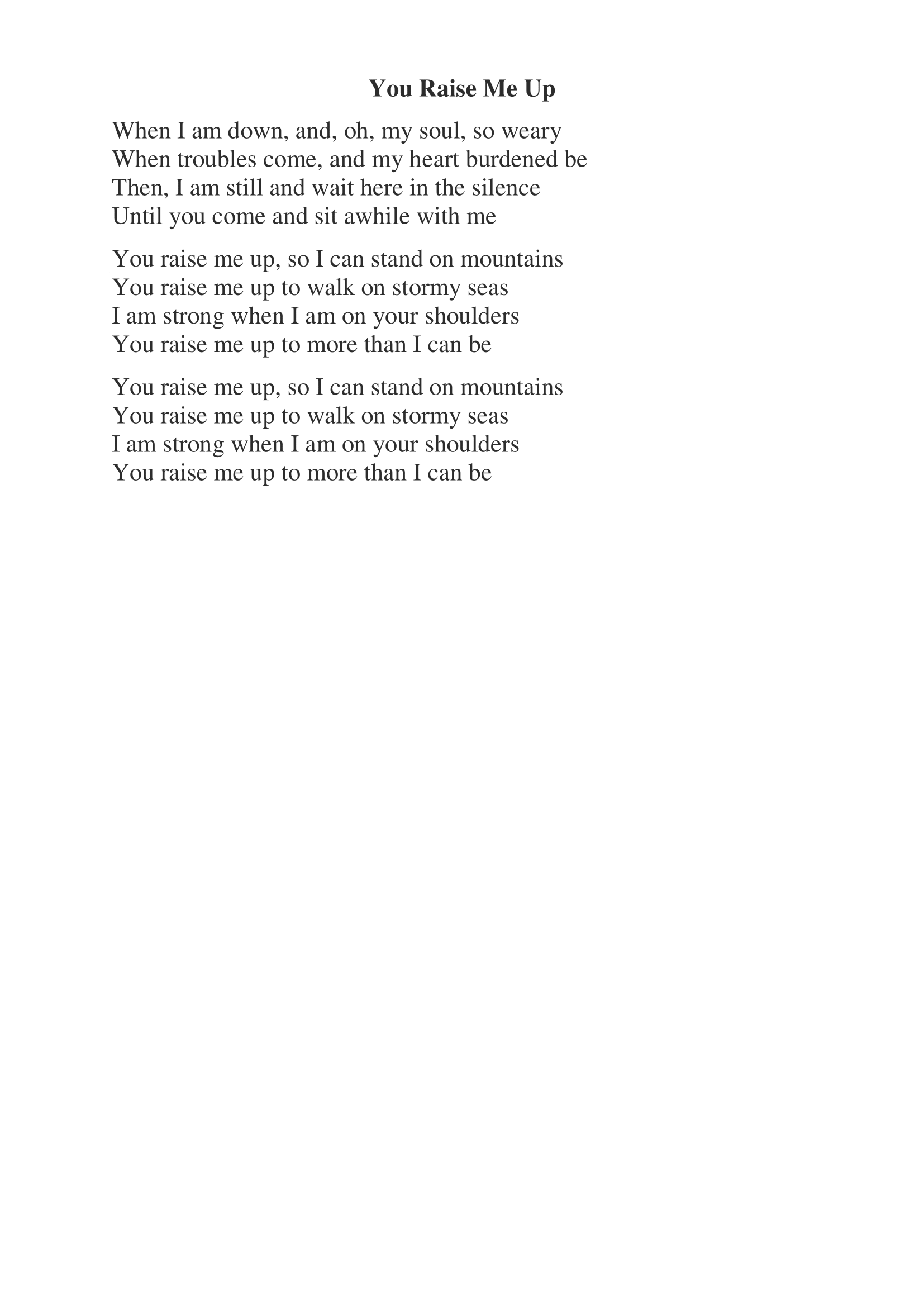
"You raise me up, so I can stand on mountains; You raise me up, to walk on stormy seas;"
Grammatically and lyrically, the "You" is whoever the listener needs it to be. For many, it’s a prayer. For others, it’s a tribute to a mother, a partner, or a mentor. This ambiguity is the secret sauce of its longevity. According to musicologist reports on copyright and licensing, the song has been covered over 125 times, often by contemporary Christian artists like Selah, but its secular appeal remains massive because it functions as a "choose your own adventure" for emotional catharsis.
The Josh Groban Effect and the 9/11 Connection
The song might have stayed a niche "New Age" track if not for a series of events in the early 2000s. David Foster, the legendary producer, heard the Secret Garden version and saw its potential for a young, rising star named Josh Groban.
Groban was hesitant at first. He reportedly thought it sounded like a church hymn. But Foster pushed. When Groban's version dropped in 2003, the timing was pivotal. The United States was still reeling from the emotional aftermath of 9/11 and the beginning of the Iraq War. The You Raise Me Up song lyrics provided a secular liturgy for a grieving nation.
It wasn't just a hit; it was a phenomenon. Groban performed it at the Super Bowl XXXVIII tribute to the NASA Space Shuttle Columbia crew. That performance cemented the song’s status as the "go-to" anthem for collective mourning and recovery.
Why the Lyrics Actually Work (Musically Speaking)
There’s a technical reason why the words feel so powerful. It’s the "climb."
The song starts in a low, almost whispered register.
- "When I am down and, oh my soul, so weary..."
- "When troubles come and my heart burdened be..."
The lyrics use long, open vowel sounds ("soul," "weary," "be"). These are physically easier to sing with resonance, creating an immediate sense of intimacy. Then, as the chorus hits, the key changes. This is the "truck driver gear change" in music theory. The song literally raises its pitch as the lyrics talk about being raised up. It’s a literal manifestation of the words in the frequency of the music.
If you look at the 2005 Westlife cover—which went straight to Number 1 in the UK—they maximized this by adding a full gospel choir. By the third chorus, the lyrics are being shouted-sung by dozens of voices. It mimics the feeling of a community coming around a single person to lift them. It’s basic psychology wrapped in a melody.
Common Misconceptions
People often think the song is a traditional folk tune. It’s not. It’s only 24 years old (written in 2001). However, Løvland has admitted that the melody shares a "musical scent" with the traditional Londonderry Air (the tune for "Danny Boy"). This was actually the subject of some legal scrutiny, but the consensus in the music industry is that while it evokes that Irish tradition, it is a distinct, original work.
Another mistake? Thinking it’s a Westlife original. While their version is iconic in Europe, they were essentially covering a cover of a cover.
The Global Impact of These Words
The song has traveled further than almost any other track of the 21st century. In South Korea, it’s a staple for students during high-stress exam seasons. In Iceland, it’s been translated and used as a literal hymn.
The You Raise Me Up song lyrics have been used to:
- Commemorate the victims of the 2004 Indian Ocean tsunami.
- Celebrate Nelson Mandela’s 91st birthday.
- Soundtrack thousands of graduation montages every single June.
The simplicity of the language allows it to be translated into dozens of languages without losing the "meat" of the message. Whether it’s in Mandarin, Spanish, or Dutch, "standing on a mountain" is a universal image for overcoming a struggle.
How to Truly Experience the Song
If you’re looking at these lyrics because you’re going through a rough patch, don’t just read them. Listen to the evolution.
Start with the original Secret Garden version featuring Brian Kennedy. It’s haunting and sparse. It feels lonely. Then, move to the Groban version to feel the orchestral swell. Finally, check out the Niall Horan and Post Malone "informal" mentions or covers that pop up on social media to see how the song continues to live in the "real world."
Practical Takeaways for Using the Song
If you are planning to use this song for an event or personal project, keep these nuances in mind:
- For Memorials: Stick to the piano or acoustic versions. The lyrics are powerful enough that they don't need a 40-piece orchestra to feel "heavy."
- For Motivation: The Josh Groban version is the gold standard for that "power-up" feeling.
- For Analysis: Look at the "Selah" version if you want to see how the lyrics can be shifted toward a more overtly religious context through vocal inflection and video imagery.
The reality is that You Raise Me Up song lyrics are a masterclass in "less is more." They don't try to be clever. They try to be true. In a world of complex, fast-paced pop music, there is something deeply grounding about a song that just admits, "Hey, I’m tired, and I need a hand."
To get the most out of the song's impact, compare the lyrical phrasing of the verses against the explosive nature of the chorus. Notice how the verses focus on the "I" (the individual struggle), while the chorus focuses on the "You" (the source of strength). That pivot is exactly why the song remains a staple of the human experience.
Check the official sheet music or verified lyric providers like LyricFind or Genius if you're planning a public performance, as some choral arrangements slightly alter the "burdened be" line to fit modern grammar, though the original 2001 phrasing remains the most authentic version of Graham's vision.



