You’ve heard it at a wedding. You’ve definitely heard it at a funeral. Maybe you heard it during a late-night scrolling session when you just needed a win. The You Raise Me Up song lyrics are basically the musical equivalent of a warm blanket, but honestly, most people have no clue where they actually came from. It wasn't written for Josh Groban. It wasn't even written for a solo singer. It’s a song with deep roots in Irish traditional music and a surprisingly complicated history that involves a legendary Norwegian-Irish duo and a poem that almost nobody remembers.
Music is weird. Sometimes a song just sits there, gathering dust, until the right voice touches it. When Brendan Graham wrote the words and Rolf Løvland composed the melody, they weren't trying to create a global anthem that would be covered over 125 times. They were just trying to finish a piece for their group, Secret Garden.
The Surprising Origin of the You Raise Me Up Song Lyrics
Back in 2001, Rolf Løvland was feeling the weight of his own compositions. He had this melody—originally titled "Silent Story"—which felt like it was searching for a soul. He reached out to Brendan Graham, an Irish novelist and songwriter, after reading one of Graham’s books. This wasn't a corporate boardroom decision. It was a creative hunch.
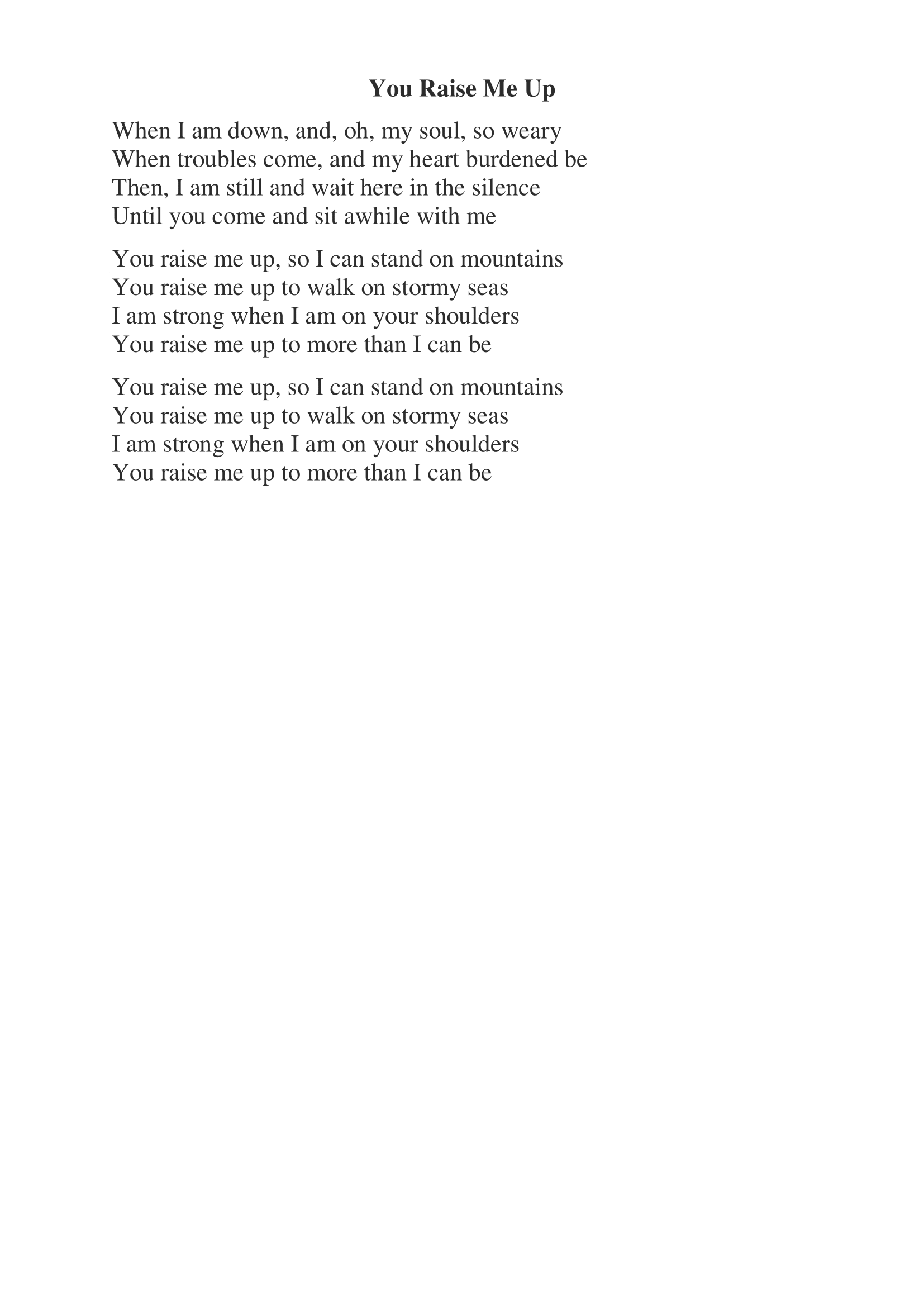
Graham wrote the You Raise Me Up song lyrics in a way that feels almost biblical without being explicitly religious. That’s the secret sauce. "When I am down and, oh my soul, so weary; When troubles come and my heart burdened be." It’s relatable. It’s heavy. It’s the feeling of being stuck in the mud. Then comes the shift. The "standing on mountains" part isn't just a metaphor; it's a visceral reaction to support.
Interestingly, the melody is heavily inspired by an old Irish tune called "Londonderry Air," which most of us recognize as "Danny Boy." If you hum them side-by-side, you’ll hear the ghost of the old Irish hills in the progression. It’s that DNA of ancient longing that makes the lyrics feel like they’ve existed forever, even though they’re barely twenty years old.
Why Josh Groban’s Version Changed Everything
Let’s be real. If Josh Groban hadn’t covered it in 2003, we might not be talking about it today. Brian Kennedy sang the original version for Secret Garden, and it was a minor hit in the UK and Ireland. But Groban? He took it to a different stratosphere. David Foster, the legendary producer, heard the song and knew it fit Groban’s operatic pop style like a glove.
The lyrics didn't change, but the delivery did. When Groban hits that final "to more than I can be," the orchestration swells in a way that feels like a literal lifting of the spirit. It stayed at #1 on the Adult Contemporary charts for weeks. It became the song people played when they were grieving, when they were graduating, or when they were celebrating NASA’s STS-107 Columbia crew. It stopped being a song and became a utility.
Breaking Down the Meaning: It’s Not Just About God
People argue about this constantly. Is it a hymn? Is it a love song? Is it a tribute to a parent?
Honestly, it’s all of them. The brilliance of the You Raise Me Up song lyrics lies in their ambiguity. "You raise me up, so I can stand on mountains." The "You" is never defined.
- For the religious: It’s a direct address to a higher power providing strength during trials.
- For the secular: It’s a thank-you note to a mentor, a spouse, or a friend who showed up when things got dark.
- For the grieving: It’s a way to honor someone who left a legacy of strength.
There is a psychological phenomenon called "frisson"—those chills you get when music hits a certain peak. This song is engineered for frisson. The lyrics build a narrative of vulnerability ("I am still and wait here in the silence") before exploding into a chorus of empowerment. It mirrors the human experience of overcoming. We all start in the silence, and we all want to end up on the mountain.
The Westlife Effect and Global Dominance
If Groban conquered America, Westlife conquered the rest of the world. In 2005, the Irish boy band released their version, and it went straight to #1 in the UK. This version added a more pop-centric, "boy band" soaring harmony that appealed to a younger demographic. It’s kind of wild to think about a song being a hit for a classical-crossover artist and a pop group within two years of each other.
Westlife’s take solidified the You Raise Me Up song lyrics as a staple of reality TV. If you watched X-Factor or American Idol in the mid-2000s, you couldn't escape it. Every contestant with a big voice tried to tackle it. Some failed miserably because they focused on the high notes instead of the "soul weary" part of the first verse. You can't have the mountain without the valley.
Common Misconceptions and Legal Tussles
You might have heard rumors that the song was plagiarized. In 2018, the estate of Icelandic songwriter Jóhann Helgason claimed the song sounded too much like "Söknuður." They even took it to court. However, the courts eventually ruled in favor of Løvland and Graham. Musicologists pointed out that the chord progressions and melodic structures are fairly common in folk music, especially given the shared heritage of European folk melodies.
Another myth is that it was written for a specific tragedy. It wasn’t. It was written as a piece of art that luckily found its way into the hearts of people during tragedies. Brendan Graham has often spoken about how the lyrics seemed to "flow through him" rather than being meticulously constructed. That’s usually how the best ones happen.
How to Truly Appreciate the Lyrics Today
If you really want to feel the impact of the You Raise Me Up song lyrics, stop listening to the radio edits. Find a live performance—specifically the one Secret Garden did with Brian Kennedy at the 2002 Nobel Peace Prize concert. Or watch Groban perform it live with a full gospel choir.
The lyrics work best when they aren't rushed. "There is no life—no life without its hunger; Each restless heart beats so imperfectly." That’s a heavy line. It acknowledges that being human is messy. It’s not a "everything is sunshine" kind of song. It’s a "life is hard, but I’ve got help" kind of song. That nuance is why it doesn't feel cheesy to people who are actually going through a hard time.
Actionable Takeaways for Music Lovers
If you're looking to explore more music that carries the same weight or if you want to use this song for an event, keep these points in mind:
- Check out the "Londonderry Air": Listen to a pure instrumental version to hear the "bones" of the melody.
- Context matters: If you're using this for a video or a ceremony, the Josh Groban version is best for "grandeur," while the Secret Garden version is better for "intimacy."
- Read Brendan Graham’s poetry: His ability to weave Celtic mysticism with modern sentiment is rare. It helps you understand the DNA of the lyrics.
- Don't overplay it: Like any powerful anthem, it can lose its punch if it becomes background noise. Save it for the moments when you actually need to feel raised up.
The enduring power of these words isn't in their complexity. It’s in their simplicity. We all get tired. We all have "restless hearts." And occasionally, if we're lucky, someone or something comes along to help us stand on those mountains. That is the legacy of this song. It’s a three-minute reminder that we don't have to carry the heavy stuff alone.



