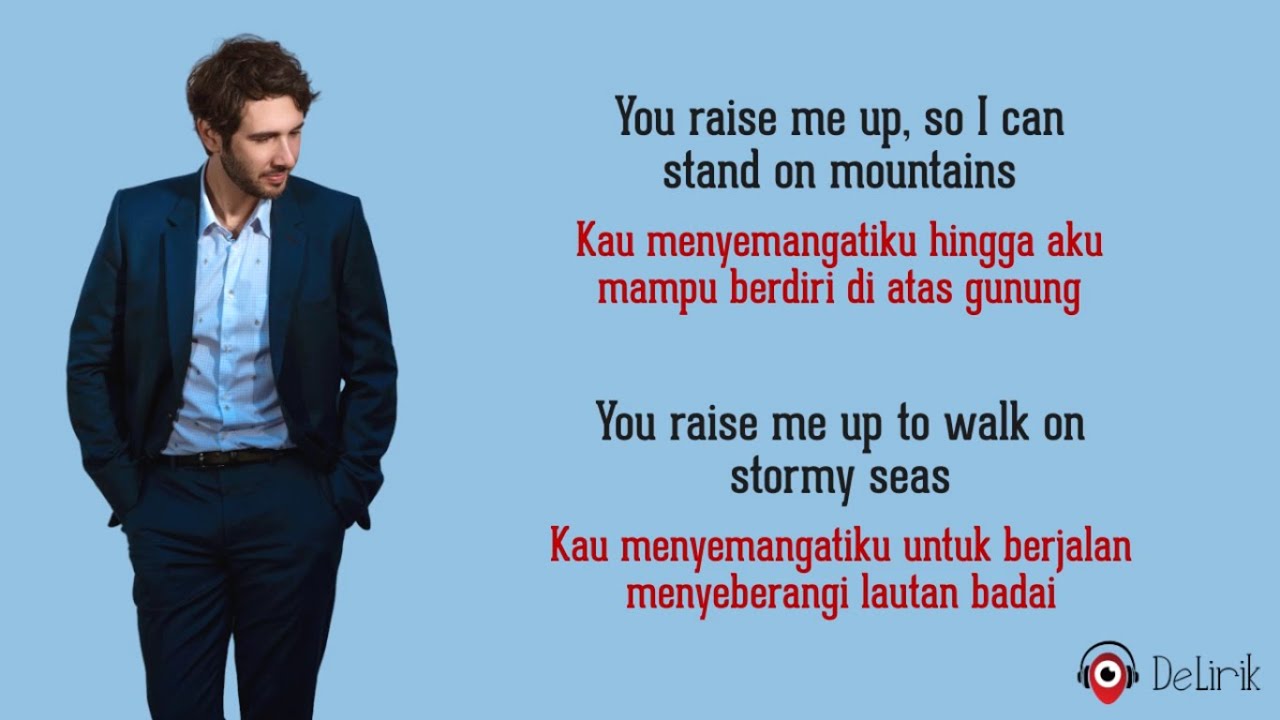
You’ve heard it at a funeral. You’ve heard it at a wedding. Maybe you heard it during a late-night scrolling session on YouTube when you just needed to feel something. You Raise Me Up lyrics have this weird, almost supernatural ability to make even the most cynical person feel a lump in their throat. It isn't just a song; it’s a global phenomenon that has been covered by over a hundred artists, from Josh Groban to Westlife to Selah.
But here’s the thing: most people actually get the history of this song totally wrong. They think it’s a centuries-old hymn or something written specifically for a talent show finale. It’s not. It’s actually a relatively modern piece of music with a messy, fascinating history that involves Irish-Norwegian collaborations and a whole lot of legal drama that most fans never even hear about.
Where Did These Lyrics Actually Come From?
It started in 2001. Rolf Løvland, the keyboardist for the Irish-Norwegian duo Secret Garden, sat down and wrote an instrumental piece called "Silent Story." He felt like the melody had a sort of spiritual, Celtic soul to it. He wasn't wrong. If you listen closely to the melody, it sounds suspiciously like "Londonderry Air," which most of us know as "Danny Boy."
Løvland knew the song needed words. He approached Irish novelist and songwriter Brendan Graham after reading one of Graham's novels. The result was the You Raise Me Up lyrics we know today. It was originally performed by Brian Kennedy on Secret Garden's Once in a Red Moon album. Funnily enough, it was only a minor hit in Ireland and Norway at first. It didn't become a "thing" until it crossed the Atlantic.
The Josh Groban Effect
If we’re being honest, the version everyone hums in the shower is the 2003 Josh Groban cover. David Foster, the legendary producer, heard the song and realized it was a perfect fit for Groban’s "operatic pop" vibe. Groban’s version went to #1 on the Adult Contemporary charts and stayed there for what felt like forever.
Why did it work? It’s the buildup. The lyrics start in a place of total exhaustion. "When I am down and, oh my soul, so weary." It’s relatable. Everyone has felt that heavy, soul-deep tiredness where you just can't move. The song mirrors the emotional arc of coming out of a depression or a trial, ending in that massive, soaring crescendo that feels like a literal weight lifting off your chest.
Breaking Down the Meaning: Is It Religious?
This is a huge point of contention. Is it a hymn? Is it a love song? Is it a secular "hang in there" anthem?
The answer is: yes.
Brendan Graham wrote the You Raise Me Up lyrics to be intentionally ambiguous. By using the phrase "You raise me up," the "You" can be whoever the listener needs it to be. For a religious person, it’s clearly God. For a kid, it’s a parent. For someone in a relationship, it’s their partner. This "blank canvas" songwriting is exactly why the song works in so many different contexts.
- At Funerals: It’s a song about the strength the deceased gave to the living.
- At Graduations: It’s a thank you to teachers and mentors.
- In Church: It’s a contemporary worship anthem.
Honestly, the simplicity is the genius. There are no complicated metaphors about metaphors. It’s just: I was down, you helped me, now I can stand on mountains. It’s direct. It’s visceral.
The Controversy: Was It Stolen?
You can't talk about this song without mentioning the "Danny Boy" elephant in the room. The estate of the composer of "Londonderry Air" didn't sue, mostly because that melody is in the public domain, but others did.
In 2007, an Icelandic songwriter named Johann Helgason claimed the song was a copy of his 1977 work "Söknuður." When you play them side-by-side, the resemblance is... striking. It’s one of those moments in music history where the line between "inspiration" and "infringement" gets really blurry. The Icelandic Performing Rights Society even did an analysis suggesting the songs were 97% mathematically identical. However, legal battles in these cases are notoriously difficult to win because basic melodic structures are limited. The case didn't result in the song being stripped from the charts, but it’s a reminder that no art is created in a vacuum.
Why We Can't Stop Listening
There is actual science behind why these specific lyrics and melodies trigger us. Musicologists often point to the "ascending scale" used in the chorus. As the notes go higher, our heart rate often increases slightly. Our brains are hardwired to associate rising pitches with rising emotions—hope, victory, or relief.
When the choir kicks in during the second chorus—which is a staple of almost every version—it triggers a "collective effervescence." That’s a fancy sociological term for when a group of people feels the same intense emotion at once. It’s why this song is a staple on X-Factor and American Idol. It’s a cheat code for emotional resonance.
Variations That Actually Matter
While Groban is the king, Westlife’s version in 2005 took the song to a different level of pop saturation in the UK. Their version is a bit "cleaner," maybe a bit more boy-band-ish, but it hit #1 nonetheless.
Then you have the Selah version. This is the one you’ll hear in more conservative or religious circles. They lean heavily into the "You" being a higher power. It’s slower, more meditative.
Even Lena Park did a version in Japanese and English for the anime Romeo x Juliet. That’s when you know a song has truly made it—when it’s being used to score the tragic death of a star-crossed lover in a Japanese cartoon.
Real-World Application: Using the Message
If you’re looking at these lyrics because you’re going through a rough patch, there’s a practical takeaway here. The song highlights two things: vulnerability and support.
- Acknowledge the "Weary" Part: You can't get to the "standing on mountains" part without admitting you’re "down." In a world that demands constant toxic positivity, the first verse of this song is a permission slip to be tired.
- Identify Your "You": Who is the person or thing that raises you up? Sometimes, just naming that person or that source of strength can shift your perspective.
- The "Stillness" Factor: One of the best lines is "I am still and wait here in the silence." We usually try to fix our problems by screaming or running. This song suggests that sometimes, the strength comes when you just stop moving and let someone else help you.
How to find the best version for your mood:
- Need a good cry? Go with Josh Groban (Live at the Greek Theatre).
- Need to feel empowered? Go with the Westlife version.
- Want something more acoustic? Look for the Secret Garden original with Brian Kennedy.
The You Raise Me Up lyrics aren't going anywhere. They’ve survived the 2000s, outlived dozens of music trends, and continue to be the go-to anthem for human resilience. Whether you think it’s a bit cheesy or a masterpiece, you can’t deny its power to connect people across every possible border.
If you want to dive deeper into the technical side of the music, look up the "Londonderry Air" sheet music and compare the intervals to the chorus of "You Raise Me Up." The mathematical similarities in the fifths and fourths explain exactly why the song feels so familiar even the very first time you hear it. Check out the 20th-anniversary performances by Secret Garden for a look at how the song has evolved since its humble beginnings in a Norwegian studio.



