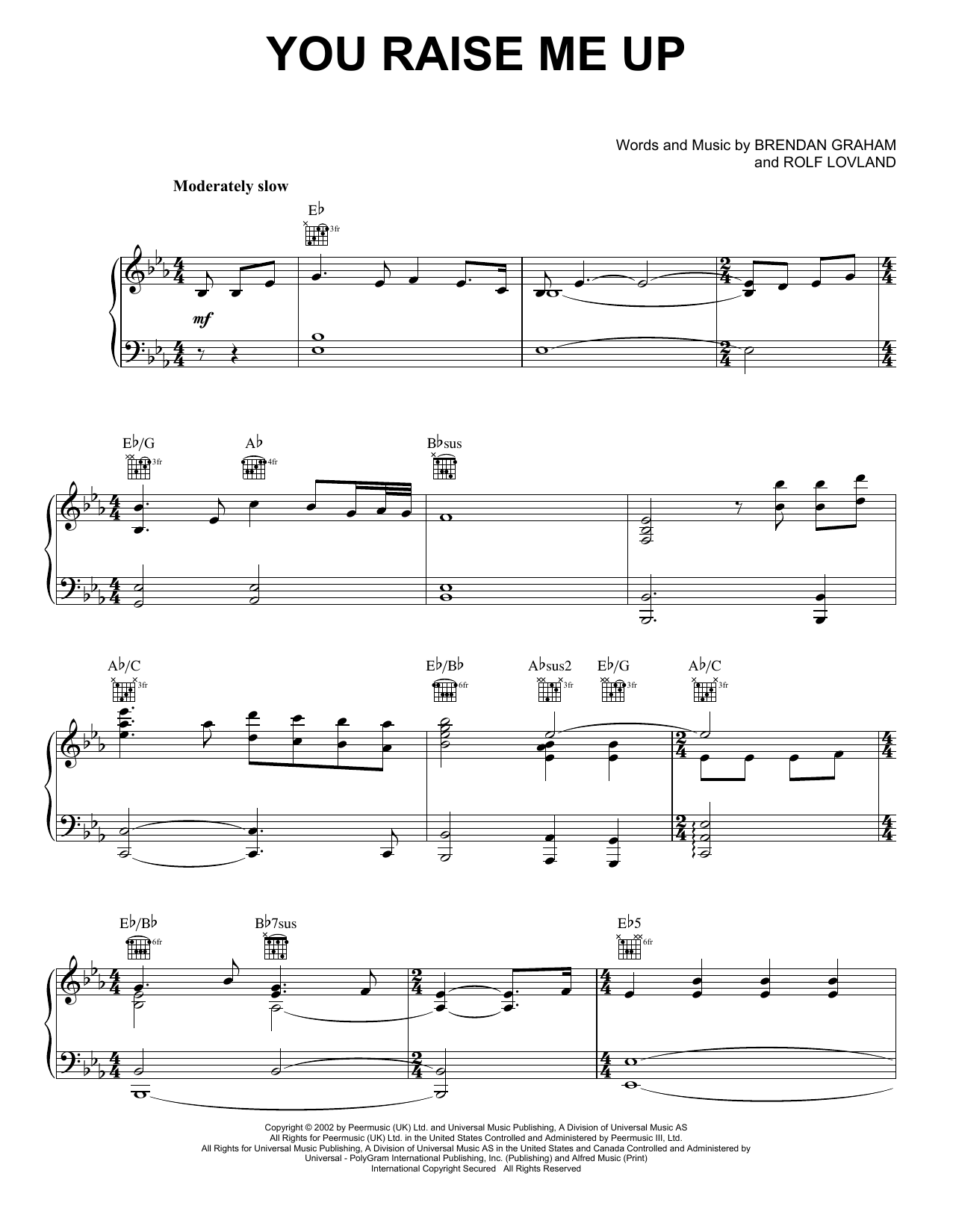
It is 2:00 AM. You’re doom-scrolling or maybe just staring at the ceiling, feeling that heavy, specific kind of exhaustion that sleep won't fix. Suddenly, a melody creeps in. It starts with a simple, breathy piano line and then that voice—velvet-thick and soaring—hits the first chorus. Honestly, even if you aren't into "classical crossover" or operatic pop, You Raise Me Up Josh Groban has probably lived in your head rent-free since 2003.
It’s the song of a thousand graduations. It's the anthem of every "In Memoriam" segment. But how did a song originally written by a Norwegian-Irish duo for a funeral become the definitive power ballad of the 21st century?
The Weird Origins of a Global Giant
Most people think this is a Josh Groban original. It's not. Not even close.
The song was actually birthed by Secret Garden, a duo consisting of Norwegian composer Rolf Løvland and Irish violinist Fionnuala Sherry. Løvland originally wrote it as an instrumental called "Silent Story." He felt the melody had an "eternal" quality, something rooted in the traditional Irish "Londonderry Air" (the same DNA as "Danny Boy").
He eventually asked Irish novelist Brendan Graham to write the lyrics. The first time the world actually heard the song? It was at Løvland’s mother’s funeral.
The Secret Garden version, featuring Brian Kennedy on vocals, was a minor hit in Ireland and Norway. But it didn't set the world on fire. It needed a catalyst. It needed a 22-year-old kid with a baritone voice that sounded like it belonged to a 50-year-old soul.
Why Josh Groban Almost Didn't Record It
Producer David Foster is basically the king of the "big ballad." He heard the song and knew it was a monster, but he had to convince a young Josh Groban to take it on for his second album, Closer.
At the time, Groban was the "new kid." He had just broken out after standing in for Andrea Bocelli during a rehearsal for the 1999 Grammys. He was talented, sure, but he was also trying to find his own identity. Recording a cover of a contemporary Celtic song felt like a gamble.
But Foster insisted. They recorded it with a massive choir and an arrangement that builds from a whisper to a literal shout. When the single dropped in late 2003, it didn't just climb the charts; it parked there. It spent six weeks at #1 on the Billboard Adult Contemporary chart and earned Groban his first Grammy nomination for Best Male Pop Vocal Performance.
The Oprah Effect and NASA
If you want to know why this song exploded into the stratosphere, look at January 2004. Oprah Winfrey was celebrating her 50th birthday. Groban performed "You Raise Me Up" for her, and the reaction was visceral.
That performance basically turned the song into a cultural phenomenon. A few weeks later, he performed it at Super Bowl XXXVIII during a tribute to the crew of the Space Shuttle Columbia. Suddenly, it wasn't just a song on the radio. It was the "healing song."
Is it a Religious Song? (The Big Debate)
Go to any church service on a Sunday and there’s a 40% chance you’ll hear a choir singing this. Because of lines like "Until You come and sit awhile with me," many listeners assume the "You" is God.
Groban himself has always been a bit vague about it, which is probably smart. He’s mentioned in interviews that the "You" can be anyone—a parent, a partner, a mentor, or a higher power. Brendan Graham, the lyricist, has echoed this. He wrote it from a place of grief and hope, but he didn't explicitly label it a "Christian song."
Still, the song reached #1 on the Christian charts when covered by the group Selah. It has this chameleon-like ability to fit into whatever spiritual or emotional box the listener needs at that moment.
The Numbers Behind the Magic
Let's talk scale. We aren't just talking about a "hit." We are talking about a legacy.
- 145+ Versions: Since Groban’s version, the song has been covered over 145 times by artists ranging from Westlife (who took it to #1 in the UK) to Becky Taylor.
- 3 Million+ Sheet Music Sales: It became the first song to sell over 76,000 copies of score on Musicnotes.com.
- Platinum Status: Groban’s version is certified 3x Platinum in the US alone.
What Most People Get Wrong
There is a common misconception that Groban’s version is "over-produced."
If you listen closely to the Closer recording, the first verse is remarkably sparse. It’s just Josh and a piano. The "bigness" that people associate with the song—the bagpipes, the gospel choir, the key change that feels like a physical lift—doesn't happen until the very end.
That restraint is why it works. If you start at a 10, you have nowhere to go. Groban starts at a 2. By the time he hits the final chorus, you’re at an 11, and you're probably crying in your car.
The 2026 Perspective: Why It Still Matters
In an era of 15-second TikTok sounds and hyper-processed vocals, You Raise Me Up Josh Groban feels like an anomaly. It's slow. It's earnest. It’s completely unapologetic about its emotions.
Actually, it’s the lack of irony that keeps it alive. We live in a very cynical world. Most music today is "cool" or "edgy." This song is the opposite of cool. It’s warm. It’s a hug in musical form.
How to Actually Listen to It
If you want the full experience, don't just put it on as background noise while you’re cleaning.
- Use decent headphones. You need to hear the texture of his lower register in the first verse.
- Wait for the bridge. There is a moment where the orchestration drops out slightly before the final swell. That’s the "drop" of the adult contemporary world.
- Check out the "Gems" version. In 2025, Reprise released a collection of Groban’s best work, including a remastered version of this track that cleans up some of the early-2000s digital grit.
Actionable Insights for the Groban-Curious
If you’ve only ever heard this one song, you’re missing out on the context of Groban’s career. He’s not just the "ballad guy." He’s a Broadway star (Sweeney Todd, Natasha, Pierre & The Great Comet of 1812) and a surprisingly good comedic actor.
- Listen to "To Where You Are": If "You Raise Me Up" is about strength, this one is about loss. It’s arguably a better vocal performance.
- Watch the "Live at the Greek" DVD: Seeing the song performed live with a full orchestra helps you understand the technical difficulty of those sustained high notes.
- Don't ignore the Westlife version: If you want something a bit more "pop" and less "operatic," the Westlife cover is a masterclass in boy-band harmony.
Ultimately, the song succeeds because it validates the feeling of being overwhelmed while promising that you don't have to carry the weight alone. It’s a simple message, but as the last two decades have proven, it’s one we never get tired of hearing.
Next Steps: To get the full picture of this era of music, look into the production work of David Foster. He is the architect behind the "Groban Sound" and understanding his "wall of sound" approach explains exactly why this song feels so massive compared to other covers. Scan the Closer album credits and you'll see a blueprint for how modern classical crossover was built.



