It is the song every American kid learns in kindergarten, usually while waving a small plastic flag that smells slightly of vinyl. You know the drill. You stand up, puff out your chest, and belt out those opening lines about a high-flying flag. Honestly, the lyrics to Grand Old Flag are so deeply embedded in the American psyche that we almost treat them like the national anthem’s energetic younger sibling. But if you actually stop and look at the words, there is a weird, frantic energy to them. It isn’t just a song; it’s a piece of 1906 musical theater history that somehow escaped the stage and became a permanent fixture of our culture.
George M. Cohan wrote it. He was the "Man Who Owned Broadway," a guy with so much swagger he basically invented the modern musical. He didn’t just write a catchy tune; he captured a specific brand of early 20th-century patriotism that was loud, unapologetic, and—interestingly enough—originally a bit controversial. Meanwhile, you can find similar stories here: The Art of the Silent Vow.
The Lyrics to Grand Old Flag: More Than Just a School Song
Let’s get the actual text out of the way first. Most people only know the chorus. That’s the part that sticks.
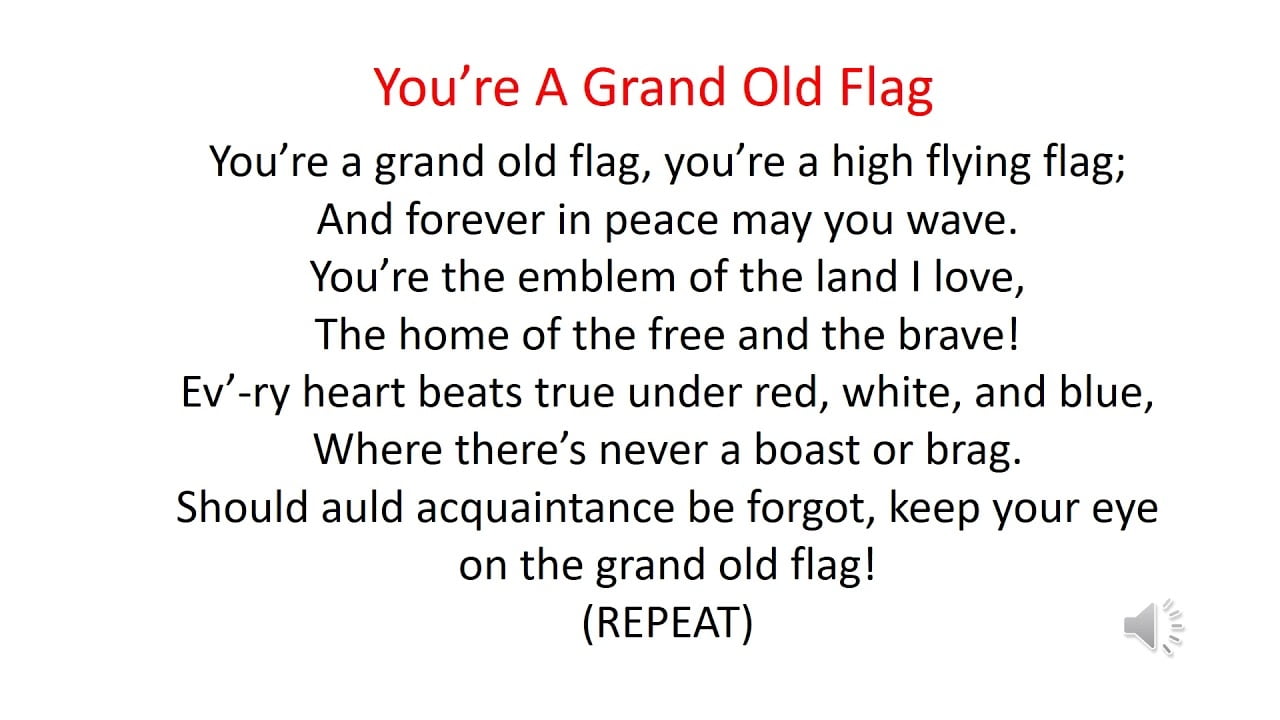
"You're a grand old flag, You're a high-flying flag And forever in peace may you wave. You're the emblem of The land I love, The home of the free and the brave. Ev'ry heart beats true 'neath the Red, White and Blue, Where there's never a boast or brag. But should auld acquaintance be forgot, Keep your eye on the grand old flag." To see the complete picture, check out the recent analysis by Deadline.
It’s simple. It’s rhythmic. It’s got that "Auld Lang Syne" reference tacked onto the end which, if you think about it, is a pretty strange lyrical choice. Why are we talking about forgetting old acquaintances in a song about a flag? Cohan was a genius at "borrowing" familiar sentiments to make his new songs feel like they had been around forever. He wanted you to feel nostalgic for the song the very first time you heard it.
The verses, which nobody ever sings, are actually where the "story" of the song lives. They talk about "marching to the drum" and "the spirit of '76." They set the scene for the musical George Washington, Jr., where the song made its debut. In the play, Cohan’s character gets into a heated argument with his father about his patriotism. He basically uses the flag as a shield in a family dispute.
The Secret "Rag" Controversy
Here is something most people totally miss: the song wasn't originally called "You're a Grand Old Flag."
When Cohan first wrote it, the title was "You're a Grand Old Rag."
I’m serious. In 1906, "rag" was a common, affectionate term for the flag among Civil War veterans. Cohan reportedly got the idea while sitting next to an old vet who had fought at Gettysburg. The old man was holding a tattered, torn-up flag and supposedly whispered, "She’s a grand old rag." Cohan loved the grit of that. He thought it felt authentic.
The public? Not so much.
When the song premiered, people lost their minds. They thought calling the American flag a "rag" was the ultimate insult. Protests started. Patriotic societies were up in arms. Cohan, being a savvy businessman who didn't want his show to flop, did a quick pivot. He swapped "rag" for "flag," and suddenly, it was a smash hit. The rhythm stayed the same, but the "disrespect" was gone. It’s funny how one consonant can change the entire trajectory of a song's legacy. If he hadn't changed it, we probably wouldn't be singing it in schools today.
Why the Song is Such an Earworm
Cohan wasn't just a songwriter; he was a master of the "patter" song. He understood that if you give people a steady, march-like beat—specifically a 2/4 time signature—they can't help but tap their feet. The lyrics to Grand Old Flag are designed to be shouted as much as they are sung.
Think about the line "Where there's never a boast or brag." It’s an incredibly ironic line for a song that is, by definition, boasting about the country. But that’s the charm. It’s got that classic American "we’re the best but we’re humble about it" vibe that dominated the pre-WWI era.
The Broadway Influence
You have to remember that in 1906, Broadway was the center of the universe for American pop culture. There was no TikTok. There was no radio. If you wanted a hit, it had to work on a stage with a live orchestra. Cohan wrote for the "cheap seats." He wanted the guy in the very back row to be able to understand every single syllable. That’s why the rhymes are so simple: flag/brag, wave/brave, blue/true.
It’s "nursery rhyme" simple, but with the power of a brass band behind it.
The Weird Connection to "Auld Lang Syne"
Let’s go back to that ending: "But should auld acquaintance be forgot, keep your eye on the grand old flag."
Musically, Cohan actually quotes the melody of Robert Burns’ classic New Year’s Eve song. It’s a bit of a "mashup" before mashups were a thing. By doing this, he was subconsciously telling the audience: "This flag is your oldest friend. Don't forget it." It was a brilliant bit of emotional manipulation. He took a song about memory and friendship and grafted it onto national identity.
Most people sing that line without even realizing they’ve switched songs for a second. It flows so naturally that it feels like a single thought.
Is It Still Relevant?
Honestly, yeah.
In a world where everything is polarized, "You're a Grand Old Flag" remains one of the few pieces of Americana that hasn't been completely co-opted by one specific political side. It’s too "theater-kid" for some and too "old-school" for others, which leaves it in this safe middle ground of pure nostalgia.
We see it in parades. We hear it at Fourth of July fireworks. We see it in movies when a director wants to instantly evoke a sense of "Small Town USA." It’s shorthand for a specific kind of optimism.
But there’s a nuance there, too. Cohan was the son of Irish immigrants. For him, writing these hyper-patriotic songs was a way of claiming his place in a country that wasn't always welcoming to the Irish. When you look at the lyrics to Grand Old Flag through that lens, they feel less like a boast and more like an anthem of belonging. He was saying, "This is my flag, too."
How to Actually Use This Knowledge
If you’re a teacher, a performer, or just someone who likes to win at bar trivia, there are a few things you can do with the history of this song.
- Listen to the original recordings: If you can find a recording of Cohan himself (or a close contemporary), listen to the tempo. It’s much faster than the plodding versions we hear in elementary schools. It’s meant to be a "ragtime" march.
- Check the verses: Don't just stop at the chorus. Read the full lyrics to understand the theatrical context. It makes the song feel more like a story and less like a chant.
- Acknowledge the "Rag" history: When teaching the song, tell the story of the "Grand Old Rag." It teaches a great lesson about how language evolves and how public perception shapes art.
- Watch the movie "Yankee Doodle Dandy": James Cagney plays Cohan, and the performance of this song is legendary. It shows exactly how much physicality and energy Cohan intended for the piece.
The lyrics to Grand Old Flag aren't just words on a page. They are a snapshot of 1906 Broadway, a veteran’s respect for a tattered banner, and a songwriter’s incredible instinct for what makes an audience cheer. Next time you hear it, don't just drone along. Think about that old man at Gettysburg and Cohan’s frantic rewrite. It makes the "high-flying" part feel a lot more meaningful.
To get the most out of this song in a modern setting, try playing it at its original, upbeat ragtime tempo. It completely changes the mood from a solemn march to a celebration that actually reflects the energy of the era it was born in. Keep the history alive by sharing the "Grand Old Rag" origin—it’s the kind of detail that turns a simple song into a real conversation.



