It is a staple of every fourth-grade choir performance and every Fourth of July parade from Maine to California. You know the tune. You can probably hum it in your sleep. But the lyrics for the grand old flag actually started out as a bit of a mistake, or at least, a very specific tribute that didn't sit well with the public at the turn of the century.
George M. Cohan, the fast-talking, high-stepping king of Broadway, wrote the song in 1906 for his musical George Washington, Jr. He didn't just pull the imagery out of thin air. He was sitting on a park bench next to a Civil War veteran—a member of the Grand Army of the Republic—who was clutching a folded, tattered flag. The old soldier reportedly looked down at the cloth and whispered, "She's a grand old rag." Cohan loved the grit of it. He loved the street-level patriotism. So, he wrote the song as "You're a Grand Old Rag." For another view, read: this related article.
The public hated it.
They didn't see it as "gritty." They saw it as disrespectful. People were genuinely offended that this flashy theater kid was calling the American flag a "rag." Cohan, being a savvy businessman who didn't want his show to flop, changed the title and the lead line to "You're a Grand Old Flag" within weeks. The rest is history, but the soul of the song remains tied to that encounter with a veteran who saw the beauty in the wear and tear of service. Related analysis on this matter has been shared by The Hollywood Reporter.
The Actual Lyrics for the Grand Old Flag (And Why They Matter)
If you're looking for the lyrics for the grand old flag to teach a class or perform, you need to get the cadence right. It isn’t just a march; it’s a "patter song." Cohan wrote it to be delivered with a specific kind of Irish-American staccato energy.
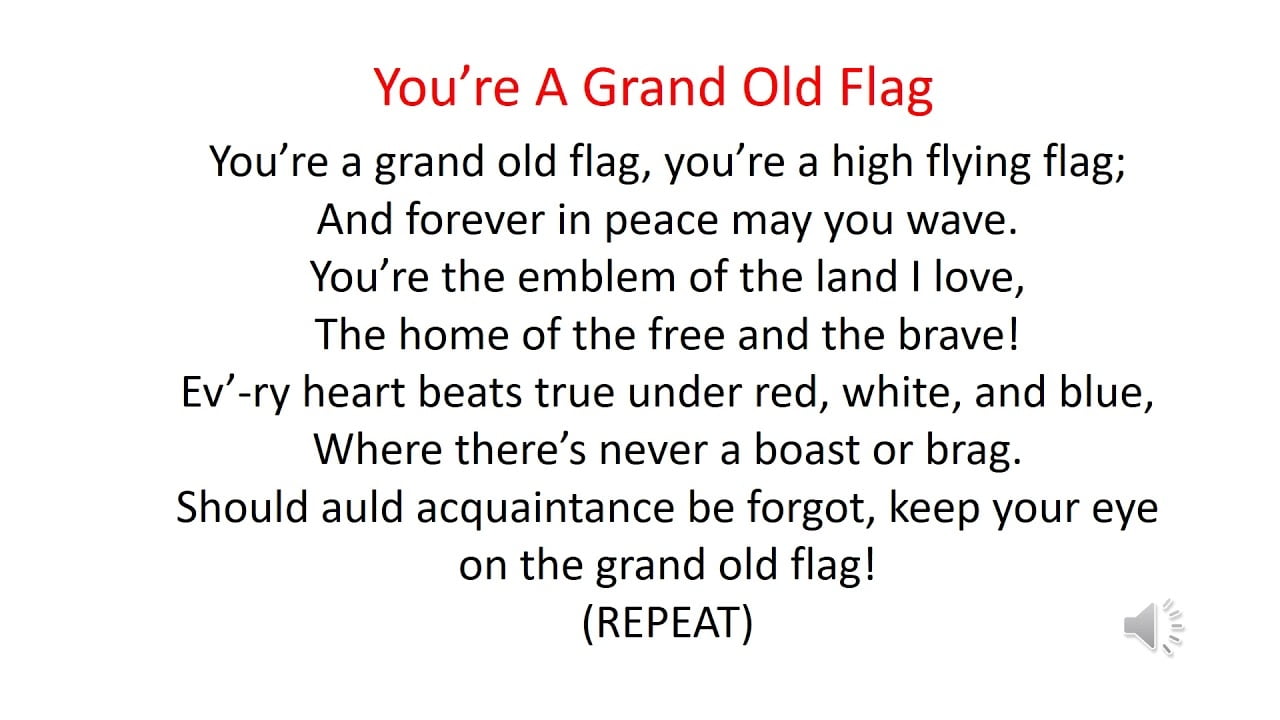
You're a grand old flag, You're a high-flying flag And forever in peace may you wave. You're the emblem of The land I love. The home of the free and the brave.
Ev'ry heart beats true 'Neath the Red, White and Blue, Where there's never a boast or brag. Should auld acquaintance be forgot, Keep your eye on the grand old flag.
Notice that last bit? "Should auld acquaintance be forgot." That’s a direct lift from Robert Burns. Cohan was a master of "musical sampling" before that was even a term. He took the most recognizable melody of nostalgia—Auld Lang Syne—and shoved it right into the middle of a patriotic anthem. It was a brilliant move. It connected the newness of the American 20th century with the deep-seated emotional roots of the immigrant population that filled the theaters of New York.
The song is short. It’s punchy. It doesn't waste time with flowery Victorian metaphors about "purple mountain majesties" or "fruited plains." It’s a city song. It’s a song about pride that you can shout over the noise of a trolley car.
The Controversy That Almost Killed the Song
Honestly, the "rag" vs. "flag" debate was a massive deal in 1906. There were literal protests. Patriotic societies across the country sent letters of condemnation. You have to understand the context of the era: the Civil War was still a living memory for many people. The flag wasn't just a symbol on a bumper sticker; it was the thing their brothers and fathers had died under just 40 years prior.
Cohan tried to defend himself. He argued that the veteran he spoke to used the word "rag" with the utmost reverence. To that old soldier, the flag was a "rag" because it had been through the fire. It was stained with blood and smoke. It wasn't a pristine piece of silk; it was a survivor. But the nuance was lost on the general public.
Cohan eventually relented because, well, he liked money. The sheet music sales for "You're a Grand Old Flag" became the first song from a musical to sell over a million copies. Think about that for a second. In an age before Spotify, before radio was ubiquitous, a million households bought the paper so they could play this song on their pianos. It was the first "viral" patriotic hit of the recorded sound era.
Why the Song Still Works in 2026
It's 120 years later. Why are we still talking about these lyrics?
Most patriotic songs are hard to sing. "The Star-Spangled Banner" has a range that humbles professional opera singers. "America the Beautiful" is lovely but a bit slow. But the lyrics for the grand old flag are accessible. You don't need a four-octave range. You just need a bit of rhythm and some enthusiasm.
It’s also surprisingly humble for a patriotic song. Look at the line: "Where there's never a boast or brag." It’s an interesting choice of words for a song that is, by definition, celebrating national pride. Cohan was trying to capture a version of Americanism that was about steady loyalty rather than noisy arrogance. Whether or not he succeeded is up for debate, but the intent was there.
The song also serves as a time capsule. When you sing it, you’re engaging with the vaudeville tradition. You’re singing the work of a man who literally had a statue built for him in Times Square—the only actor to have one. Cohan was the "Man Who Owned Broadway," and this song was his greatest gift to the American songbook.
How to Perform the Song Properly
If you're actually using these lyrics for a performance, don't sing it like a church hymn. It’s not "God Bless America." It’s a march.
- Tempo: Keep it fast. Around 120 beats per minute. If you can’t march to it, you’re going too slow.
- Diction: Crisp. Cohan was famous for his "talking-singing" style. Every "t" and "d" should be sharp.
- Spirit: It’s supposed to be fun. It’s from a musical comedy, after all.
I’ve seen too many school assemblies where the kids look like they’re at a funeral while singing this. That’s the opposite of what Cohan intended. He wanted people tapping their toes. He wanted the energy of a parade.
Practical Next Steps for Using the Lyrics
If you are planning to use the lyrics for the grand old flag for a public event, school project, or publication, keep these specific points in mind:
- Check the Copyright: The good news is that the song entered the public domain decades ago. You can print the lyrics, record your own version, or use it in a video without paying a cent in royalties to the Cohan estate.
- Verify the Auld Lang Syne Connection: If you're teaching this to students, show them the connection to the Scottish folk song. It’s a great lesson in how culture is recycled and reimagined.
- Use the "Rag" Backstory: If you're giving a speech or a presentation, start with the "Grand Old Rag" anecdote. It’s a hook that immediately grabs people's attention because it sounds like a scandal, but ends as a tribute to veterans.
- Lyric Accuracy: Many modern lyric sites accidentally swap "emblem of" with "symbol of." Stick to "emblem of"—it’s what Cohan wrote and it fits the meter of the bar much better.
The song remains a powerhouse because it doesn't ask for much. It just asks you to keep your eye on the flag. It’s simple, it’s effective, and despite its rocky start as a "rag," it became the definitive musical representation of the American spirit.



