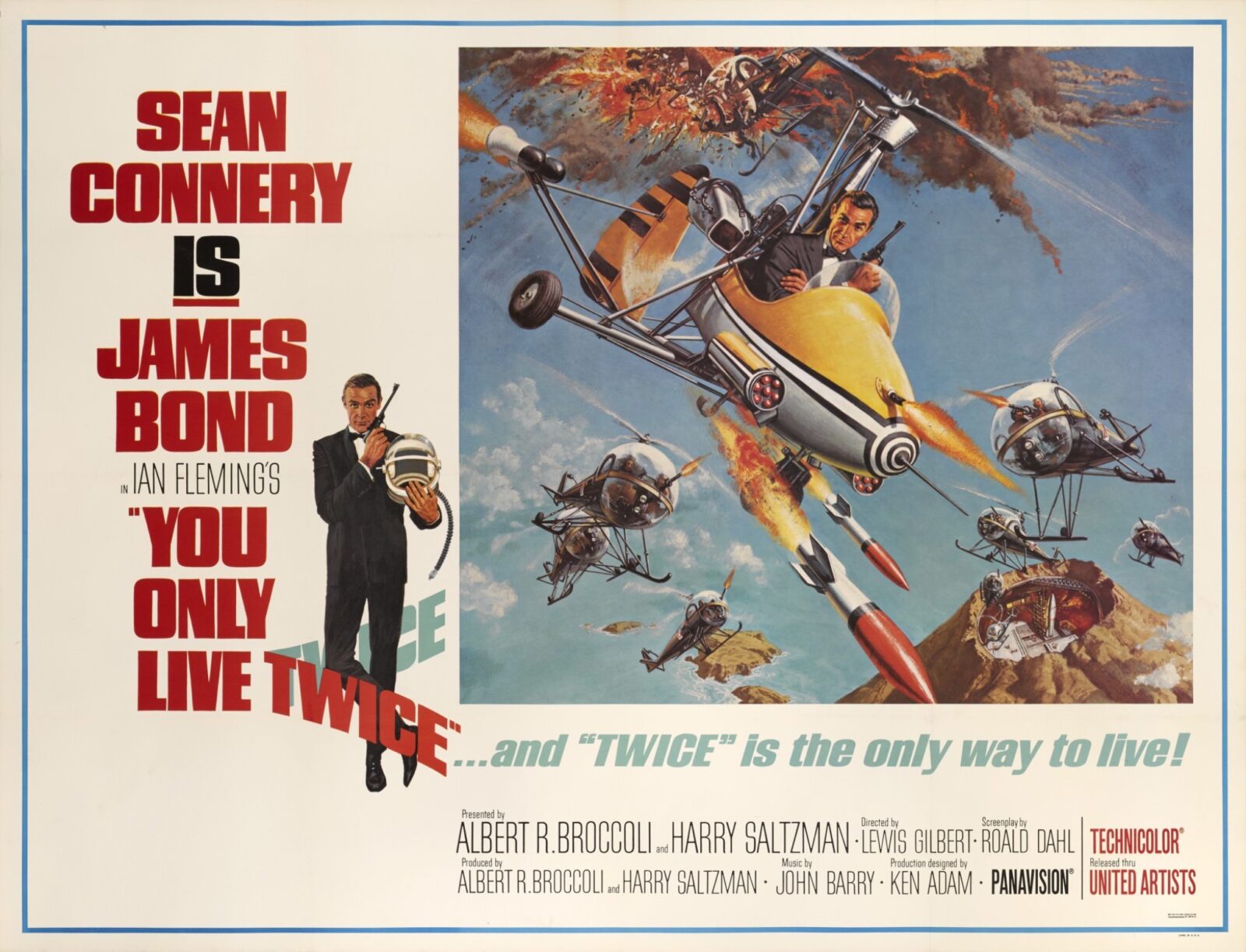
Sean Connery was done. By the time he touched down in Japan to film You Only Live Twice, the man was essentially a prisoner of his own fame. Photographers followed him into bathrooms. Fans mobbed his car. The pressure was so immense that he famously announced this would be his final outing as 007, a declaration that sent shockwaves through a 1960s public that couldn't imagine anyone else in the tailored suit. It’s a miracle the movie got made at all, let alone that it became the massive, volcanic spectacle we remember today.
Honestly, this isn't just another spy movie. It is the moment the Bond franchise shifted from gritty espionage into the realm of the "super-spectacle."
The Roald Dahl Connection and the Script That Changed Everything
Most people don't realize that the screenplay for You Only Live Twice was written by Roald Dahl. Yes, the same guy who gave us Charlie and the Chocolate Factory. Dahl was a close friend of Ian Fleming, but he actually hated Fleming’s original novel. He thought it was more of a travelogue than a thriller. So, he basically tossed the book out the window. He kept the Japanese setting and a few character names, then built a completely new plot from scratch.
Dahl understood something fundamental about the 1967 audience: they wanted gadgets. They wanted scale. They wanted a villain who felt like a god.
He gave them Ernst Stavro Blofeld in a hollowed-out volcano.
The plot is peak Cold War paranoia. A mysterious spacecraft is literally swallowing American and Soviet capsules whole in orbit. The world is on the brink of World War III. Bond’s solution? Fake his own death in Hong Kong, get buried at sea, and then sneak into Japan to investigate. It’s absurd. It’s brilliant. It's the blueprint for every "evil genius" trope that Austin Powers would later spend three movies mocking.
That Volcano Base: A Masterclass in Practical Effects
Ken Adam is the unsung hero of this film. As the production designer, he was tasked with building Blofeld’s lair. He didn't just build a set; he built a world. The volcano interior at Pinewood Studios cost roughly $1 million in 1966—which was more than the entire budget of Dr. No.
It had a working monorail. It had a retractable roof. It was 120 feet tall.
When you watch the final assault where the ninjas (yes, ninjas) abseil down from the ceiling, you aren't looking at CGI. You’re looking at dozens of stuntmen on real ropes in a massive steel structure. This is why the movie still holds up. There is a physical weight to the environment that modern digital effects struggle to replicate. You can almost smell the cordite and the damp rock.
The "Yellowface" Controversy and 1960s Sensibilities
We have to talk about the "Japanese Bond" transformation. To go undercover, 007 undergoes a surgical and cosmetic change to look Japanese.
It’s uncomfortable.
By modern standards, the sequence where Bond gets a haircut and a skin tint to "blend in" is widely considered a low point for the franchise's cultural sensitivity. Even at the time, it felt like a weird narrative detour. The film tries to ground itself in Japanese culture—showcasing sumo wrestling, traditional weddings, and the beautiful landscapes of Kyushu—but the central conceit of Bond "becoming" Japanese is a heavy-handed plot device that aged poorly.
However, looking past that, the film gave us some of the strongest "Bond Girls" of the era. Akiko Wakabayashi (Aki) and Mie Hama (Kissy Suzuki) weren't just window dressing. Aki, in particular, drives a sleek Toyota 2000GT and saves Bond's life multiple times before her tragic exit. She was the one doing the heavy lifting while Bond was still figuring out how to use his gadgets.
Little Nellie: The Miniature Marvel
Speaking of gadgets, let's talk about the autogyro.
Wallis WA-116 Agile. That's the technical name. We know it as "Little Nellie."
Ken Wallis, the inventor and a former RAF Wing Commander, actually flew the craft in the movie. It wasn't a prop; it was a real, functioning aircraft. The sequence where Bond takes on four full-sized helicopters in a tiny, one-man whirlybird is peak 1960s cinema. It’s fast, it’s dangerous, and it used real aerial cinematography that required dozens of takes over the mountains of Japan.
The Face of SPECTRE
For years, Blofeld was a mystery. We saw his hands. We saw his white Persian cat. We heard his voice. In You Only Live Twice, the veil finally dropped.
Donald Pleasence stepped into the role and created the definitive cinematic villain. The scar across the eye, the calm, detached voice, the piranha tank—it all started here. Pleasence played Blofeld with a chilling lack of empathy. He wasn't a screaming maniac; he was a businessman of terror.
While other actors like Telly Savalas and Charles Gray would later take on the mantle, Pleasence’s version is the one burned into the collective consciousness of pop culture. He turned SPECTRE from a shadowy organization into a tangible, terrifying threat.
The Connery Paradox
You can see the exhaustion on Sean Connery's face in certain scenes. He was 36, at the height of his physical prime, but he was mentally checked out. He felt the character had become a caricature. He was tired of the "Bond-mania" that prevented him from walking down a street in Tokyo without a riot breaking out.
Despite this, his performance is incredibly polished. He brought a certain "don't care" attitude that actually worked for a Bond who had just faked his own death. It gave the character a harder edge than we saw in Thunderball. He was a man who knew the stakes were high, but he’d seen it all before.
Legacy and the Shift to Camp
This film was the turning point. After You Only Live Twice, the Bond series realized it couldn't just be about cold-blooded assassins in hotel rooms anymore. The audience wanted the volcano. They wanted the space capsules.
It paved the way for the Roger Moore era, where the gadgets became even more outlandish and the plots more global. Without this film, we don't get The Spy Who Loved Me or Moonraker. It proved that Bond could survive being "unrealistic" as long as it was spectacular.
What You Should Watch For Next Time
If you’re planning a rewatch, pay attention to the cinematography by Freddie Young. He was the guy who shot Lawrence of Arabia, and he treats the Japanese landscape with the same reverence. The wide shots of the Ama divers and the volcanic peaks are stunning.
Also, listen to Nancy Sinatra’s title theme. It’s arguably one of the top three Bond songs of all time. The sweeping strings and the melancholic melody perfectly capture the "you only live twice" philosophy—one life for yourself, and one for your dreams.
Actionable Insights for Bond Fans:
- Visit the Locations: Many of the filming sites in Japan remain accessible. The Shin-Yokohama area and the mountains of Kagoshima (where the volcano scenes were inspired) offer a "Bond trail" for travelers. The Hotel New Otani in Tokyo served as the exterior for Osato Chemicals and still looks remarkably similar today.
- Explore the Roald Dahl Drafts: If you’re a literary nerd, look up the history of Dahl’s involvement. His letters about the production provide a hilarious and often biting look at the chaos of 1960s filmmaking.
- Appreciate the Practical Stunts: Next time the volcano battle starts, remind yourself that there are no digital doubles. Every explosion and every fall was performed by a human being in a massive, custom-built warehouse.
- Contextualize the "Yellowface": When watching with friends, it’s worth acknowledging the film as a product of 1967. It’s a fascinating look at how Western cinema viewed the East during the height of the Cold War—simultaneously respectful of the technology and beauty, yet clumsy with the cultural identity.
The film remains a titan of the genre. It’s messy, it’s loud, it’s slightly problematic, and it’s absolutely essential. It’s the moment 007 became a superhero.



