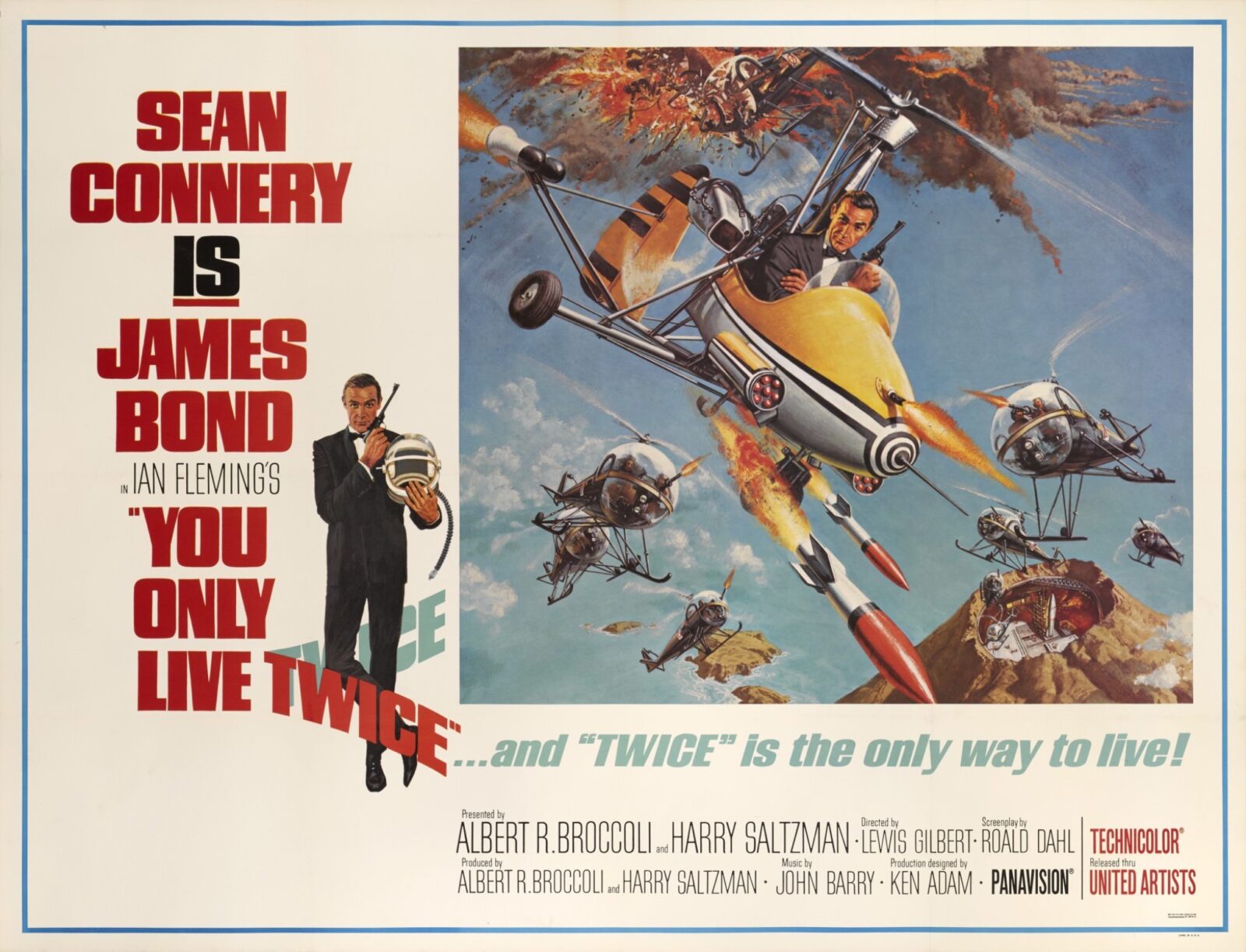
Sean Connery looked tired. Honestly, by the time cameras started rolling on the 1967 film You Only Live Twice, the man was basically finished with 007. He was getting mobbed in bathrooms in Japan. Fans were literally following him into private spaces. It’s wild to think about now, but that exhaustion actually seeps into the performance, giving us a version of the You Only Live Twice Bond that feels more cynical and detached than the suave hero of Goldfinger.
People forget how much of a massive gamble this movie was. It was the first time the franchise truly went "sci-fi" in a big way. We’re talking about a plot involving giant spacecraft swallowing other spacecraft in orbit. It was a huge departure from the gritty, noir-adjacent roots of Ian Fleming's novels. In fact, Roald Dahl—yes, the guy who wrote Charlie and the Chocolate Factory—wrote the screenplay, and he basically threw out Fleming's book entirely. He kept the title, the Japanese setting, and a few names. That's it.
The Volcanic Lair and the Death of Realism
Lewis Gilbert, the director, knew he had to go big because Thunderball had set the bar so high. But how do you top an underwater army? You build a volcano.
Ken Adam, the legendary production designer, created the SPECTRE volcano base at Pinewood Studios for about $1 million. In 1967, that was an insane amount of money—nearly the entire budget of Dr. No. It had a working monorail and a sliding helipad. When you watch the You Only Live Twice Bond storm that base with a literal army of ninjas, you aren't looking at CGI. You're looking at hundreds of stuntmen on a massive, physical set. It’s one of the last great monuments to practical filmmaking before computers took over Hollywood.
The scale was so big it almost swallowed the characters.
Bond himself becomes a bit of a passenger in this movie. He’s sent to investigate the hijacking of American and Soviet space capsules. The Cold War tension is the engine, but the fuel is the gadgetry. This is the movie that gave us "Little Nellie," the gyrocopter that Bond uses to fight off a fleet of full-sized helicopters. It’s glorious, over-the-top, and a little bit ridiculous.
The Controversy: That "Transformation" Sequence
We have to talk about the elephant in the room. Or rather, the "Japanese" Bond.
In the film, 007 has to go undercover as a Japanese fisherman. This involved Sean Connery wearing a wig, prosthetic eyelids, and getting a fake tan. To a modern audience, it’s incredibly cringey. Even for 1967, it felt like a weird narrative detour that didn't really accomplish much. The "transformation" is barely a disguise. It’s Connery in a bowl cut.
This specific plot point highlights the tension between the books and the films. In Fleming's original novel, Bond is a broken man. He’s grieving the death of his wife, Tracy. M sends him on a "suicide mission" to Japan just to get him out of his funk. The book is dark, atmospheric, and psychological. The You Only Live Twice Bond on screen, however, is a superhero. The movie trades the internal trauma for a spectacle of ninjas and piranha tanks.
Why the Setting Matters
Japan in the late sixties was a revelation to Western audiences. The film acts as a sort of travelogue. You get the contrast of the ultra-modern Tokyo—specifically the New Otani Hotel, which served as the exterior for Osato Chemicals—and the traditional, rural villages.
The cinematography by Freddie Young is breathtaking. He’s the guy who shot Lawrence of Arabia, and he brings that same sense of scale to the Japanese coastline.
- The Ama Divers: The film features the traditional female shell-divers.
- Kobe Docks: The fight scene here is filmed with a soaring crane shot that shows just how many stuntmen were actually involved in these brawls.
- Mount Shinmoedake: This was the actual volcano used for the exterior shots of Blofeld's base.
Blofeld Finally Shows His Face
For years, Ernst Stavro Blofeld was just a pair of hands stroking a white cat. He was a voice, a presence, a mystery. You Only Live Twice finally gave him a face, and it belonged to Donald Pleasence.
His performance defined the "Bond Villain" trope forever. The facial scar. The Nehru jacket. The calm, high-pitched voice. Every parody of a villain you’ve ever seen, from Dr. Evil to Mr. Burns, traces back to this specific iteration of the character.
Interestingly, Pleasence wasn't the first choice. They originally hired Jan Werich, but after a few days of filming, the producers realized he looked too much like a "jolly Santa Claus" and didn't seem threatening. They brought in Pleasence last minute, and history was made. He managed to be creepy without being loud. He was the perfect foil for the You Only Live Twice Bond because he didn't rely on physical strength; he relied on the absolute power of his organization.
The Music of Nancy Sinatra
You can't discuss this film without the music. John Barry’s score is arguably his best in the series. The title track, performed by Nancy Sinatra, is haunting. It has this ethereal, shimmering quality that captures the mystery of the East.
Sinatra was reportedly terrified during the recording session. It took about 25 takes to get it right. Barry ended up having to piece together the final version from several different takes because she struggled with the high notes. Yet, the final product is a masterpiece of pop-noir. It sets a tone that the movie itself doesn't always live up to—a tone of longing and danger.
Dissecting the Practical Effects
The space sequences are surprisingly decent for the pre-Star Wars era. They used a "split-screen" technique and detailed miniatures. When the SPECTRE "Bird One" craft opens its nose-cone to swallow the Gemini capsule, it looks tactile. It has weight.
Compare this to modern Bond films where everything is a digital blur. There’s a scene where Bond is hanging from a helicopter over the Tokyo docks. That’s actually Sean Connery (mostly). There’s a tangible sense of danger in the air.
However, the pacing is a bit weird.
The middle of the film drags. We spend a lot of time on the wedding ceremony and Bond "becoming Japanese." It slows the momentum to a crawl. But then, the final 20 minutes hit, and it’s pure adrenaline. The ninja assault on the volcano is a masterclass in action choreography. You have people rappelling from the ceiling, explosions everywhere, and Bond fighting Hans (Blofeld's bodyguard) over a piranha tank.
Actionable Insights for the Bond Fan
If you're revisiting the You Only Live Twice Bond or watching it for the first time, here is how to actually appreciate it without getting bogged down in the dated elements:
- Watch the Ken Adam Documentary Material: Most Blu-ray releases have features on the set design. Understanding that the volcano was a real building makes the final battle 10x more impressive.
- Read the Book After: Since the movie is so different, the book feels like a "lost" Bond story. It’s much darker and provides the emotional context for why Bond is in Japan in the first place.
- Look for the Cameos: Notice the henchmen. You’ll see several actors who appeared in other Bond films in different roles. The "Bond Family" was a real thing back then; they reused the same stunt crews and supporting actors constantly.
- Listen to the Score Individually: John Barry’s "Mountains and Sunsets" track is a masterclass in using local instrumentation (like the koto) within a Western orchestral framework.
The Legacy of the 1967 Epic
You Only Live Twice was supposed to be Connery's swan song. He famously quit during production, though he was eventually lured back for Diamonds Are Forever after George Lazenby’s brief tenure.
The film's legacy is complicated. On one hand, it’s the peak of "Gadget Bond." It’s fun, colorful, and visually stunning. On the other hand, it pushed the series toward the campiness that would eventually define the Roger Moore era. It moved away from the spy who bled and toward the spy who could solve any problem with a button on his dashboard.
Was it the best Bond film? Probably not. From Russia with Love usually takes that crown for purists. But was it the most influential? You could make a strong case for it. It established the "Secret Lair" as a cinematic trope. It gave us the definitive Blofeld. It proved that Bond could survive in a world of space travel and high-tech gadgets.
Basically, it's a spectacle. You don't watch it for the deep character development. You watch it to see a guy in a suit fight a private army inside a mountain. And honestly, sometimes that’s exactly what cinema is for.
To get the most out of this era of film history, look for the 4K restored versions. The colors of 1960s Japan pop in a way that the old VHS or early DVD transfers never quite captured. Pay attention to the background—the bustling streets of Tokyo in '67 are a time capsule of a world that was rapidly changing.
Next Steps for the 007 Enthusiast:
- Compare the "Little Nellie" sequence to modern drone cinematography to see how far aerial photography has come.
- Research the work of Roald Dahl as a screenwriter; his dark wit is subtly present in some of the more macabre death scenes in the film.
- Track the evolution of SPECTRE from this film through the Daniel Craig era to see how the organization’s "aesthetic" was modernized while keeping the core DNA of the 1967 original.



