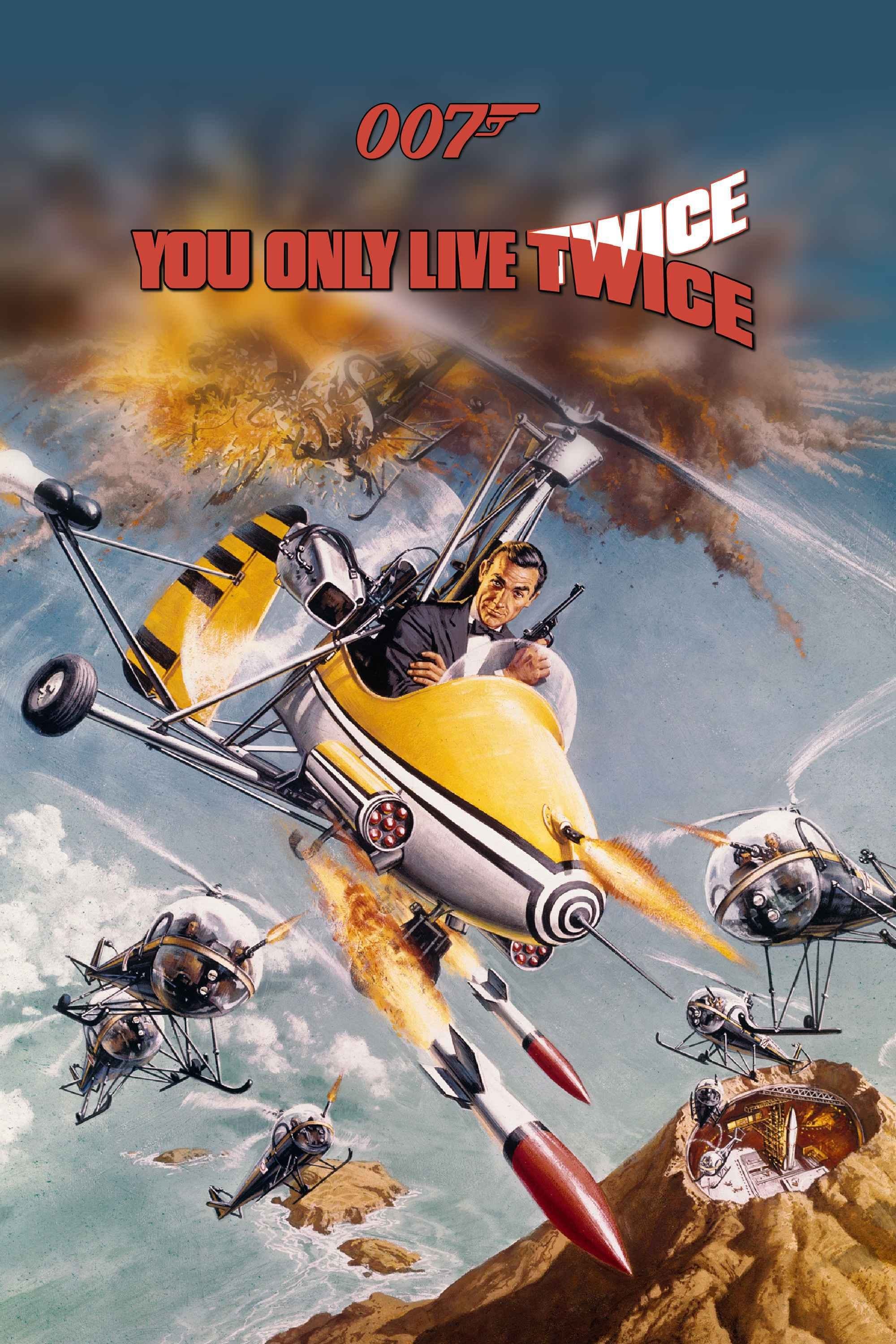
Sean Connery was done. By the time he arrived on set for You Only Live Twice 1967, the Scottish actor was essentially a prisoner of his own fame, hounded by paparazzi even into the bathrooms of Tokyo hotels. He was bored. He was frustrated. Yet, somehow, this chaotic production—penned by children’s author Roald Dahl of all people—became the blueprint for every blockbuster you’ve ever loved.
It’s the movie with the volcano lair. The one with the space capsules being swallowed by larger ones. It’s the definitive James Bond experience, yet it feels fundamentally different from the gritty espionage of From Russia with Love. Honestly, if you look at the DNA of modern action cinema, it doesn't start with Goldfinger. It starts right here in 1967, with a bald man stroking a white cat.
The Roald Dahl Connection You Probably Forgot
Producers Albert R. Broccoli and Harry Saltzman found themselves in a bind. Ian Fleming’s original novel was a dark, brooding meditation on grief and revenge. Bond was a broken man after the death of his wife. That didn't exactly scream "summer popcorn flick." So, they hired Roald Dahl.
Yes, the guy who wrote Charlie and the Chocolate Factory.
Dahl famously admitted he had no idea how to write a screenplay. He basically treated the script like a formulaic joke, later calling the novel Fleming’s worst book. He stripped away the entire plot, kept a few characters and the Japanese setting, and invented the rest. He gave us the "Bond gets buried at sea" opening. He gave us the gadget-laden "Little Nellie" gyrocopter. It was a total departure from reality. People often forget how much of the "Bond Formula"—the gadgets, the massive sets, the megalomaniac villain—was actually the result of Dahl's bizarre imagination.
Why You Only Live Twice 1967 Still Looks Better Than Modern CGI
We talk about "spectacle" now like it’s something you buy in a software package. In 1967, spectacle meant Ken Adam.
Adam, the production designer, was a literal genius who convinced the producers to spend a massive chunk of the budget—around $1 million at the time—just on a single set. This was the volcano crater interior. It wasn't a miniature. It wasn't a matte painting. It was a full-scale, functioning fortress built at Pinewood Studios. It had a working monorail, a sliding roof, and enough room for hundreds of stuntmen to rappel down from the ceiling.
When you watch the final battle today, there’s a weight to it. You can feel the coldness of the steel and the heat of the pyrotechnics. Modern movies use green screens because it's cheaper and safer, but nothing in the Marvel Cinematic Universe feels as tactile as the chaos inside that volcano.
But it wasn't all smooth sailing. The production was cursed. Director Lewis Gilbert almost didn't take the job. A cameraman lost a leg during the filming of the Little Nellie sequence. Connery was constantly at odds with the producers. It’s a miracle the movie even exists.
The Problematic Lens of the 1960s
Let's be real for a second. We have to talk about the "Bond becomes Japanese" subplot.
In the film, Bond undergoes a "transformation" to blend in with the local population. It involves a wig, some prosthetic eyelids, and a lot of skin dye. It is, to put it mildly, incredibly uncomfortable to watch in the 21st century. It’s a relic of an era that lacked even a basic understanding of cultural sensitivity.
What’s interesting, though, is how the film treats the Japanese Secret Service. Unlike many films of the time that depicted Asian characters as sidekicks or villains, Tiger Tanaka (played by Tetsurō Tamba) is presented as Bond’s equal—or even his superior. He has better gadgets, a better private train, and a more disciplined army of ninjas. It’s a weirdly progressive take wrapped inside a deeply regressive disguise.
The Birth of Ernst Stavro Blofeld
Before You Only Live Twice 1967, Blofeld was a voice and a pair of hands. He was the shadow behind the curtain. This movie finally put a face to the name: Donald Pleasence.
Initially, the producers cast Jan Werich. But after a few days of filming, they realized Werich looked like a "benevolent Santa Claus." He wasn't scary. They pivoted to Pleasence, who gave us the scar, the fixed stare, and the chillingly calm delivery. This performance created the trope. Every villain from Dr. Evil to the parodies in The Simpsons traces back to this specific 1967 portrayal.
Pleasence isn't on screen for very long, but his impact is massive. He made SPECTRE feel like a global threat rather than just a group of guys in suits.
The Ending That Almost Ended Bond
By the time the credits rolled, Sean Connery had announced his retirement from the role. He’d had enough of the "Bond-mania."
The movie was a massive hit, grossing over $111 million worldwide. But the soul of the series was at a crossroads. Was Bond a spy or a superhero? You Only Live Twice leaned heavily into the superhero side. It set a bar for scale that the next film, On Her Majesty's Secret Service, tried to scale back, leading to a decade of the franchise struggling to find its identity before Roger Moore eventually leaned fully into the camp that Dahl and Gilbert pioneered here.
Actionable Takeaways for the Bond Completionist
If you’re revisiting this classic or watching it for the first time, keep these things in mind to get the most out of the experience:
- Watch the background in the volcano. Almost all the stuntmen were real martial artists. The rappelling sequences were done without modern safety harnesses in many shots.
- Listen to Nancy Sinatra's theme. It’s widely considered one of the best in the series. John Barry’s score here is arguably his peak, blending traditional Japanese instruments with brassy Western spy motifs.
- Look for the "Little Nellie" sequence. The pilot, Ken Wallis, was the actual inventor of the autogyro. He flew 81 sorties for the film, and the dogfight took weeks to coordinate without the help of digital effects.
- Compare the pacing. Notice how the film takes its time. There are long stretches of Bond just traveling through Japan. It’s a travelogue as much as it is an action movie—a vibe modern Bond films have largely abandoned for breakneck speed.
The best way to appreciate You Only Live Twice 1967 is to see it as the bridge between the old world of 1950s literary espionage and the new world of the global blockbuster. It’s messy, it’s beautiful, it’s offensive, and it’s spectacular. Most importantly, it’s never boring.
Next Steps for Enthusiasts:
To truly understand the impact of this film, watch it back-to-back with the 1967 spoof Casino Royale (released the same year) and the 2021 No Time to Die. You'll see how the franchise spent fifty years trying to both honor and escape the "volcano lair" shadow cast by this specific movie. For a deeper technical dive, seek out Ken Adam’s original sketches for the SPECTRE base; they are masterpieces of architectural design that influenced real-world industrial aesthetics for decades.



