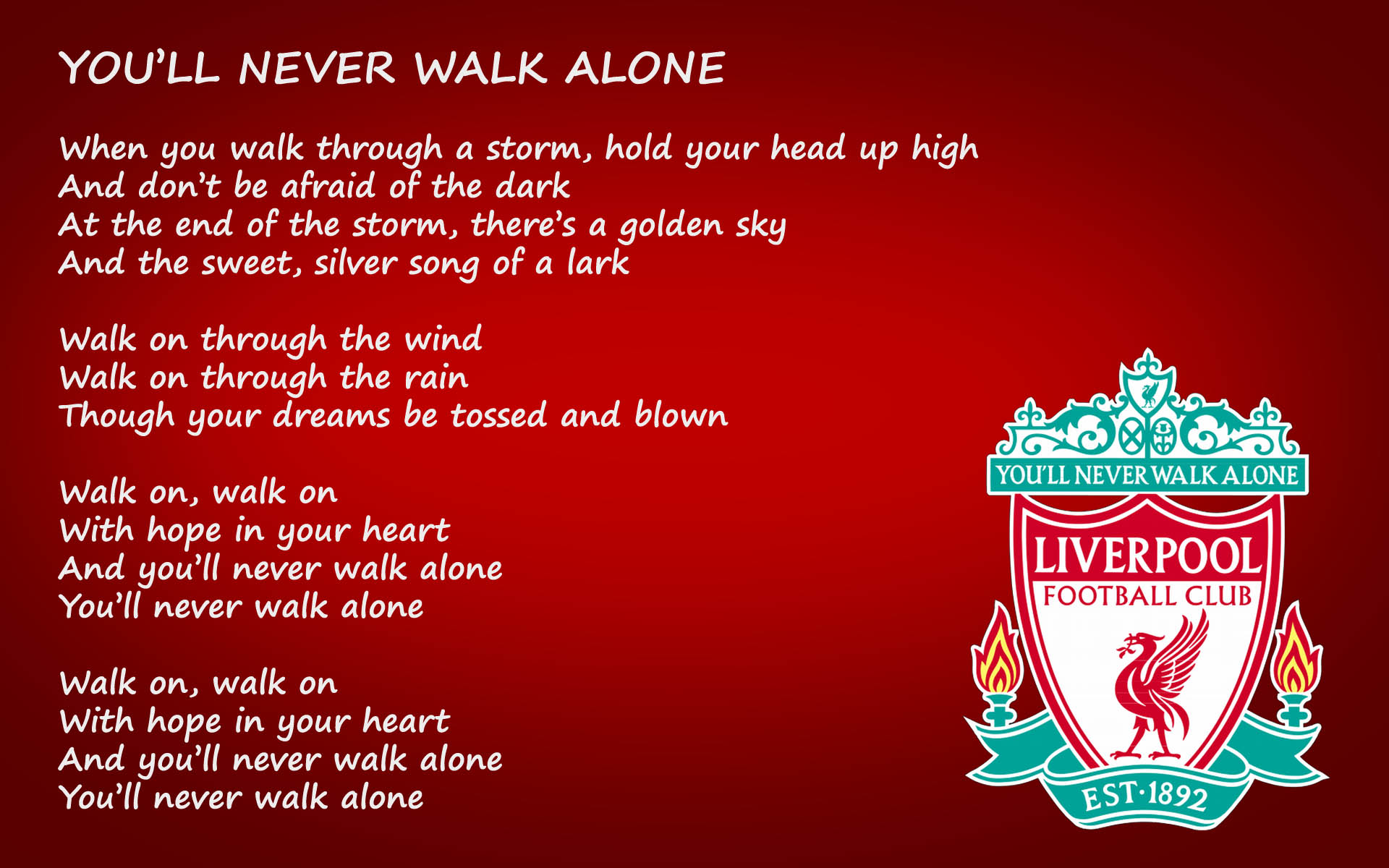
It starts as a low hum. A few voices in the Kop or the Yellow Wall at Dortmund begin to vibrate, and before you know it, forty thousand people are screaming at the top of their lungs. But if you think the words to You Never Walk Alone are just about football, you’re missing the point. Honestly, the song shouldn't even work in a stadium. It’s a show tune. It’s slow. It’s got these long, soaring notes that are notoriously hard to hit after three pints of lager. Yet, when that wall of sound hits you, it feels less like a song and more like a collective exorcism of grief and hope.
Most people assume it’s a Liverpool thing. They’re right, but they’re also wrong. The journey of these lyrics from a 1945 Broadway stage to the muddy terraces of 1960s England is one of the weirdest, most organic cultural shifts in music history. It wasn’t a marketing campaign. There was no "brand activation." It was just a bunch of Scousers who liked a catchy tune and decided it perfectly captured the feeling of living in a tough, industrial port city where you had to lean on your neighbor just to get by.
The Broadway Birth of an Anthem
In 1945, Oscar Hammerstein II and Richard Rodgers were working on Carousel. It’s a heavy play. Darker than most people remember. The song appears twice, but the most famous moment is when Nettie Fowler sings it to her cousin Julie Jordan after Julie’s husband, Billy Bigelow, kills himself. Think about that for a second. The anthem of global football—the song played at weddings and funerals and championship parades—started as a way to comfort a grieving widow in a musical about a tragic carnival barker.
Hammerstein’s lyrics are deceptively simple. He uses basic imagery: storms, wind, rain, and a golden sky. But it’s the pacing. The way the song builds from a whisper to a roar mimics the actual experience of surviving a crisis. You start out walking through the dark, scared, and you end up realizing you aren't actually solo.
Carousel was a smash. But the song didn’t stay on Broadway. It became a standard. Frank Sinatra covered it. Elvis Presley gave it a go. For a while, it was just another classy ballad that professional crooners used to show off their range. It needed a bit of grit, a bit of northern English rain, to become what it is today.
How the Words to You Never Walk Alone Hit the Mersey
Enter Gerry Marsden. In 1963, Gerry and the Pacemakers were part of the "Merseybeat" explosion alongside The Beatles. They were looking for a hit. Gerry remembered seeing Carousel as a kid and loved the sentiment. He convinced his band and producer George Martin (yes, the George Martin) to record a version.
It was a gamble.
At the time, pop music was about "She Loves You" and upbeat rock-and-roll. A slow-building ballad with a string section felt old-fashioned. But Gerry’s voice had this specific, earnest quality. It hit Number 1 in the UK.
Back then, Anfield—the home of Liverpool FC—had a DJ named Stuart Bateman who would play the top ten hits over the PA system before kickoff. The crowd would sing along to whatever was popular. "You Never Walk Alone" stayed at the top of the charts for weeks. When it finally dropped out of the top ten, the fans kept singing it anyway. They literally shouted at the DJ to keep playing it. They’d claimed it.
The Weight of the Lyrics After Hillsborough
If you want to understand why the words to You Never Walk Alone carry such massive weight today, you have to talk about 1989. The Hillsborough disaster, where 97 fans were killed due to police negligence and overcrowding, changed the song forever. It stopped being a "sports song." It became a prayer.
In the days after the disaster, when Anfield was covered in a carpet of flowers and scarves, people would gather and sing it. It provided a vocabulary for a city that was broken and being blamed by the national media. When you sing "walk on through the wind, walk on through the rain," and you're a Scouser in 1989, you aren't thinking about a football match. You’re thinking about the fight for justice. You’re thinking about the families who lost children.
The song became a symbol of defiance. It’s why you see the words "You'll Never Walk Alone" on the Shankly Gates and on the club crest. It isn't just branding. It’s a promise of communal support.
Why the Rest of the World Joined In
Liverpool isn't the only club that claims it. Celtic fans in Glasgow will tell you they were the first to sing it (though the timeline usually favors the Mersey). Go to Dortmund, Germany, and you’ll see 80,000 people in the "Gelbe Wand" singing it in English, their voices echoing off the concrete. It’s moved to Feyenoord in the Netherlands, FC Tokyo in Japan, and even teams in Australia.
Why?
Because the human condition is inherently lonely. Modern life is isolating. We spend our time behind screens, working jobs that feel disconnected from our communities. Standing in a stadium with 50,000 strangers and screaming that you aren't alone is a rare, visceral moment of connection. It’s one of the few places where it’s socially acceptable for men to show extreme emotion.
Interestingly, the song has a specific structure that makes it perfect for crowds.
- It starts in a lower register (easy for the baritones).
- The tempo is slow enough that it doesn't get muddled in a large echoey space.
- The climax—"And you'll never walk alone"—lands on a long, sustained note that lets people pour every bit of lung capacity into it.
Common Misconceptions and Trivia
People get the lyrics wrong all the time. They think it’s "walk on with hope in your heart," which is correct, but they often miss the "tossed and blown" part. The "tossed and blown" line is actually the most important bit because it acknowledges that life is messy. It’s not a "everything is great" song. It’s a "everything is terrible but we’re doing this together" song.
Also, did you know Pink Floyd used a recording of the Anfield crowd singing the song? Check out the track "Fearless" on the 1971 album Meddle. You can hear the fans chanting it in the background as the song fades out. It’s a haunting, beautiful use of the anthem that shows just how much it had permeated the culture within less than a decade of Gerry Marsden’s version.
Some people find the song sentimental or cheesy. Fair enough. If you hear it in a grocery store, it might feel like a Hallmark card. But context is everything. Hearing it at a funeral for a 20-year-old or at a stadium after a last-minute goal in a semi-final changes the DNA of the music. It becomes armor.
How to Truly Experience the Anthem
If you’re ever in Liverpool or Dortmund, you can’t just stand there. You have to participate. But there’s an etiquette to it.
- The Scarf Hold: You don’t just wave your arms. You hold your scarf taut above your head with both hands. This creates a literal wall of color.
- The Timing: The singing usually starts when the first notes of the Gerry and the Pacemakers version hit the speakers. But the best part is when the music fades out halfway through, and the crowd takes over a cappella.
- The Breath: You have to pace yourself. If you go too hard on "When you walk through a storm," you’ll have nothing left for the high "at the end of a storm" part.
Actionable Insights for the Soul
Whether you're a football fan or not, the words to You Never Walk Alone offer a pretty solid blueprint for getting through a rough patch.
- Acknowledge the Storm: Don’t pretend things are fine. The song starts by admitting there's a storm. Denial doesn't help.
- Keep Your Head Up: Literally. The lyric "hold your head up high" is about maintaining dignity when you're being beaten down by circumstances.
- Find Your "Kop": Everyone needs a group. Whether it’s a hobby group, a therapy circle, or just a couple of friends who show up when things get ugly.
- Focus on the "Golden Sky": It’s the "this too shall pass" philosophy. The storm is finite; the sky is permanent.
The song is over 80 years old now. It’s been sung in trenches, in hospitals, and in some of the most famous sporting arenas on the planet. It works because it doesn't promise that the rain will stop immediately. It just promises that you won't be standing in the rain by yourself. In a world that feels increasingly fragmented, that’s about as powerful as a few lines of poetry can get. Next time you hear it, don't just listen to the melody—listen to the person singing next to you. They're the reason the song exists.