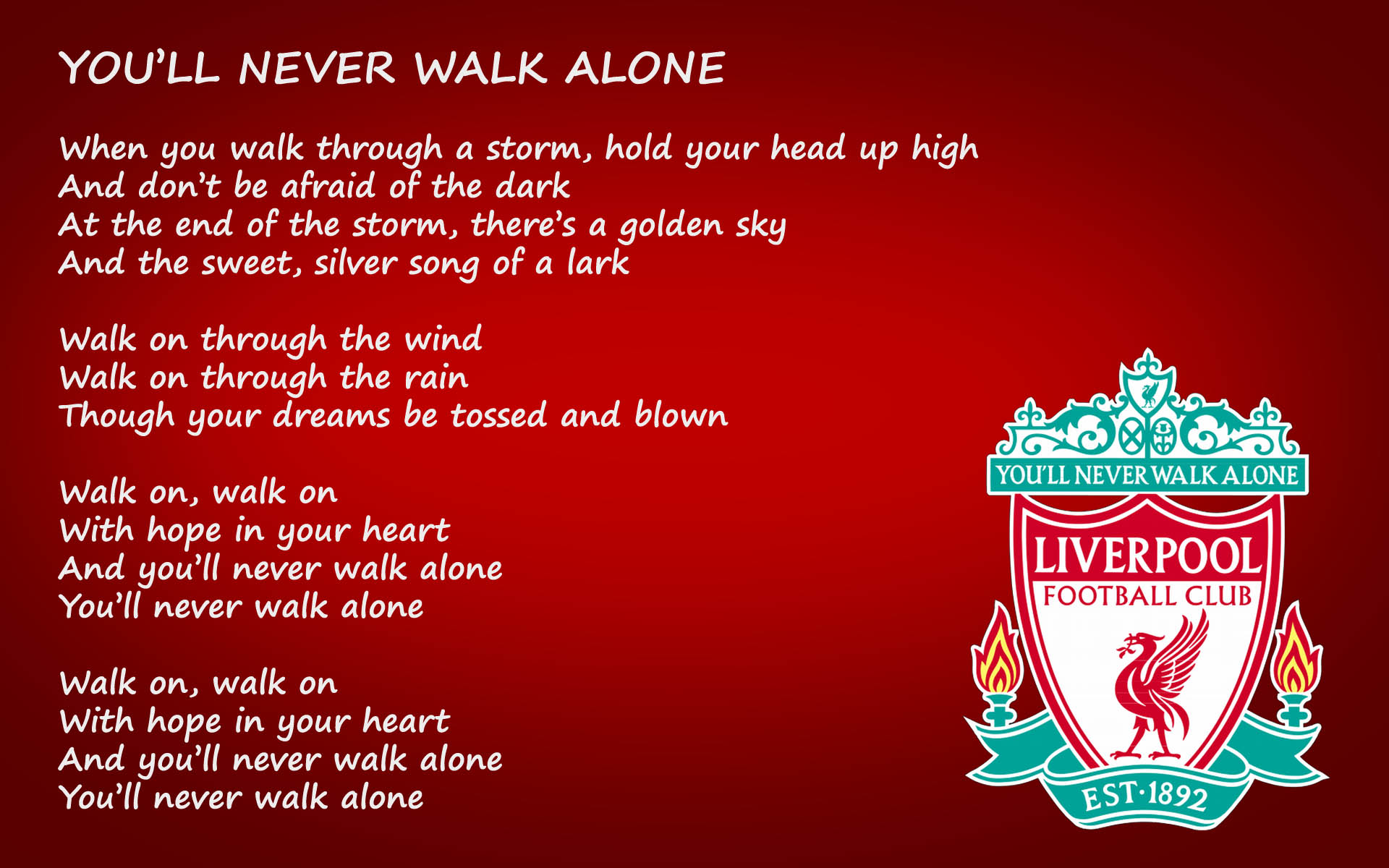
You’ve heard it. Even if you aren't a soccer fan or a musical theater nerd, you’ve heard those swelling strings and the slow, rhythmic build-up that defines the You Never Walk Alone lyrics. It’s everywhere. It is a anthem of grief, a roar of defiance, and a weirdly perfect piece of 1940s songwriting that somehow found its way from a Broadway stage to the muddy terraces of Anfield in Liverpool.
Most people think it’s just a sports song. Honestly, it’s much weirder than that.
The song wasn't written for a trophy lift or a memorial. It was written for a scene of profound, messy heartbreak. Specifically, it was penned by Oscar Hammerstein II and Richard Rodgers for their 1945 musical Carousel. In the show, the song is sung to comfort a character named Julie Jordan after her husband, Billy Bigelow, dies. It’s a funeral song, basically. But Hammerstein, who had just lost his own mother, tapped into something more universal than just stage drama. He wrote about the "golden sky" at the end of a storm. He wrote about walking through the wind and the rain. It’s simple. It’s raw. It’s remarkably effective at making grown adults cry in public.
The Liverpool Connection: How Gerry Marsden Changed Everything
If you search for the You Never Walk Alone lyrics today, the first thing you’ll probably see is a sea of red scarves. This didn't happen by accident. In the early 1960s, Liverpool was the center of the musical universe thanks to Merseybeat. Gerry Marsden, leader of Gerry and the Pacemakers, was looking for a follow-up to their hits. He remembered seeing Carousel as a kid and being struck by the melody.
His producer, the legendary George Martin (yes, the Beatles' guy), wasn't convinced. Martin wanted something upbeat. Marsden insisted. He slowed the tempo down, gave it that iconic, slightly nasally vocal delivery, and released it in 1963. It hit number one in the UK.
At Anfield, the stadium DJ used to play the top ten hits over the PA system before kickoff. The fans would sing along to everything from The Beatles to Cilla Black. But when "You'll Never Walk Alone" dropped out of the charts, the fans kept singing it. They refused to let it go. It became theirs. By the time Bill Shankly, Liverpool’s transformative manager, heard it, the bond was sealed. He told Marsden, "Gerry, my son, I have given you a football team, and you have given us a song."
Why the Lyrics Actually Work (The Psychology of the Anthem)
Let's look at the actual structure. "Walk on, walk on, with hope in your heart." It’s an imperative. It’s an order.
The song doesn't promise that things are going to be easy. It acknowledges the "dark" and the "storm." This is why it resonates so deeply in places experiencing genuine hardship. It isn't a "we are the champions" type of boast. It’s a survivalist’s mantra. When the Hillsborough Disaster happened in 1989, where 97 fans lost their lives, the You Never Walk Alone lyrics transitioned from a pre-match ritual to a sacred hymn of collective mourning. It provided a vocabulary for a city that was grieving and fighting for justice at the same time.
There’s a specific musical trick happening here too. The song starts in a relatively low register. It’s intimate. Then, as it reaches the "Walk on" climax, the notes climb higher and the volume naturally increases. When 50,000 people do that together, it creates a physical vibration. You feel it in your chest. It’s a communal exhale.
It’s Not Just Liverpool Anymore
While Liverpool FC is the most famous custodian of the song, they aren't the only ones. Far from it. Celtic fans in Glasgow claim they were actually the first to sing it, though the timeline usually favors the Mersey. Then you have Borussia Dortmund in Germany. Their "Yellow Wall" singing the song is one of the most intimidating sights in world sports.
It’s reached:
- Feyenoord in the Netherlands.
- FC Tokyo in Japan.
- The Pink Floyd track "Fearless" (they literally sampled the Anfield crowd singing it).
- Even Elvis Presley and Frank Sinatra recorded versions.
Sinatra’s version is interesting because he treats it like a standard, focusing on the croon. Elvis treats it like a gospel track. But neither captures the grit of the Gerry Marsden version, which remains the definitive "people's version" because it sounds like it’s being sung by someone who has actually walked through a storm.
Misconceptions and Modern Use
People often get the lyrics slightly wrong. They’ll say "walk through the storm" instead of "walk on through the storm." It’s a minor detail, but the "on" is the most important word in the song. It implies persistence. It’s about the movement, not just the destination.
During the global pandemic in 2020, the song saw a massive resurgence. It was played simultaneously by hundreds of radio stations across Europe as a tribute to healthcare workers. It became a bridge between the sports world and the real world once again. It’s a utility song. It fits wherever people feel isolated.
Actionable Insights for Using the Song's Power
If you are looking to understand the cultural weight of this anthem or perhaps use it in a meaningful way, keep these nuances in mind:
- Respect the Source: If you’re performing it, remember it’s a theater song first. The phrasing should be conversational, not overly operatic.
- Tempo is Everything: The song fails if it’s rushed. The build-up is the point. The slow burn from the "toss of the clouds" to the "golden sky" is where the emotional payoff lives.
- Context Matters: Using this song at a wedding is fine, but it’s a heavy lift. It carries the weight of funerals and stadium tragedies. Make sure the audience is ready for that level of intensity.
- Study the 1963 Recording: For the most authentic "pop" feel, study the string arrangement in the Gerry and the Pacemakers version. It’s the blueprint for every stadium singalong that followed.
To truly appreciate the You Never Walk Alone lyrics, listen to a recording of the Anfield crowd from a European night. Don't look at the lyrics on a screen; listen to the way the fans breathe between the lines. That silence in the middle of a crowd is where the real magic of the song resides. It’s the sound of a community reminding itself that, despite the wind and the rain, they are still standing.
Next Steps for Music Enthusiasts
Go listen to the original 1945 Broadway cast recording and compare it immediately to the 1963 Gerry Marsden version. You’ll notice how Marsden stripped away the theatrical polish and replaced it with a blue-collar sincerity that changed the song’s DNA forever. After that, look up the footage of the 2005 Champions League Final in Istanbul—specifically the halftime singing. It’s the best evidence of how a simple set of lyrics can literally change the energy of a physical space.



