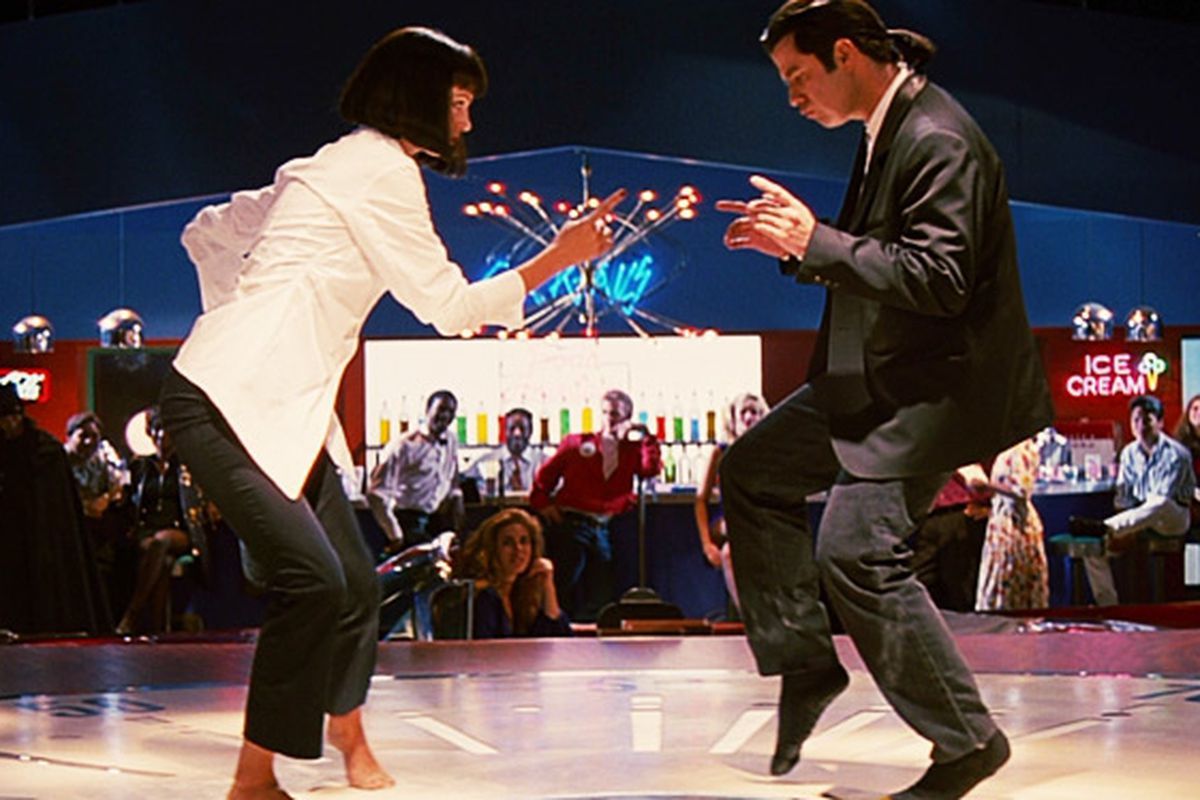
It is the bare feet. Or maybe the way Uma Thurman’s Mia Wallace moves her hands like she is trying to wipe a foggy window. Everyone remembers the scene at Jack Rabbit Slim’s. It is 1994. Quentin Tarantino is about to change cinema forever with a needle drop. When that guitar riff kicks in—that bouncy, double-stop Chuck Berry signature—it doesn't just start a dance contest. It cements the song from the Pulp Fiction dance as a permanent piece of the global subconscious.
The track is "You Never Can Tell," often called "C’est La Vie" by people who only know the chorus. It was written and performed by the legendary Chuck Berry. But here is the thing: the song wasn't a new hit when the movie came out. It was already thirty years old. Berry actually wrote it while he was sitting in a federal prison cell in the early 60s. He was doing time for a Mann Act violation, and yet he managed to pen one of the most upbeat, celebratory songs about teenage marriage and the "sunny South."
Tarantino is a nerd. A massive, obsessive, record-store-clerk kind of nerd. He didn't pick this song because it was cool. He picked it because it felt like a weird, anachronistic fit for a 1950s-themed diner where the waiters are dressed like Buddy Holly and Marilyn Monroe. It shouldn't work. John Travolta, the king of disco from Saturday Night Fever, doing a deadpan twist to a 60s rock-and-roll track? It sounds like a disaster on paper.
The Weird History of You Never Can Tell
Most people think of Chuck Berry and think of "Johnny B. Goode" or "Maybellene." Those are the high-octane tracks. "You Never Can Tell" is different. It’s got that distinctive piano—played by Johnnie Johnson—that sounds like it belongs in a saloon. The lyrics tell a very specific story about a "teenage wedding" where the "old folks wished them well." It’s wholesome. It’s domestic.
That is exactly why it works in Pulp Fiction.
Mia Wallace and Vincent Vega are not wholesome people. He is a heroin-using hitman; she is the "bored" wife of a terrifying crime boss. Putting them in a brightly lit, kitschy restaurant to dance to a song about a young couple buying a "souped-up jitney" and a "cherry red '53" creates this incredible friction. It’s the irony that fuels the scene. If they had danced to something dark or edgy, the tension would have been too on-the-nose. Instead, we get the Twist, the Watusi, and the Swim.
Why John Travolta Almost Didn't Do It
You'd think Travolta would be jumping at the chance to show off his moves again. He hadn't really danced on screen in a big way since the late 70s and early 80s. But he was actually hesitant. He didn't want to parody himself. Tarantino had to convince him that the song from the Pulp Fiction dance required a very specific, low-energy vibe.
"I said to Quentin, 'What kind of dance do you want?'" Travolta later recalled in various interviews. Tarantino wanted the Twist. But Travolta told him that if they were going to do the Twist, they had to do it the way people actually did it back then. He suggested adding the "B-movie" touches—the fingers across the eyes, the subtle hip sways.
Uma Thurman was even more terrified. She reportedly told Tarantino she "didn't have the rhythm" for it. Imagine being one of the most famous actresses in the world and having to dance opposite the guy who did Grease. She was intimidated. Tarantino, in his typical fashion, just told her to "not worry about it" and to just have fun. That lack of polish is why the scene is legendary. It doesn't look like a choreographed music video. It looks like two people who are slightly high, slightly awkward, and trying to win a plastic trophy.
The Technical Brilliance of the Scene
If you watch the scene closely, the cinematography by Andrzej Sekuła is deceptively simple. It uses long takes. This is vital. In modern movies, editors chop dance scenes into a thousand pieces to hide the fact that actors can't dance. Here, the camera stays back. It lets you see their whole bodies.
The sound mixing is also worth noting. The song from the Pulp Fiction dance starts with that heavy bass and piano, but as the camera moves around the diner, the acoustics change slightly. It feels like you are actually sitting in a booth at Jack Rabbit Slim’s, smelling the expensive shakes and the floor wax.
The Chuck Berry Comeback
Before Pulp Fiction, Chuck Berry was respected as a pioneer, but he wasn't necessarily "current." This movie changed that. Suddenly, every wedding DJ in America had "You Never Can Tell" on their must-play list. It rejuvenated his royalty checks and introduced a generation of Gen Xers and Millennials to the specific swing of his storytelling.
- The song reached #14 on the Billboard Hot 100 back in 1964.
- The Pulp Fiction soundtrack went multi-platinum.
- The "Mia and Vincent" dance has been parodied in everything from The Simpsons to Community.
Common Misconceptions About the Dance
A lot of people think the dance was improvised. It wasn't. While it has a loose feel, Tarantino had very specific references in mind. He was heavily influenced by a dance scene in Jean-Luc Godard’s Bande à part (Band of Outsiders). He wanted that French New Wave "coolness"—the idea of people breaking into dance for no apparent reason other than they felt like it.
Another myth: They didn't actually win the contest. If you listen carefully later in the movie, there is a radio broadcast playing in the background of another scene that suggests the trophy might have been stolen. It adds this extra layer of "Tarantino-ness" to the whole thing. Did they win because they were good, or did they win because they were the most dangerous people in the room? Or did they just take the trophy and leave?
The Legacy of the Sound
The song from the Pulp Fiction dance is more than just a background track. It’s a character. It represents the "Old World" of 1950s Americana colliding with the "New World" of 1990s violence and irony. When the song ends and the scene cuts, the energy of the movie shifts. The honeymoon period of Mia and Vincent's night is over, and the chaos—the overdose, the adrenaline shot, the panic—is about to begin.
Honestly, if you are looking to recreate this vibe at a party or just want to understand why it works, you have to look at the tempo. It’s 156 beats per minute, roughly. It’s fast enough to move to, but slow enough to "cool guy" your way through it. You don't need to be a pro. You just need a pair of white socks and a lot of confidence.
To truly appreciate the impact of this moment, you should look into the rest of the Pulp Fiction soundtrack. It popularized the "surf rock" aesthetic, featuring artists like Dick Dale and The Revels. But "You Never Can Tell" remains the heart of the film's pop-culture footprint.
How to Master the Pulp Fiction Vibe
If you want to dive deeper into the world of Tarantino's musical choices or perhaps try to mimic the iconic moves yourself, here are the next steps to take:
- Listen to the full Chuck Berry version: Pay attention to the lyrics. The story of Pierre and Mademoiselle is actually a beautiful piece of short-form storytelling that mirrors the "couple on the run" themes Tarantino loves.
- Watch Band of Outsiders (1964): See the Madison dance scene that inspired Tarantino. You will see the exact DNA of Mia and Vincent’s movements.
- Study the "V-sign" move: If you’re dancing to this at a wedding, remember the fingers across the eyes (the "B-movie" move) should be done with a completely straight face. The secret is the lack of a smile.
- Explore the Soundtrack: Check out "Misirlou" and "Girl, You'll Be a Woman Soon" to see how Tarantino uses different genres to build tension and release throughout the film.



