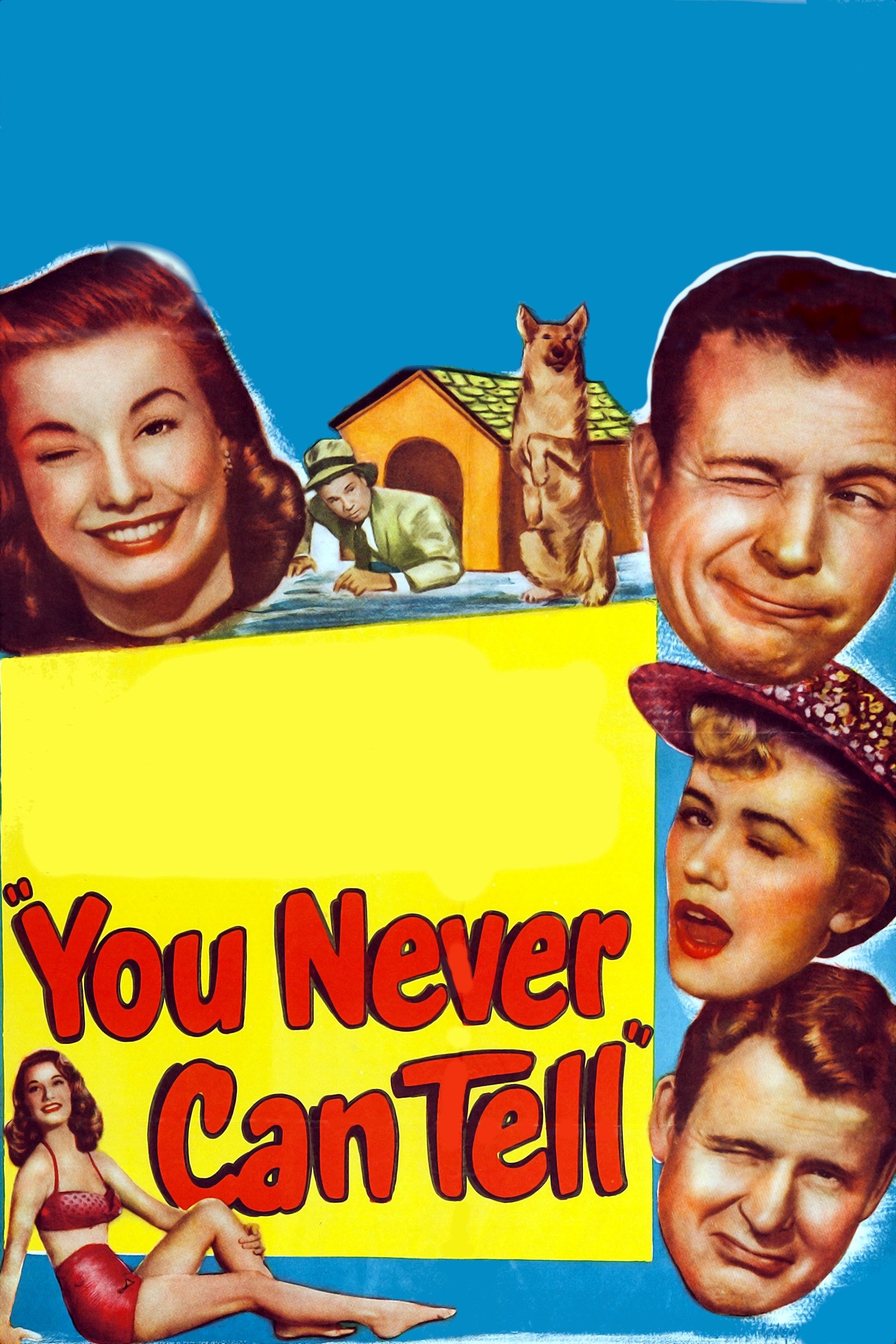
Ever wonder what happens when a German Shepherd gets murdered and comes back as a private investigator to solve his own death? No, this isn't some weird fever dream or a gritty modern reboot of a Saturday morning cartoon. It’s the actual plot of the 1951 cult classic You Never Can Tell movie. Honestly, if you haven’t seen it, you’re missing out on one of the most bizarrely charming high-concept comedies of the mid-century era. It’s weird. It’s witty. It’s got Dick Powell playing a human who used to be a dog.
Back in the early fifties, Universal-International took a massive gamble on this script. Lou Breslow, who both wrote and directed the film, clearly had a "why not?" attitude toward storytelling. The premise is straightforward but insane: King, a millionaire’s beloved dog, is poisoned. When he reaches the "Great Beyond"—a sort of celestial processing center—he’s granted a temporary return to Earth in human form to find his killer. He’s joined by a former horse who is now his human sidekick.
It's a "fish out of water" story, but the fish is a canine and the water is human society.
The Weird Logic of the You Never Can Tell Movie
Most people remember Dick Powell as the hard-boiled detective from Murder, My Sweet, but here he plays King Williams with a peculiar, jerky physicality. He doesn't just walk; he stalks. He tilts his head when he’s confused. He hates cats. He has an irresistible urge to chase sticks. It's subtle, but it works. The film doesn't rely on heavy makeup or special effects to sell the transformation. Instead, it relies on Powell's performance and the audience's willingness to go along with the gag.
Think about the era. 1951 was the year of A Streetcar Named Desire and The African Queen. Cinema was trending toward realism and grit. Then comes this movie about a reincarnated dog trying to protect a beautiful heiress played by Peggy Dow. It’s a total outlier.
Why the "Great Beyond" Scenes Matter
The opening sequence in the Great Beyond is actually quite clever. It sets the rules. You can't just go back and tell everyone you're a dog. You have to follow the "human code." King, now "Rex Shepard," is warned that if he acts too much like a dog, he’ll be hauled back. This creates a constant tension. Every time Rex sees a fire hydrant or a cat, there’s a genuine risk he’ll blow his cover.
Joyce Holden plays Goldie, the former racehorse who accompanies Rex. Her performance is equally twitchy. She has a thing for sugar cubes and carrots. Together, they navigate a world of greedy relatives and shady lawyers. It’s basically a classic noir mystery flipped on its head and injected with a dose of absurdity.
Directing the Absurd: Lou Breslow’s Vision
Lou Breslow wasn't a household name like Hitchcock, but he had a knack for comedy. He’d written for the Marx Brothers and Abbott and Costello. You can feel that DNA in the You Never Can Tell movie. The pacing is brisk. Some scenes are just two minutes of Powell sniffing around a room, which sounds boring on paper but is hilarious in execution because of the context.
The film operates on two levels. For kids, it’s a silly story about a dog-man. For adults, it’s a satire on the legal system and the way we treat animals. The "will" that King was supposed to inherit (yes, the dog was the primary beneficiary of a massive estate) is the catalyst for the entire plot. It highlights the ridiculousness of extreme wealth and the lengths people will go to for a piece of the pie.
The Mystery at the Heart of the Film
Strip away the reincarnation and you actually have a decent whodunit. Was it the lawyer? The distant cousin? The housekeeper? The film keeps you guessing, mostly because Rex uses his canine senses to find clues that a human detective would miss. He literally smells the murderer.
Interestingly, the movie received mixed reviews upon release. The New York Times at the time called it "thin," but audiences liked it. It’s one of those films that found its real life on television in the 60s and 70s. It became a staple of late-night movie blocks, which is where most of its cult following originated.
Analyzing the Performance: Dick Powell’s Pivot
If you look at Dick Powell’s career, this was a strange choice. He had spent years trying to shed his "pretty boy" singer image from the 1930s. He fought hard to play Philip Marlowe. Why go back to a gimmick comedy?
Maybe he just wanted to have fun. Or maybe he saw the brilliance in the physical comedy. Powell plays it completely straight. He doesn't wink at the camera. He treats the mission with the gravity of a life-and-death investigation. That’s the secret sauce. If the lead actor thinks it’s a joke, the audience won’t care. Because Powell takes it seriously, we do too.
Breaking Down the Supporting Cast
Peggy Dow as Ellen is the emotional anchor. She was a rising star at the time, coming off Harvey (another film with an invisible/imaginary animal theme). She plays the "straight man" to Powell’s eccentricities. Then you have Charles Drake and Albert Sharpe, who fill out the ensemble with the kind of reliable character acting that defined 1950s studio films.
- Dick Powell: Rex Shepard (The Dog)
- Peggy Dow: Ellen (The Protagonist's love interest)
- Joyce Holden: Goldie (The Horse)
- Charles Drake: Perry (The Villain?)
The chemistry between Powell and Holden is particularly good. They share a bond that the "regular" humans can't understand. It’s a literal animal magnetism.
Misconceptions About the Movie
One big mistake people make is confusing this with other "animal-into-human" movies like The Shaggy Dog. That movie came later (1959) and was a Disney production. You Never Can Tell is more sophisticated and, frankly, a bit darker. It starts with a murder, after all. It’s not a "family movie" in the modern, sanitized sense. It’s a comedy with teeth.
Another misconception is that it’s a fantasy film. While the premise is fantastic, the execution is a noir parody. The lighting is often moody. The stakes feel real. When Rex is in danger, you actually worry, even though you know he’s technically already dead.
Why This Film is a "Discover" Gem Today
In 2026, we are obsessed with high-concept stories. Everything is a multiverse or a simulation. Returning to a film like the You Never Can Tell movie feels refreshing. It doesn't need a $200 million budget to tell a story about the soul. It uses clever dialogue and physical acting.
It’s also a fascinating time capsule. You see the fashion of 1951, the cars, the social etiquette. But then you have this guy sniffing a lady’s perfume and identifying the brand from twenty feet away because his nose is still "dog-active." It’s a weirdly perfect blend of era-specific style and timeless silliness.
How to Watch It Now
Finding a high-quality version can be tricky. It isn't always on the major streaming platforms like Netflix or Max. You usually have to hunt for it on Turner Classic Movies (TCM) or find a boutique DVD release. It hasn't received a massive 4K restoration yet, which is a shame. The black-and-white cinematography is crisp and deserves a proper digital cleanup.
If you’re a fan of "The Twilight Zone" but wish it was funny, or if you like classic detective stories but find them too dry, this is your movie. It’s a 87-minute breezy watch that leaves you smiling.
Final Verdict: Does It Hold Up?
Kinda. Parts of it are definitely dated. The pacing in the second act slows down a bit too much for modern tastes. However, the core concept is so strong that it carries the film through the lulls. Powell’s performance alone is worth the price of admission.
It’s a reminder that Hollywood used to be much weirder than we remember. We think of the 50s as this buttoned-up, conservative era, but then you find a movie where a German Shepherd gets a second chance at life as a private eye. That’s pure creative anarchy.
If you want to dive deeper into the world of 1950s experimental comedy, your next steps are clear:
- Search for "You Never Can Tell 1951" on physical media sites like Criterion or Kino Lorber to see if a restored version is in the works.
- Compare this to The Shaggy Dog (1959) to see how the "human-animal" trope evolved over a decade.
- Look up Lou Breslow’s other writing credits; his work with the Marx Brothers explains a lot about the comedic timing in this film.
- Check out Dick Powell’s other 50s work to appreciate just how much of a departure this role was for him.
The You Never Can Tell movie remains a strange, flickering light in the history of Universal Pictures. It’s a film that proves that sometimes, the best way to tell a human story is through the eyes—and nose—of a dog.



