Honestly, if you grew up in the 90s, you didn't just hear Toni Braxton; you felt her. There was something about that husky, chocolatey contralto that made every heartbreak feel like a cinematic event. But while "Un-Break My Heart" usually gets all the glory for being the massive, world-shaking titan, there’s a quieter, more soulful magic in her 1994 hit You Mean the World to Me. It’s the kind of track that defines an era without needing to shout.
It wasn't just a song. It was a mood.
The Anita Baker Connection (That Almost Didn't Happen)
Here’s a bit of trivia that most casual listeners miss: You Mean the World to Me was originally written with Anita Baker in mind. Think about that for a second. You can almost hear Anita’s signature "Rapture"-era phrasing in the melody. But Anita passed on it.
That rejection became Toni’s golden ticket.
LaFace Records—specifically the powerhouse trio of L.A. Reid, Babyface, and Daryl Simmons—knew they had a star on their hands. They gave the song to Toni, and she basically took that "Anita-style" blueprint and injected it with her own smoky, low-register vulnerability. It’s funny how the music industry works; one legend's "no" creates another legend's definitive moment.
Why the Song Refused to Leave the Charts
When the single dropped in April 1994, it didn't just vanish after a few weeks. It was a slow burn. It debuted at a modest number 86 on the Billboard Hot 100 but eventually clawed its way up to number 7.
It stayed on the charts for 31 weeks.
Thirty-one weeks! In today’s TikTok-speed music cycle, 31 weeks on the Hot 100 is almost unheard of for a ballad. People weren't just streaming it on a loop; they were calling radio stations, buying the CD single at Sam Goody, and recording it off the air onto cassette tapes.
Breaking Down the Sound
The production is peak 90s LaFace. You’ve got those "finger-poppin'" rhythms—as Billboard’s Larry Flick called them at the time—mixed with these thick, slick synths. It manages to be both "warm and fuzzy" and incredibly polished.
- The Vocals: Toni does this thing where she slides into notes from below. It's technically called "scooping," but on her, it just sounds like pure silk.
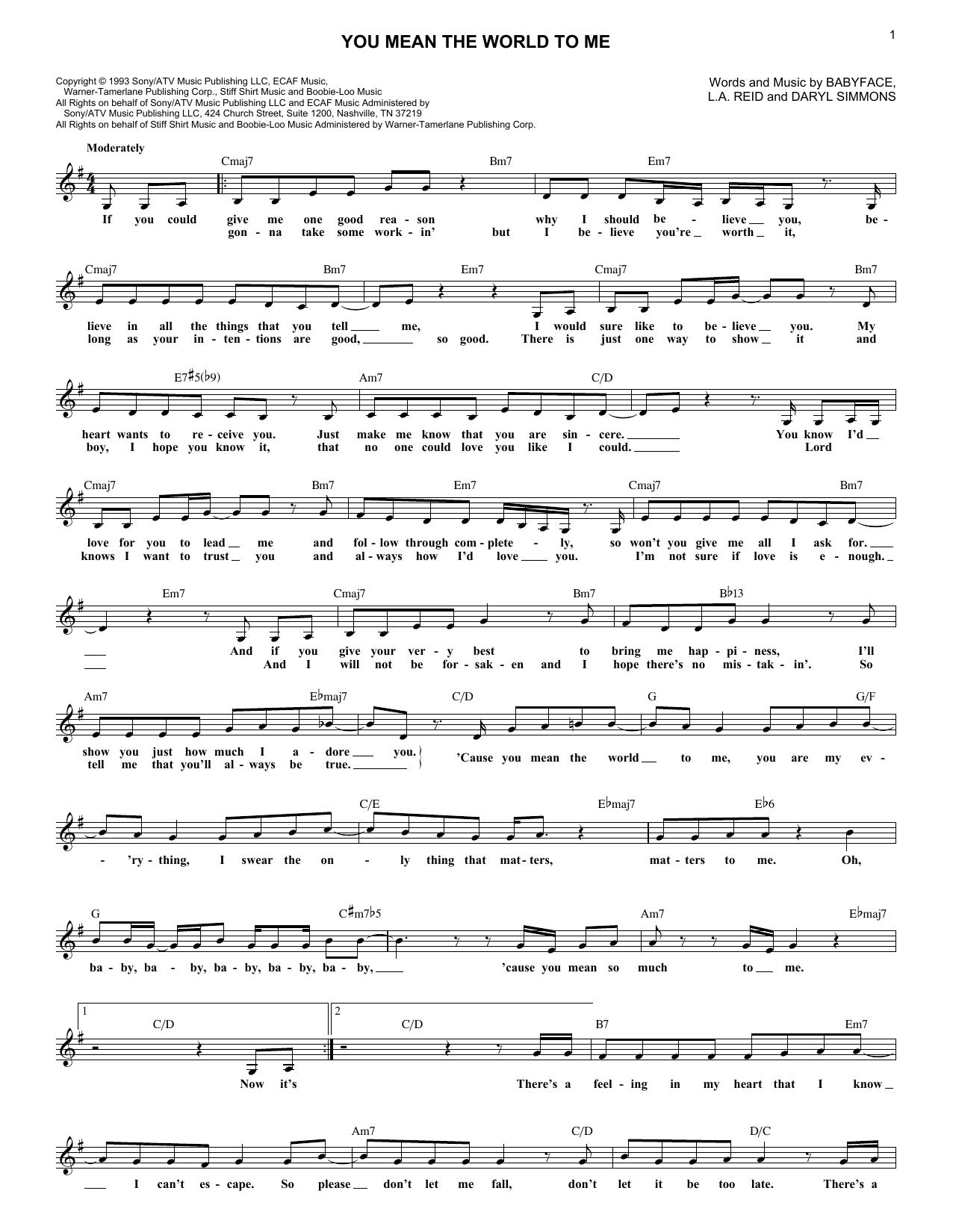
- The Lyrics: It’s a song about the tension between skepticism and surrender. "If you could give me one good reason why I should believe you..." It starts with doubt and ends in total devotion.
- The Bridge: The way the music swells when she sings "I'll show you just how much I adore you" is a masterclass in R&B dynamics.
The music video, directed by Lionel C. Martin, didn't hurt either. It was simple: Toni at a piano in a mansion, looking effortless. No CGI, no backup dancers, just a vibe. Michael Calvin Bacon played the love interest, and for a solid summer, that video was on heavy rotation on MTV and BET.
The Legacy of a "Fourth Single"
Usually, by the time an artist gets to their fourth single from an album, the momentum is dying down. Not for Toni. Her self-titled debut was a juggernaut. You Mean the World to Me followed hits like "Another Sad Love Song" and "Breathe Again," yet it still felt fresh. It helped push that debut album to over 10 million copies sold worldwide.
It also nabbed a Soul Train Music Award nomination for Best R&B/Soul Single – Female. Even though it was competing with massive hits from Whitney Houston and Janet Jackson, it held its own because it felt more intimate. It wasn't a "power ballad" in the Whitney sense; it was a "soul burner."
What Most People Get Wrong
People often lump this song into the "sad song" category because it's Toni Braxton. She’s the Queen of Heartbreak, right? But if you actually listen to the words, it’s one of her most optimistic tracks. It’s about a relationship that’s actually working—or at least one where she’s willing to put in the "workin'" because the person is "worth it."
It’s a rare moment of light in a discography that’s often draped in velvet-lined sorrow.
How to Appreciate the Track Today
If you want to really "get" why this song matters, do these three things:
- Listen to the "Radio Edit" vs. the Album Version. The radio edit tightens the intro, but the album version lets the atmosphere breathe.
- Watch the 1994 MTV Awards performance. It’s a reminder that she didn't need auto-tune or a massive stage production to command a room.
- Check out the live B-side "Seven Whole Days." Most of the CD singles came with a live version of "Seven Whole Days" that shows off her improvisational skills.
The song is a bridge between the classic soul of the 70s and the hip-hop soul that would dominate the late 90s. It’s sophisticated but accessible. It’s basically the musical equivalent of a glass of expensive red wine on a rainy Tuesday. Even decades later, when that first synth chord hits, you know exactly where you are.
To keep the 90s R&B nostalgia going, you might want to look into the production credits of Babyface during this specific 1993-1994 window—he was essentially untouchable, crafting similar hits for TLC and Boyz II Men that shared this same DNA.



