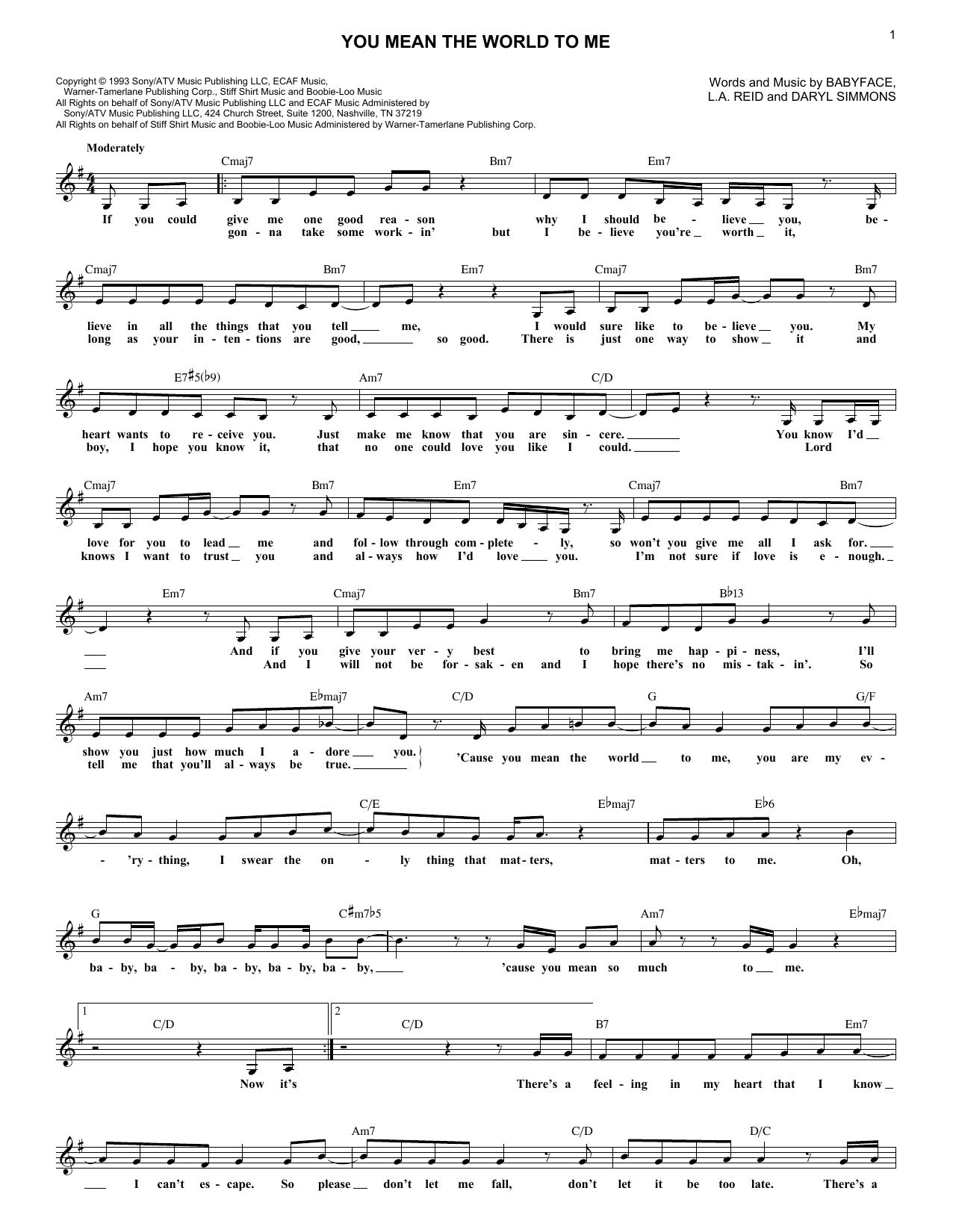
Honestly, if you grew up in the 90s, you probably remember exactly where you were when you first heard that smoky, low-register vibrato. It was everywhere. Toni Braxton didn't just sing; she emoted in a way that felt like she was reading your private journal. And while everyone points to "Un-Break My Heart" as her definitive moment, real fans know the true magic happened a couple of years earlier. Specifically, with her fourth single from that legendary self-titled debut. You Mean the World to Me is, quite simply, a masterclass in R&B vulnerability.
It’s 1994. The radio is dominated by a mix of West Coast G-funk and the rising tide of alternative rock. Then, this piano-driven ballad drops. It doesn't scream for attention. It doesn't have a flashy rap feature. It just has Toni.
The Secret Sauce: Babyface, L.A. Reid, and Daryl Simmons
You can’t talk about this song without mentioning the "Holy Trinity" of 90s production. Antonio "L.A." Reid, Kenneth "Babyface" Edmonds, and Daryl Simmons. They were the architects of the LaFace Records sound. When they got together in the studio—specifically at Studio LaCoCo in Atlanta—they weren't just making "tracks." They were building a legacy.
They wrote and produced You Mean the World to Me with a very specific goal: to showcase Toni’s range. Most people think of her as just a "deep voice" singer, but listen to the pre-chorus. There’s an escalation there. The way the synth pads swell? That's intentional. It’s designed to create what the industry calls "romantic escalation." Basically, it’s the musical equivalent of a slow-motion hug.
The song officially hit the CD shelves on April 21, 1994. But here’s the wild thing: it actually debuted on the Billboard Hot 100 nearly three weeks before its official release. Radio stations were so hungry for new Toni material that they just started spinning it from the album. It eventually peaked at number seven. Not bad for a fourth single, right?
Why the Music Video Mattered
The visual for You Mean the World to Me was directed by Lionel C. Martin. If that name sounds familiar, it’s because he was the go-to guy for R&B royalty back then. He kept it simple. Toni at a piano in a mansion. Soft lighting. Cinematic intercuts with her love interest.
Speaking of the love interest—most people don't realize that was Michael Calvin Bacon. He’s a German-born actor who later went on to star in VR Troopers. It was the quintessential 90s "luxury" video. It wasn't about being edgy; it was about being timeless. It stayed in heavy rotation on MTV and VH1 all summer long because it just felt expensive.
Breaking Down the Chart Success
The numbers are actually pretty staggering when you look at the 1994 year-end charts.
- Billboard Hot 100: Peaked at #7 and stayed on the chart for 31 weeks.
- Billboard Hot R&B Singles: Hit #3.
- Canada: Cracked the top 10 (peaked at #6).
- UK: Reached #30.
It wasn't just a flash in the pan. By the time 1994 wrapped up, the song was the #17 song of the entire year in the US. This kind of longevity is why Toni’s debut album eventually went 8x Platinum.
The Misconception About "Sad Love Songs"
People often lump Toni Braxton into the "sad song" category. I mean, her first single was literally called "Another Sad Love Song." But You Mean the World to Me is actually optimistic. Sorta. It’s a confession. It’s about that terrifying moment where you realize you're actually in love and you’re ready to admit it.
Musically, it’s written in G major. That’s a "happy" key, technically speaking. But Toni’s delivery gives it this weight. She has this way of making even a love song feel like she’s fighting for her life. It’s that grit in her voice.
Legacy and That Infamous Grammy Run
1994 was the year of Toni. She won Best New Artist and Best Female R&B Vocal Performance (for "Another Sad Love Song"). Then, a year later, she won another Grammy for "Breathe Again." You Mean the World to Me was the bridge between those two massive milestones. It kept her name in everyone's mouth while she was touring the world.
The song even earned a Soul Train Music Award nomination for Best R&B/Soul Single in 1995. Even though she didn't take home the trophy for this specific track, it solidified her as the premier "adult contemporary" R&B star. She wasn't just for the kids; she was for the sophisticated listeners who wanted real instruments and real vocals.
Revisiting the Track Today
If you listen to it now, it hasn't aged a day. That’s the beauty of the Babyface era. They used real bass (played by Kayo) and real drums (often L.A. Reid himself). It doesn't have the "plastic" sound of some mid-90s dance-pop.
For many, this song is the ultimate wedding track. For others, it’s the soundtrack to a very specific kind of 90s nostalgia. You know, the kind involving landline phones and recording songs off the radio onto a cassette tape.
How to Appreciate This Classic in 2026
If you want to dive back into the Toni Braxton discography, don't just stream the radio edit. Look for the Extended Mix found on the 1994 UK CD single. It runs over five minutes and lets the instrumentation breathe in a way the radio version doesn't.
Also, check out the live version of "Seven Whole Days" that was often included as a B-side. It shows the raw power of her voice without the studio polish. It’s a reminder that before the reality shows and the financial struggles, Toni Braxton was—and still is—one of the greatest vocalists to ever step into a recording booth.
Your Next Steps:
- Compare the Mixes: Listen to the original album version versus the "Radio Edit Remix." The remix has a slightly punchier percussion that changed the vibe for the dance charts.
- Watch the Un-Cut Video: Look for the high-definition remasters of the Lionel C. Martin video to see the 90s aesthetic in full detail.
- Explore the Credits: Look into the work of Daryl Simmons; he’s often the unsung hero behind these massive LaFace hits.



