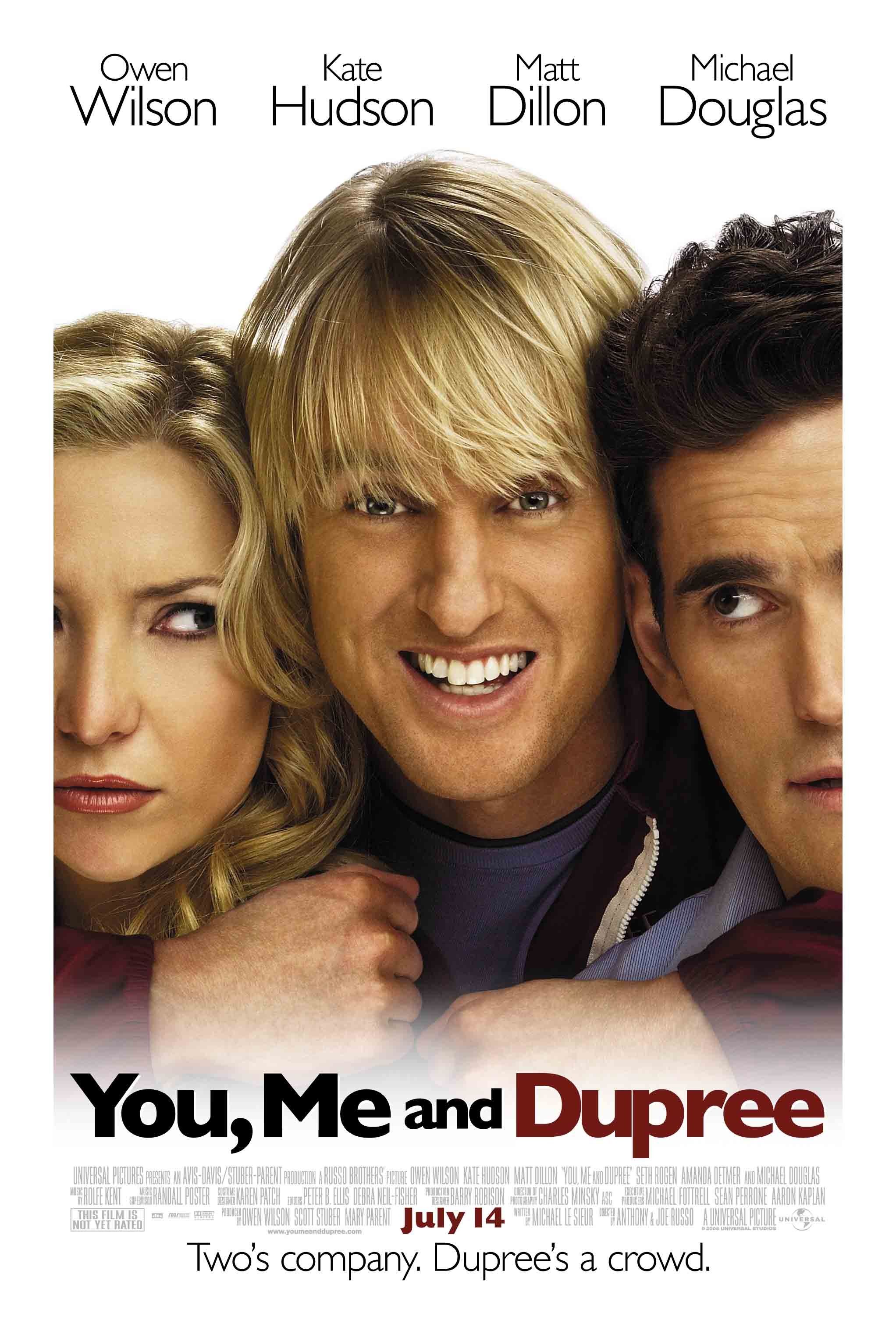
Honestly, if you turned on a TV at any point during the mid-2000s, you couldn't escape the "slacker" trope. It was everywhere. But You, Me and Dupree did something specific. It took the concept of the uninvited houseguest—a premise as old as What About Bob?—and filtered it through the lens of post-college burnout and corporate existential dread.
The movie stars Owen Wilson as Randolph Dupree. He’s the guy we all know. The one who stayed behind in the "fun" phase while everyone else got mortgages and spreadsheets. When his best friend Carl (Matt Dillon) marries Molly (Kate Hudson), Dupree loses his job and his home. Naturally, he crashes on their couch. Chaos ensues.
But there’s a layer to this film that most people sort of gloss over. It’s not just about a guy who won't leave. It’s about the crushing weight of the "American Dream" and what happens when someone refuses to play the game.
The "Dupree-ism" Philosophy and the Owen Wilson Magic
Owen Wilson was at the absolute peak of his "Butterscotch Stallion" powers in 2006. He wasn't just playing a character; he was playing a vibe. Dupree isn't a villain. He isn't trying to ruin Carl’s life. He actually loves Carl. He’s just... untethered.
The film relies heavily on "Dupree-isms." These are little nuggets of pseudo-philosophical wisdom that sound like they came from a fortune cookie found in a surf shop. "You've got to find your 'ish', Carl." It’s easy to laugh at, but in the context of the 2026 gig economy and the "quiet quitting" movement, Dupree looks less like a loser and more like a pioneer. He’s the original proponent of work-life balance, even if his "work" is mostly nonexistent.
The chemistry between the leads is what keeps this from being a generic throwaway. You have Matt Dillon playing the "straight man" with a simmering rage that feels very real. Kate Hudson provides the grounding force. Then you have Michael Douglas as Mr. Thompson—the overbearing father-in-law.
Douglas is terrifying here. He represents the corporate machine that wants to grind Dupree into dust. When he tells Carl he needs to get a vasectomy to focus on the business, it’s played for laughs, but it’s dark. Really dark.
Why the Critics Were Wrong (and Why Audiences Loved It)
Critics mostly hated it. Rotten Tomatoes has it sitting at a measly 20%. They called it derivative. They said it was a waste of talent.
They missed the point.
Movies like You, Me and Dupree aren't trying to be Citizen Kane. They are comfort food. They are about the anxiety of transition. Moving from your 20s to your 30s is terrifying. You start realizing that your friends are becoming strangers with ties and titles. Dupree is the ghost of Christmas Past, reminding you that you used to be fun.
The box office tells a different story than the reviews. It made over $130 million worldwide. People showed up because the dynamic of the "third wheel" is universal. We have all been Dupree, or we have all had a Dupree on our sofa for three weeks too long.
The Russo Brothers Before the Avengers
Here is a fun fact that most people forget: this movie was directed by Anthony and Joe Russo.
Yes, the same guys who directed Avengers: Endgame and Captain America: The Winter Soldier. Before they were handling billion-dollar franchises and cosmic battles, they were filming Owen Wilson accidentally setting a living room on fire while trying to bake a salmon.
You can see their fingerprints on the pacing. The way the domestic tension escalates feels very "Russo." They have a knack for ensemble dynamics. Even in a silly comedy, they manage to make the relationship between Carl and Dupree feel earned. It’s a bromance, sure, but it’s one rooted in a history we don't see, only feel.
The Corporate Satire Nobody Talks About
While the surface plot is about a houseguest, the subtext is a brutal takedown of corporate culture. Carl works for a land development firm. His father-in-law is his boss. His identity is being slowly erased.
Dupree is the antithesis of this. He represents "The Ness." Your essence. Your soul.
When the movie leans into the workplace scenes, it becomes a different beast. It highlights the absurdity of the corporate ladder. Carl is forced to change his name professionally. He's forced to change his lifestyle. Dupree’s presence in the house acts as a catalyst for Carl’s eventual breakdown. It’s not that Dupree is a bad influence; it’s that Carl’s life is a fragile house of cards that can't withstand one person being authentic.
Breaking Down the Cast and Their Impact
- Owen Wilson: Perfectly cast. Nobody else can deliver lines about "soul-searching" while wearing a Hawaiian shirt quite like him.
- Matt Dillon: His physical comedy is underrated. The way his face twitches when Dupree mentions "Seven Minute Abs" is a masterclass in frustration.
- Kate Hudson: She has the hardest job. She has to be the voice of reason without being a "buzzkill." She mostly pulls it off.
- Michael Douglas: He steals every scene. He plays the role with the same intensity he brought to Gordon Gekko, but with a weirdly hilarious fixation on his daughter’s reproductive choices.
Real-World Lessons from a "Stupid" Movie
It’s easy to dismiss a movie where a guy uses a bidet for the first time as "lowbrow." But there is a legitimate psychological element to You, Me and Dupree.
Boundaries.
The film is a 108-minute lesson in why boundaries matter. Carl and Molly didn't have them. Dupree didn't know they existed. Most of the conflict could have been solved with one honest conversation in the first ten minutes. But then we wouldn't have a movie.
In a world that is increasingly lonely, where people are more disconnected despite being "connected," the idea of a friend who refuses to leave has a strange sort of warmth to it. Dupree is annoying, but he’s there. He’s present. In 2026, where we all communicate through screens, a guy actually sitting on your porch—even if he’s wearing your robe—feels almost nostalgic.
What Most People Get Wrong
People think Dupree is a "man-child." I disagree.
A man-child avoids responsibility because he's afraid of it. Dupree avoids it because he doesn't value what the system offers. He’s not lazy; he’s a minimalist. He finds joy in the small things, like a perfect sunset or a neighborhood library. He's basically a monk with a library card and a penchant for trouble.
The ending of the movie often gets criticized for being too neat. Dupree becomes a motivational speaker. Carl stands up to his boss. Everything is fixed.
But look closer. Dupree doesn't change. He just finds a way to get paid for being himself. That’s the dream, isn't it? To find a way to monetize your "ish" so you don't have to sleep on a couch anymore.
How to Apply "The Ness" to Your Life
If you want to take something away from this film besides a few laughs, look at your own "Ness."
- Audit your influences. Are you like Carl, letting a "Mr. Thompson" dictate your worth? Or are you holding onto your original personality?
- Check your couch. Do you have people in your life who challenge your comfort zone? Sometimes we need a Dupree to shake things up, even if it's messy.
- Find your "Ish." What is the one thing you do that makes you feel like you? Not the worker, the spouse, or the parent. Just you.
You, Me and Dupree isn't a masterpiece of cinema. It’s a time capsule. It’s a reminder of a specific era of comedy and a specific kind of anxiety. If you haven't seen it in a decade, it's worth a rewatch. You might find that you relate to Dupree a lot more now than you did back then.
To truly understand the impact of the film, watch it alongside other 2006 comedies like Talladega Nights or The Break-Up. You’ll notice a recurring theme of men struggling with their place in a rapidly changing world. Dupree is the only one who seems to have figured it out by simply opting out.
Actionable Next Steps:
- Revisit the film with an eye on the cinematography. Notice how the Russos use tight shots to emphasize Carl's claustrophobia.
- Identify your corporate "vasectomy." What parts of your personality are you sacrificing for a paycheck?
- Practice setting a boundary today. Say no to one thing that drains your "Ness" without offering anything in return.



