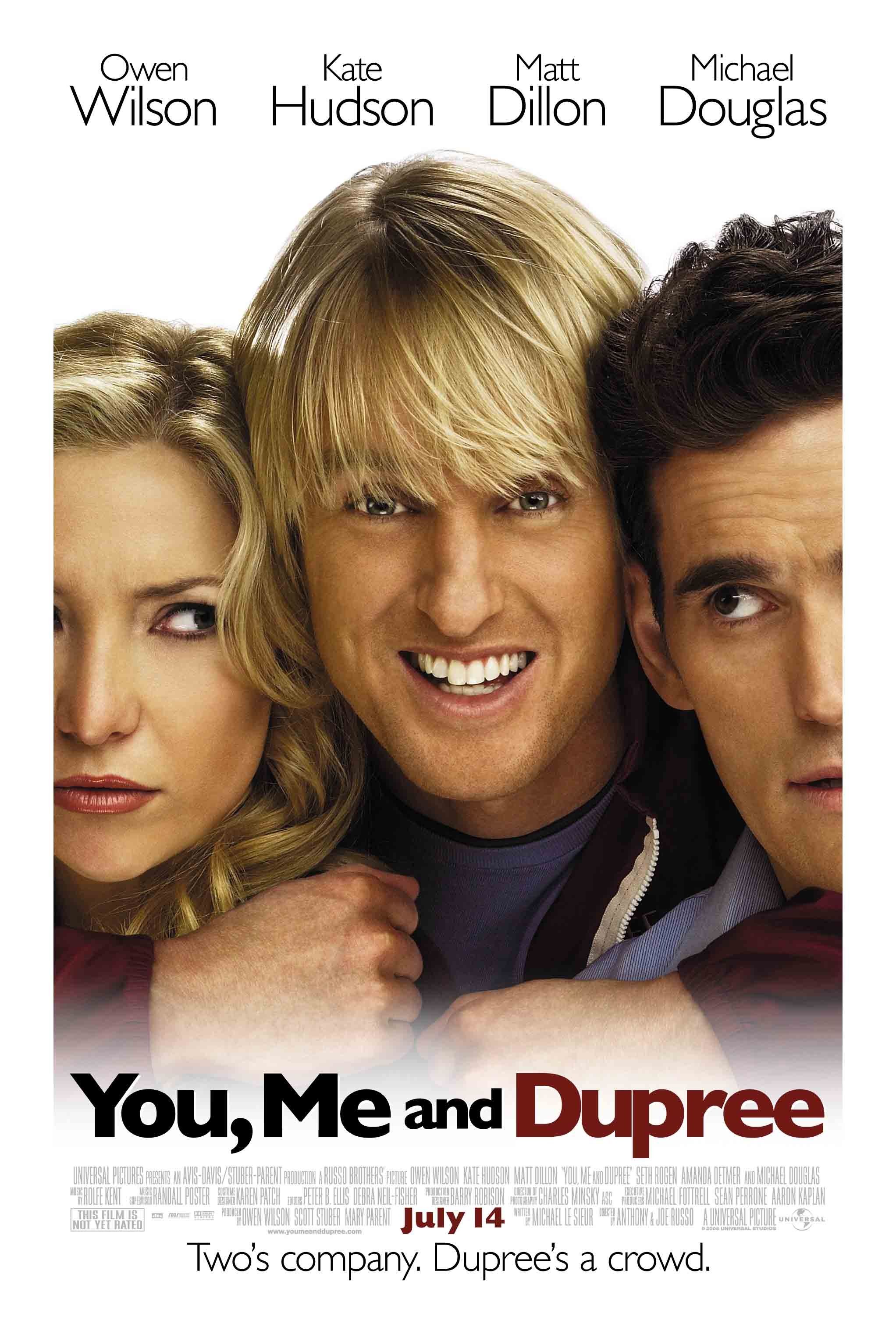
Honestly, if you grew up in the mid-2000s, you probably remember the yellow poster. Owen Wilson, sporting that signature shaggy blonde hair and a mischievous grin, sandwiched between a very stressed-looking Matt Dillon and Kate Hudson. You, Me and Dupree wasn't trying to win an Oscar. It didn't want to change the world. It just wanted to ask one very uncomfortable question: What do you do when your best friend moves onto your couch and refuses to leave?
It’s been nearly two decades since the movie dropped in 2006.
Back then, critics were somewhat lukewarm. Rotton Tomatoes still has it sitting at a pretty mediocre 20% from critics, though the audience score tells a much friendlier story. Why? Because the "houseguest from hell" is a universal trope. We’ve all been Carl. We’ve all been Molly. And, if we’re being really honest with ourselves, most of us have had a "Dupree phase" where we were just a little too comfortable living off the grid (and off our friends).
The Plot That Every Newlywed Fears
The setup is basic. Carl (Matt Dillon) and Molly (Kate Hudson) are the perfect couple. They’ve got the house, the careers, and the fresh wedding glow. Then comes Randy Dupree.
Dupree is the best man who loses his job, his car, and his apartment all in one fell swoop. Naturally, Carl offers him a place to crash for a "couple of days." We all know how that goes. Those days turn into weeks. The weeks turn into... well, a lifestyle.
What makes You, Me and Dupree work isn't just the slapstick. It’s the tension of the "third wheel" dynamic. It taps into that specific anxiety of early marriage where you’re trying to build a private life, but the ghosts of your bachelor past keep showing up to ruin the expensive rug.
Why Owen Wilson Was the Only Choice
Could anyone else have played Randy Dupree? Probably not.
Wilson has this specific "slacker-philosopher" energy. He makes Dupree feel less like a parasite and more like a lost soul who just happens to enjoy riding a bicycle in his underwear. He brings a weirdly poetic vibe to the character. Dupree isn't a bad guy; he’s just someone who hasn't checked his mail in three years and thinks "the system" is out to get him.
His chemistry with Matt Dillon is what anchors the film. Dillon plays the straight man with a simmering rage that feels very real. You can see the veins popping in his neck as he watches Dupree bond with his father-in-law, played by the legendary Michael Douglas.
The Michael Douglas Factor
Speaking of Michael Douglas, his role as Mr. Thompson is actually one of the most underrated parts of the movie. He plays Molly’s dad and Carl’s boss. He is the ultimate corporate shark.
He spends half the movie trying to castrate Carl—metaphorically, of course. He wants Carl to change his last name. He wants to control every aspect of the marriage. This creates a fascinating parallel. While Dupree is invading Carl’s home life, Mr. Thompson is invading his professional identity. Carl is being squeezed from both sides.
It’s a classic comedic structure. You have the chaos of the "bottom" (Dupree) and the pressure of the "top" (Thompson). Carl is the man in the middle just trying to keep his sanity.
Small Details You Might Have Missed
- The "Carlness" of it all: There is a specific scene where Dupree tries to explain his philosophy of "living for the moment" vs. "the grind." It’s actually surprisingly deep for a movie that features a house fire caused by a candle.
- The soundtrack: It’s peak 2006. You’ve got those breezy, acoustic-driven tracks that defined the mid-aughts comedy scene.
- The supporting cast: Seth Rogen makes a brief appearance. It was right before Superbad and Knocked Up turned him into a household name. Seeing him here is like a little time capsule of the Apatow era beginning to dawn.
Real Talk: Is the Movie Actually Good?
Look, let’s be real. If you’re looking for high-brow cinema, move along.
But if you want a movie that perfectly captures the "Quarter-Life Crisis," this is it. It’s about that transition from being a "guy" to being a "husband." It’s about the fear of losing your individuality to a mortgage and a 9-to-5.
Dupree represents the part of us that doesn't want to grow up. He’s the personification of the "fun friend" who eventually becomes the "tiring friend." The movie handles this with a surprising amount of heart. By the end, you don't actually want Dupree to leave—you just want him to find his own version of "Dupree-ness" that doesn't involve sleeping on a friend's sofa.
The Impact on the "Cringe Comedy" Genre
You, Me and Dupree arrived at a time when movies like Meet the Parents and The 40-Year-Old Virgin were dominating. We were obsessed with awkwardness.
The film leans heavily into the "second-hand embarrassment" factor. The scene where Molly walks in on Dupree in the bathroom? Classic. The "Seven Kinds of Smoke" speech? Iconic in its own weird way. It contributed to a decade of movies where the humor came from people being stuck in rooms they shouldn't be in.
Where to Watch and What to Look For
If you’re revisiting it today, you’ll notice things that didn't land back then. The pacing is a bit erratic. Some of the jokes feel a little dated in 2026. However, the core theme of boundaries remains evergreen.
You can usually find it streaming on platforms like Peacock or available for rent on Amazon. It’s the perfect "Sunday afternoon with a hangover" movie. It requires zero brain power but offers a lot of laughs.
How to Handle a Real-Life Dupree
If you actually have a friend like this, the movie is less of a comedy and more of a documentary. Experts in psychology often point to the "Dupree" archetype as someone with avoidant personality traits or just a severe lack of social boundaries.
- Set a deadline: Carl’s mistake was not giving a move-out date.
- Assign chores: If they’re staying for free, they’re the new housekeeper.
- Talk openly: Don't let the resentment simmer until you're throwing a chocolate fountain at them (yes, that happens in the movie).
The reality is that most "Duprees" don't realize they're being a burden. They think they're adding "vibes" to the house. Clear communication is usually the only way to get your couch back.
Practical Steps for Moving Forward
If you're a fan of this specific era of comedy, there are a few things you should do to get the most out of your re-watch.
First, watch it as a double feature with Wedding Crashers. It’s the ultimate Owen Wilson peak-era experience. You get to see the transition from him being the guy who crashes weddings to the guy who crashes marriages. It’s a spiritual sequel in a way.
Second, pay attention to the production design. The house in the movie is a character of its own. It’s that early 2000s "luxury" that feels so specific to the pre-recession era. Large, empty rooms that are just waiting for a slacker to mess them up.
Finally, take the "Dupree" philosophy to heart—in moderation. The movie’s big takeaway isn't that being a slacker is good, but that being too rigid will break you. Carl was failing because he was trying to be perfect. Dupree was failing because he was trying to be nothing. The middle ground is where the happy life is.
Go find your "you-ness." Just maybe don't do it on someone else's sofa.



