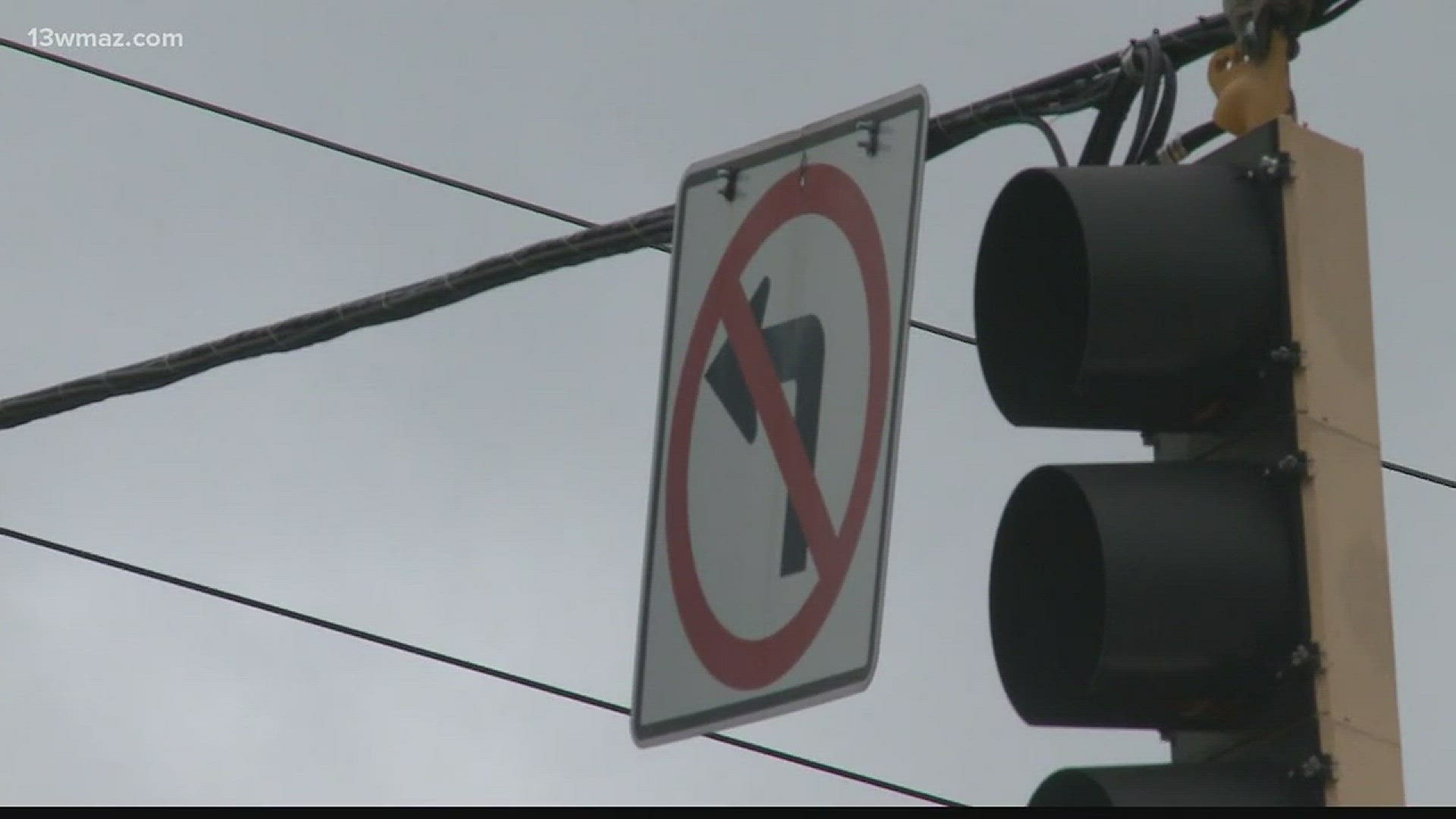
Most drivers sit at a red light staring at the bumper in front of them, waiting for the green glow like it’s a permission slip from the universe. We’ve all been there. You’re idling, burning gas, and the road to your left is completely empty. It feels like a waste of time. But here’s the thing: in a lot of places, you’re actually allowed to move. You may turn left at a red light if you’re moving from one one-way street onto another one-way street, provided there isn’t a sign screaming "No Turn on Red" at you.
It sounds wrong. We’re taught from age sixteen that red means stop. Period. But the law is a bit more nuanced than the posters at the DMV suggest.
Rules vary wildly depending on whether you’re in Michigan, Oregon, or a tight grid in downtown Indianapolis. Most people know about right turns on red. That’s standard. But the "Left on Red" rule is the dark matter of traffic law—it exists, it’s everywhere, but almost nobody actually sees it or uses it.
Honestly, if you do it in front of a cop who isn't brushed up on the specific municipal code, you might still get pulled over. You’ll win the court case, sure, but who wants the headache?
The One-Way to One-Way Golden Rule
The most common scenario where this is legal involves two one-way streets. Imagine you are driving north on a one-way road. You reach an intersection. The cross street is also a one-way road, but it flows to the west (your left).
Because you aren't crossing any lanes of oncoming traffic to make that turn, many states view it exactly like a right turn on red. You’re just merging into the flow of traffic that is already moving away from you or across your path from the right.
Forty-two states currently allow this.
If you’re in a place like Washington state or Alaska, the law is even more permissive. In those specific neck of the woods, you can actually turn left onto a one-way street even if you’re currently on a two-way street. Think about that for a second. You’re sitting in the left-turn lane of a normal, two-way road. The light is red. As long as the street you are turning onto is a one-way heading left, you can go.
It feels illegal. It feels like you're cheating. But according to the Revised Code of Washington (RCW 46.61.055), it’s perfectly fine as long as you stop first and yield to pedestrians.
Where the Law Gets Weird
Not every state plays by the same rulebook. If you try this in South Dakota, Connecticut, or Maine, you’re getting a ticket. Those states are among the few that have no "Left on Red" provision whatsoever, regardless of whether it’s a one-way street or not.
Then there’s the New York City factor.
In NYC, you can’t even turn right on red unless a sign specifically says you can. So, naturally, turning left on red is a massive no-go. The city's density makes the "predictability" of traffic more important than the "efficiency" of a few cars turning early. If you’re driving in Manhattan, just keep your foot on the brake until the light changes.
Michigan has its own flavor of traffic weirdness, often referred to as the "Michigan Left," but that usually involves U-turns and dedicated lanes. However, even there, the basic one-way to one-way rule holds up.
Let's talk about the actual execution. You can't just roll through.
- You must come to a complete, bone-jarring stop. No "California rolls."
- You have to look for pedestrians. This is where most people fail. A pedestrian crossing from your left has the right of way, and since they have a "Walk" sign, they aren't expecting a car to come barreling through a red light.
- You must yield to all other traffic in the intersection.
If there’s a sign that says "No Turn on Red," the sign wins. Always. It doesn't matter if the state law says it's okay; the local municipality has decided that specific intersection is too dangerous for the maneuver. Maybe there’s a blind spot, or maybe it’s near a school. Don’t argue with the sign.
Why Do These Laws Even Exist?
It’s all about throughput. Traffic engineers hate idling cars.
An idling car is a car that isn't moving toward its destination, which contributes to congestion. It also wastes fuel and increases emissions. By allowing turns on red, cities can move more vehicles through a grid without changing the timing of the lights.
Research from the National Highway Traffic Safety Administration (NHTSA) has looked into "Turn on Red" laws for decades. While there’s always a slight increase in risk for cyclists and pedestrians, the trade-off in traffic flow is usually seen as worth it by state legislatures.
But there’s a psychological barrier.
Even in states where it’s legal, like California or Texas, you’ll see drivers sit through an entire red light on a one-way street. They don't know the law. Or, they’re afraid the person behind them will honk, or they're worried a cop will misunderstand the situation.
There's also the "Left Turn on Red" onto a freeway on-ramp. This is a niche one. In some states, a freeway on-ramp is legally considered a one-way street. If you’re turning left to hop on the I-5 in Oregon, and the ramp is a one-way, you might be legally clear to turn on red. But check your local statutes first—California, for example, is very specific that the ramp must be clearly marked or meet strict "one-way" definitions.
The Danger Zones and Insurance Fault
Here’s the reality: if you turn left on red and get into an accident, you are almost certainly going to be found at fault.
Insurance companies treat "Turn on Red" maneuvers with a lot of scrutiny. Because you are the one entering the flow of traffic against a red signal, the burden of safety is 100% on you. You can't claim the other guy was speeding or that you didn't see him. If the light was red for you, you were the one who had to ensure the way was clear.
Different vehicles also have different rules. In some states, motorcyclists and bicyclists can turn left on red if the weight-sensitive sensors in the ground fail to detect them.
Imagine you're on a 500-pound motorcycle. You're sitting at a red light for three cycles and it won't change because you aren't heavy enough to trigger the induction loop. States like Illinois (the "Dead Red" law) allow certain vehicles to proceed through a red light after waiting a specific amount of time—usually 120 seconds—if the light is clearly not changing for them. This isn't strictly a "turn" rule, but it’s a vital piece of "red light" trivia for anyone on two wheels.
Summary of State Variations
You basically have three camps of law in the U.S. regarding this:
- The Majority: One-way street to another one-way street is allowed.
- The Permissive Few: Two-way street to a one-way street is allowed (e.g., Oregon, Washington, Idaho, Michigan, Alaska).
- The Strict Few: No left on red under any circumstances (e.g., New York, New Jersey, South Dakota).
What to Do Next Time You're at the Light
Don't just gun it because you read this.
The first step is to verify your specific state's driver handbook. They are all available online as PDFs. Look for the "Traffic Signals" or "Turns" section. It will explicitly state the "One-Way to One-Way" rule if it exists.
Next, pay attention to the street signs. Look for "One Way" arrows. If you are on a one-way and the street you're crossing is a one-way going left, and there's no sign prohibiting the turn, you're likely in the clear.
Finally, check your mirrors. If there’s a cop right behind you, and you aren't 100% sure about the local ordinance, just wait for the green. It’s not worth the twenty seconds you’ll save if it results in a roadside debate about traffic theory.
Actionable Steps for Navigating Left on Red
Driving is as much about confidence as it is about safety. If you want to use these laws to your advantage, follow this protocol:
- Confirm the One-Way Status: Look for the white-on-black "One Way" signs on both the street you are on and the street you are entering. Both must be one-way (in most states) for this to be legal.
- The Full Stop is Non-Negotiable: Your tires must stop rotating completely. If a camera is monitoring the intersection, it’s looking for that distinct pause.
- Check the "Double Threat": When turning left on red onto a one-way, remember that traffic is coming from your right. However, pedestrians may be stepping off the curb from your left. You have to look both ways, even though traffic is only coming from one.
- Identify Local Exceptions: If you're in a downtown metro area, be extra cautious. Some cities have "blanket" rules that override state laws to protect high pedestrian volumes.
- When in Doubt, Stay Put: The legal permission to turn is not a requirement. If the traffic is too heavy or your line of sight is blocked by a parked truck, just wait. No one can legally ticket you for staying stopped at a red light.
Knowing the law makes you a better driver, but applying it with common sense makes you a safer one. Next time you're stuck at that quiet downtown intersection at midnight, check the signs—you might just be able to keep moving.



