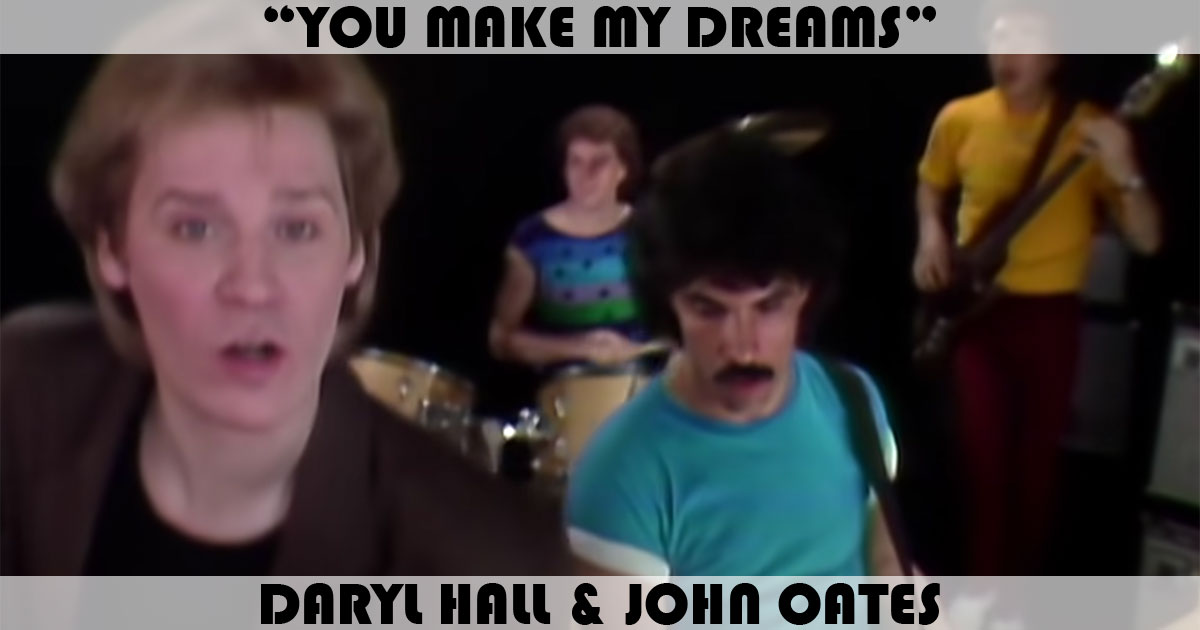
You know that feeling when a song starts and you immediately want to punch the air or skip down a hallway? That’s the "You Make My Dreams" effect. It’s a three-minute explosion of pure, unadulterated 1980s joy that has somehow managed to outlive almost every other synthesizer-heavy hit from that era. Daryl Hall and John Oates weren't just making a pop song when they recorded this in 1980. They were capturing lightning in a bottle. Honestly, the track is basically the sonic equivalent of a perfect cup of coffee on a sunny Tuesday morning. It’s caffeinated. It’s bright. It’s slightly aggressive in its optimism.
Released as the fourth single from their ninth studio album, Voices, the song didn't just climb the charts—it set up permanent residence in the collective consciousness. It peaked at number five on the Billboard Hot 100 in 1981, but its chart position forty-some years ago is the least interesting thing about it. What’s wild is how You Make My Dreams by Daryl Hall & John Oates has transitioned from a radio hit to a ubiquitous cultural shorthand for "something good just happened."
That Signature Staccato Groove
If you ask a musician why this song works, they’ll tell you it’s all about the Yamaha CP-30 electric piano. That’s the instrument making that "chug-chug-chug" sound. John Oates has often told the story of how he walked into the studio and just started playing that rhythmic, almost bluesy riff. It’s deceptively simple. You’d think anyone could write a three-chord bop like that, but the pocket they found is incredibly tight. It’s not just pop; it’s rock-and-soul.
Daryl Hall’s vocals are equally pivotal. He doesn't just sing the lyrics; he attacks them with this rhythmic precision that matches the keys. When he hits those "ooh-hoo" harmonies, it’s peak Philly Soul influence meeting New York City grit. The production was handled by the duo themselves along with Neil Kernon, and they made a conscious choice to keep it lean. There’s no bloat. No five-minute guitar solo. It’s a masterclass in "don't bore us, get to the chorus" songwriting.
Why 500 Days of Summer Changed Everything
For a long time, the song was just another 80s relic. Then came 2009. If you’ve seen the movie 500 Days of Summer, you know exactly which scene I’m talking about. Joseph Gordon-Levitt’s character walks out of an apartment, catches his reflection in a window, sees Han Solo, and leads a full-blown parade to the tune of this song.
That single cinematic moment rebranded the track for Gen Z and Millennials. Suddenly, it wasn't a "dad song" anymore. It became the ultimate meme of personal victory. Since then, it’s been in Step Brothers, Despicable Me 2, and countless commercials for everything from insurance to breakfast cereal. It’s become a massive earworm that generates millions of streams every single month, decades after the master tapes were filed away.
The Lyrics: More Than Just a Love Song?
On the surface, it’s a simple "thank you" to a partner. "You make my dreams come true." Straightforward. But if you look at the bridge—the part where Daryl sings about "twisted" things and "a wrap around my dreams"—there’s a slight edge to it. It acknowledges that the world outside is a bit of a mess. The "dream" isn't a literal sleeping dream; it’s the reality of a stable, happy life in the face of a chaotic world.
John Oates has mentioned in various interviews that the song was written quickly. Sometimes the best ones are. They didn't overthink it. They just let that driving beat carry the emotion. Interestingly, while the song is often credited as "You Make My Dreams Come True" in popular culture, the official title on the record is just "You Make My Dreams." That "come true" part is just what our brains fill in because the hook is so effective.
The Enduring Power of the Hall & Oates Machine
By the time 1980 rolled around, Hall & Oates were already veterans. They’d had hits in the 70s like "Sara Smile" and "Rich Girl," but they were reinventing themselves for a new decade. Voices was the album where they truly figured out how to blend their soul roots with the emerging new wave sound.
- It was recorded at Electric Lady Studios in NYC.
- The album also featured "Kiss on My List" and "Everytime You Go Away."
- It marked their transition into self-production.
The song’s longevity is also a testament to the "Rock n' Soul" brand they built. Unlike some 80s acts that relied heavily on gated reverb and dated technology, the core of this track is a driving piano and a great vocal. That's why it doesn't feel like a museum piece. When you hear it at a wedding today, the dance floor still fills up. Kids who weren't born until thirty years after it was recorded know every single word.
Technical Brilliance in Simplicity
Music theorists often point to the song's use of a "shuffle" beat. It’s not a straight 4/4 pop beat; it has a swing to it. That swing is what makes it feel human and bouncy rather than robotic. In an era where drum machines were starting to take over, having a track that felt this "played" was crucial.
Then there’s the brevity. The song is only about 2 minutes and 31 seconds long. In the modern era of TikTok and short-form content, this is actually a massive advantage. It gets in, does its job, and gets out before you have a chance to get tired of the hook. It’s built for replayability.
How to Appreciate the Track Today
If you really want to hear the nuance, stop listening to it through your phone speakers. Put on a decent pair of headphones and listen to the bass line. It’s incredibly melodic and busy, providing a counter-narrative to the main piano riff. The layering of the backing vocals in the final chorus is also way more complex than it sounds at first listen.
Actionable Ways to Experience the Song’s Legacy
- Watch the Music Video: It’s a trip. It features the band in front of a blue screen with some very "state-of-the-art" 1980 graphics. It’s charmingly low-budget compared to the epic videos they’d make later in the decade for "Out of Touch."
- Listen to the Live Versions: Daryl Hall’s Live from Daryl’s House series has featured several artists covering or joining him on this track. Seeing it played live in a stripped-back setting proves that the songwriting is rock solid even without the studio polish.
- Analyze the Transition: Listen to the song immediately after "Private Eyes" or "Maneater." You can hear the evolution of their sound—from the raw energy of Voices to the ultra-polished pop of H2O and Big Bam Boom.
The reality is that "You Make My Dreams" by Daryl Hall & John Oates isn't just a song anymore; it's a mood. It’s a tool used by filmmakers to signal joy and a go-to for anyone needing a quick hit of dopamine. While the duo's relationship has famously cooled in recent years—with legal battles and public disagreements making headlines—the music they created during this peak period remains untouchable. It survives the drama, the decades, and the changing trends because, honestly, it’s just really hard to stay in a bad mood once that Yamaha CP-30 starts chugging along.
If you're looking to dive deeper into their discography, don't stop here. Check out the rest of the Voices album, specifically the track "United State," to see how experimental they were actually getting with their "Philly Soul" roots during that 1980 transition period.
Next Steps for Music Enthusiasts: To get the most out of this era of pop history, compare the original studio recording of "You Make My Dreams" with the 2000s-era live performances found on the Live in Dublin album. You'll notice how the duo slightly slowed the tempo in later years to give the groove more room to breathe, a common technique for veteran soul performers. Additionally, researching the "Greatest Hits" tracklist will show you exactly how this song paved the way for the "Maneater" era dominance that followed.



