If you close your eyes and listen to the frantic, galloping bassline of You Make Me Feel (Mighty Real), you aren't just hearing a disco song. You’re hearing a revolution. It’s loud. It’s unapologetic. It’s the sound of a Black, gender-fluid man from San Francisco screaming his joy into a world that often wanted him silenced.
Sylvester James Jr. didn't care about your boxes. He was the "Queen of Disco," but he was also a gospel singer, a fashion icon, and a pioneer of High-NRG music. When this track dropped in late 1978, it changed everything. It wasn't just another club hit; it was a manifesto of authenticity.
Honestly, disco was getting a bit corporate by the late 70s. You had the Bee Gees and the Saturday Night Fever soundtrack dominating the suburbs. But Sylvester? He brought it back to the grit and the glitter of the underground. Along with producer Patrick Cowley, he created a sonic landscape that felt like the future.
The Gospel Roots of a Dance Floor Anthem
Most people think of disco as shallow. They're wrong. To understand why You Make Me Feel (Mighty Real) hits so hard, you have to look at where Sylvester started. He grew up in the church. Specifically, the Palm Lane Church of God in Christ in Los Angeles.
That's where he learned how to move a crowd.
The song didn't even start as a high-speed dance track. It was originally a mid-tempo gospel ballad. Can you imagine that? It was soulful and slow. But then Patrick Cowley, a synthesizer wizard who basically invented the "San Francisco Sound," got his hands on it. He added those pulsating electronic sequences. Suddenly, the church pews were replaced by the light-up floor of a bathhouse or a club like The Trocadero Transfer.
It’s that tension between the spiritual and the physical that makes it work. Sylvester’s falsetto isn't just a vocal choice; it's an instrument of ecstasy. He’s taking the fervor of a Sunday morning service and dragging it into a Saturday night. It's transcendental.
Why the Production Broke All the Rules
Patrick Cowley was a genius. Period. Before he died tragically young of AIDS-related complications in 1982, he redefined what dance music could sound like.
In You Make Me Feel (Mighty Real), the production is incredibly dense yet sharp. They used the Sequential Circuits Prophet-5, one of the first polyphonic synthesizers. That's what gives the song that shimmering, liquid texture. It feels expensive, even though it was recorded with a DIY spirit in San Francisco’s Fantasy Studios.
Look at the backing vocals. You have Martha Wash and Izora Rhodes—the Two Tons o' Fun. You might know them later as The Weather Girls ("It's Raining Men"). Their voices are massive. They provide a wall of sound that pushes Sylvester even higher. When they belt out those harmonies, it’s not just support; it’s a conversation. It’s community.
- The song peaked at number 36 on the Billboard Hot 100.
- It topped the Billboard Dance Club Songs chart for weeks.
- In the UK, it was a massive Top 10 hit, cementing Sylvester as an international superstar.
But charts don't tell the whole story. The song became an anthem for the LGBTQ+ community during a time when being out was a radical act of bravery. It wasn't just "mighty real" because of the lyrics; it was real because the person singing it refused to hide.
The San Francisco Sound vs. NYC Disco
While New York had Studio 54 and the lush, orchestral sounds of Nile Rodgers and Chic, San Francisco was doing something weirder. It was more electronic. More frantic.
Sylvester was the face of this movement. He’d walk down Castro Street in full drag or shimmering sequins, and people just... accepted it. He was their royalty. When You Make Me Feel (Mighty Real) played, it reflected the city's energy. It was fast—usually around 130 to 135 BPM. That's fast for disco! It forces you to move. You can't just sway; you have to sweat.
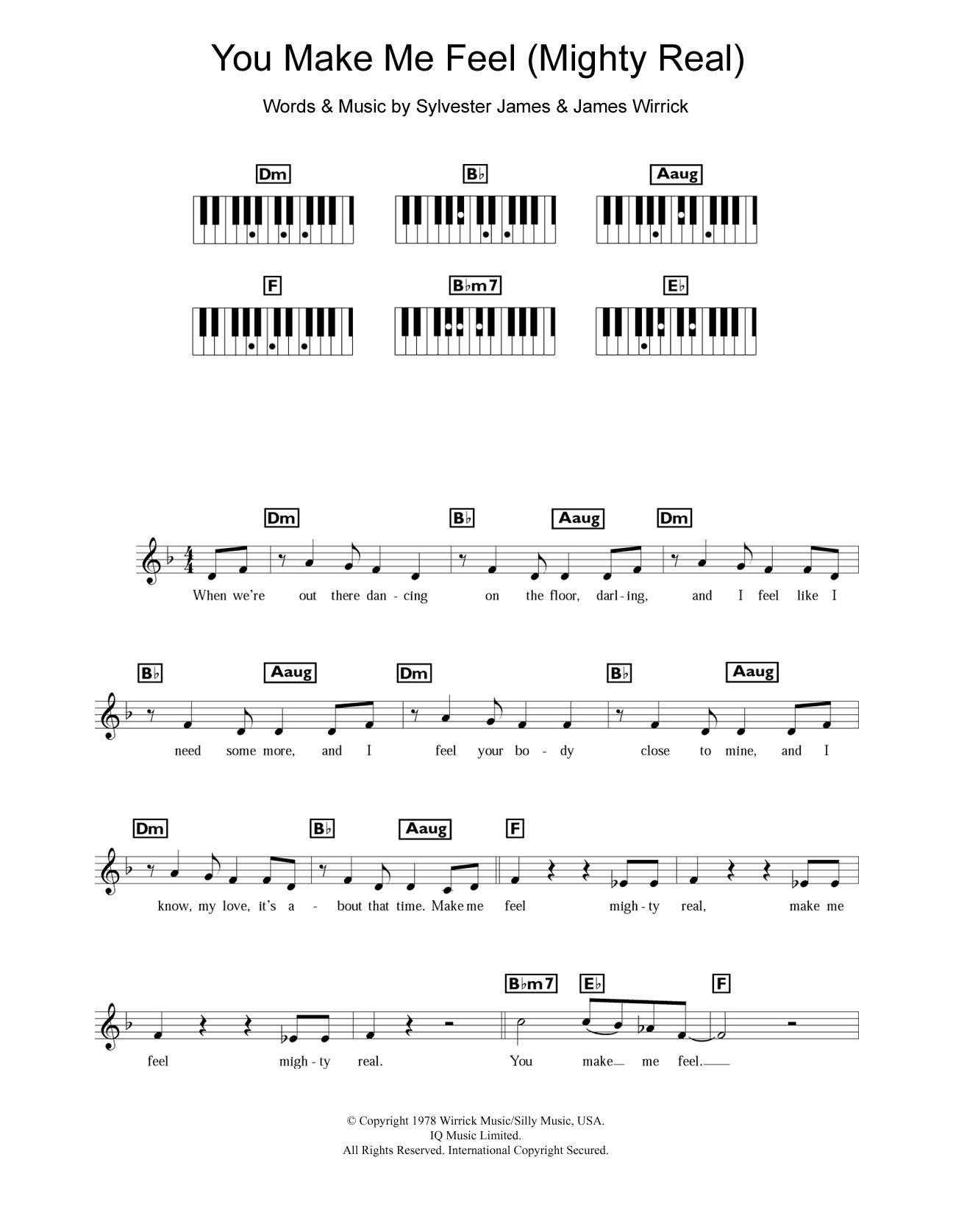
The lyrics are deceptively simple. "When we're out there dancing on the floor, darling, and I feel like I need some more." It sounds like a typical love song. But in the context of the 1970s gay liberation movement, "feeling real" meant feeling human. It meant being seen.
Beyond the Glitter: The Tragedy and Legacy
Sylvester’s life wasn't all glitter and gold records. He faced immense pressure to "tone it down" to cross over to a wider audience. He refused. He told interviewers that he wasn't "masquerading" as a woman; he was just being Sylvester.
When the AIDS crisis devastated the community in the 80s, Sylvester didn't run away. He became an activist. Even as he was dying in 1988, he made sure his royalties would benefit San Francisco AIDS charities. That’s the "mighty real" part of his story that often gets skipped over in the retrospectives.
His influence is everywhere now. You hear it in RuPaul. You hear it in Lady Gaga. You hear it in every house track that uses a soaring falsetto and a four-on-the-floor beat.
The song has been covered a million times. Jimmy Somerville had a huge hit with it in the late 80s, bringing it to a new generation. But nobody quite captures the raw, jagged joy of the original. There's a certain grit in Sylvester’s voice, a little bit of dirt from the blues and gospel, that keeps it from being too polished.
How to Hear it With Fresh Ears
If you want to truly appreciate the track, don't just stream it on your phone speakers.
- Find a 12-inch mix: The original extended version is where the magic happens. You get to hear the breakdown where the drums and synths just lock in.
- Listen to the bass: It’s not a real bass guitar; it’s a synth bass, and it’s relentless. It never stops for breath.
- Focus on the ad-libs: Toward the end of the track, Sylvester starts shouting and riffing. That's the gospel singer coming out. He’s "testifying."
It’s easy to look back at the 70s as a joke—the hair, the bell-bottoms, the cocaine. But songs like this remind us that it was a time of immense creative friction. People were fighting for the right to exist, and they used the dance floor as their battlefield.
Sylvester didn't just give us a catchy tune. He gave us a template for how to be ourselves. He proved that you could be flamboyant, queer, and Black, and still reach the top of the charts without compromising an inch of your soul.
Actionable Takeaways for Music Lovers
To really dive into this era, start by exploring Patrick Cowley’s solo work like "Menergy" or "Megatron Man." You'll see how he and Sylvester basically built the foundation for modern EDM.
Next, check out the documentary Unsung episode on Sylvester. It details the struggle he went through with his record labels and his unwavering commitment to his art.
Finally, put on You Make Me Feel (Mighty Real) next time you're having a bad day. It’s scientifically impossible to stay in a bad mood when that first synth line kicks in. It’s a shot of pure adrenaline. It’s a reminder that no matter what the world tells you, you are allowed to feel mighty real.
The most important thing to remember is that Sylvester’s music was about liberation. It wasn't just about the club; it was about the freedom to be exactly who you are, at 132 beats per minute, without apology or explanation. He left us with a roadmap for joy, and all we have to do is hit play.
Next Steps for Deep Discovery: Research the "San Francisco Sound" and how it differed from the Philly Soul sound of the same era. Look into the "Two Tons o' Fun" discography to hear more of that powerhouse vocal style that defined the late 70s. For a deeper dive into the technical side, look up the history of the Prophet-5 synthesizer and how it changed the texture of pop music forever.



