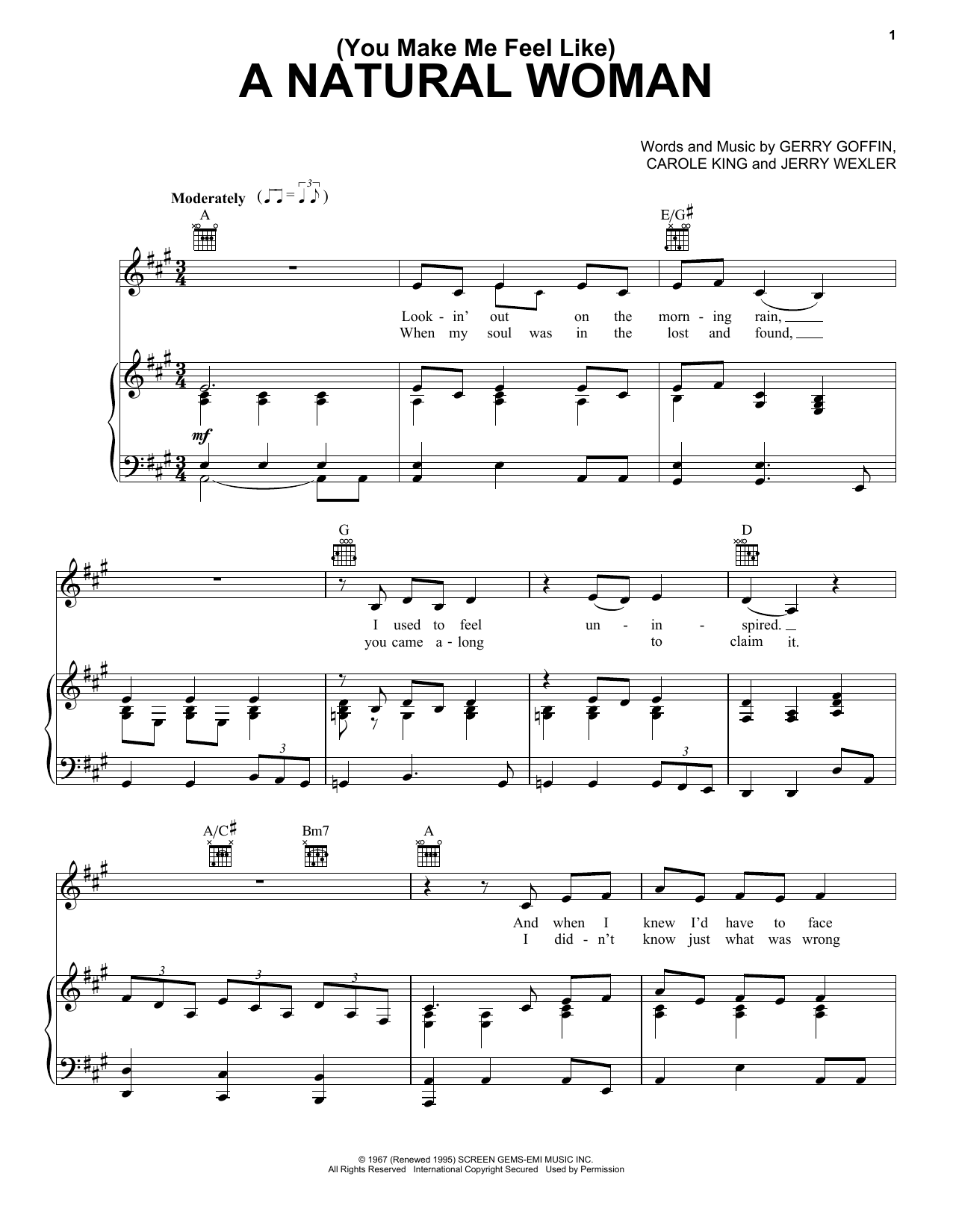
It starts with a car window. Jerry Wexler, the legendary Atlantic Records producer, is riding through the streets of New York City when he spots Carole King walking down the sidewalk. He rolls down the window and shouts out a title he’d been chewing on: "How about a song called 'A Natural Woman' for Aretha?"
Carole King went home that night. She sat at the piano with her then-husband, Gerry Goffin. By the next morning, they had a hit.
Most people think (You Make Me Feel Like) A Natural Woman is just a love song. It’s not. It is an anthem of identity, a seismic shift in soul music history, and the moment Aretha Franklin stopped being a jazz singer and became the Queen of Soul. You’ve heard it a thousand times at weddings, on the radio, and in every singing competition known to man. But the story behind how Aretha Franklin made you feel that specific brand of magic is a lot more complicated than a simple studio session.
The Struggle Before the Soul
Before 1967, Aretha was lost. Seriously. She spent years at Columbia Records trying to be the next Dinah Washington. They had her singing show tunes and polished jazz standards. It didn’t work. She was talented, sure, but she wasn’t Aretha.
When she moved to Atlantic, everything changed. Wexler brought her to Muscle Shoals, Alabama. He put her back at the piano. That’s the secret sauce. Aretha’s piano playing is the heartbeat of her best work. When she recorded (You Make Me Feel Like) A Natural Woman, she wasn't just a vocalist following a chart. She was leading the arrangement from the keys.
The song was released in September 1967. Think about that year for a second. The Summer of Love was winding down. The Civil Rights Movement was in a state of intense, painful transition. Amidst all that chaos, this song arrives. It felt grounded. It felt real.
Why the Song Structure is a Genius Trap
Musically, it’s a masterclass in tension. It starts in the key of C major, feeling very "church." The verses are restrained. Aretha’s voice is almost a whisper when she sings about being "uninspired." She sounds tired. She sounds like she’s given up.
Then the chorus hits.
The transition is a literal explosion. When she hits that high note on "Natural," it’s not just a display of vocal range. It’s a release of every bit of tension built up in the verse. The backing vocals—provided by her sisters, Erma and Carolyn—act as a Greek chorus. They aren't just harmonizing; they are testifying.
Honestly, Carole King didn’t think she could sing it herself for years. She finally recorded her own version for the Tapestry album in 1971. It’s great, don't get me wrong. It’s vulnerable and earthy. But Carole’s version is a folk song. Aretha’s version is a religious experience.
That 2015 Kennedy Center Moment
You cannot talk about (You Make Me Feel Like) A Natural Woman without talking about the 2015 Kennedy Center Honors. If you haven't seen the video lately, go watch it. Now.
Aretha walks out in a full-length fur coat. She sits at the piano. Carole King is in the balcony, basically losing her mind with joy. President Barack Obama is literally wiping a tear from his eye.
She was 73 years old.
Her voice shouldn't have been that strong, but it was. When she stood up from the piano, dropped the fur coat to the floor, and reached for those final notes, she wasn't just performing a hit from the sixties. She was asserting her dominance over American music. It was a reminder that while trends change, true soul is timeless. It was the last great televised moment of her career, and it cemented the song as her definitive statement.
The Feminine Identity and the 1960s
There is a political layer here that people often miss. In 1967, the idea of being a "natural" woman was a radical concept. We were moving away from the ultra-manicured, 1950s housewife aesthetic into something more authentic.
The lyrics talk about a woman who felt "soul deep in lost and found." It’s about being seen for who you actually are, without the masks. For Black women in America during the sixties, this carried even more weight. It was about dignity. It was about the right to feel beautiful and "natural" in a world that often told them they weren't.
Wexler knew exactly what he was doing when he gave this title to Aretha. He knew she would give it the weight it deserved.
Misconceptions and Studio Secrets
People often think the song was recorded with a massive orchestra in the room. Nope. It was the Sweet Inspirations on backup and the legendary "Wrecking Crew" style session musicians providing the backbone. The strings were dubbed in later to give it that cinematic swell, but the core of the track is just a few people in a room in New York City.
Another thing? The song almost didn't make it to the Lady Soul album. There was a lot of debate about whether it was "too pop" compared to tracks like "Chain of Fools." Thankfully, the label realized that the cross-over appeal was exactly what Aretha needed to become a global superstar.
How to Truly Appreciate the Performance
If you want to hear what makes Aretha's version the gold standard, listen to the bridge. When she sings, "Oh, baby, what you've done to me," listen to the way she drags the notes. She’s "behind the beat." This is a jazz technique that creates a sense of longing. If she sang it perfectly on the beat, it would sound like a commercial. By hanging back, she makes it feel like she’s making up the words as she goes.
That is the definition of soul. It's the "felt" quality.
Making the Most of the Aretha Experience
To truly understand the impact of (You Make Me Feel Like) A Natural Woman, you have to look at it as part of a larger body of work. It’s the centerpiece of the 1968 album Lady Soul, which is arguably one of the greatest records ever pressed to vinyl.
- Listen to the Mono Mix: If you can find it, the original mono mix of the song has a much punchier bass and drum sound. The stereo versions we hear on streaming today often wash out the grit of the rhythm section.
- Watch the 1968 Sweden Footage: There is a live performance from her European tour where she performs the song in a simple dress with minimal lighting. It strips away the "diva" persona and shows the raw vocal power she possessed at her peak.
- Compare the Covers: Listen to Mary J. Blige’s version or Celine Dion’s version. They are technically proficient, but notice what’s missing. They often try to "out-sing" the song. Aretha is the song.
- Check the Credits: Take note of the production. Jerry Wexler didn’t just produce; he curated a sound that allowed Aretha to be the architect of her own hits.
The legacy of this track isn't just in the notes. It's in the way it empowered a generation to embrace their own skin. It remains a blueprint for every soul singer who has followed, from Whitney Houston to Adele. You don't just listen to this song; you live in it for three minutes and forty-four seconds.


