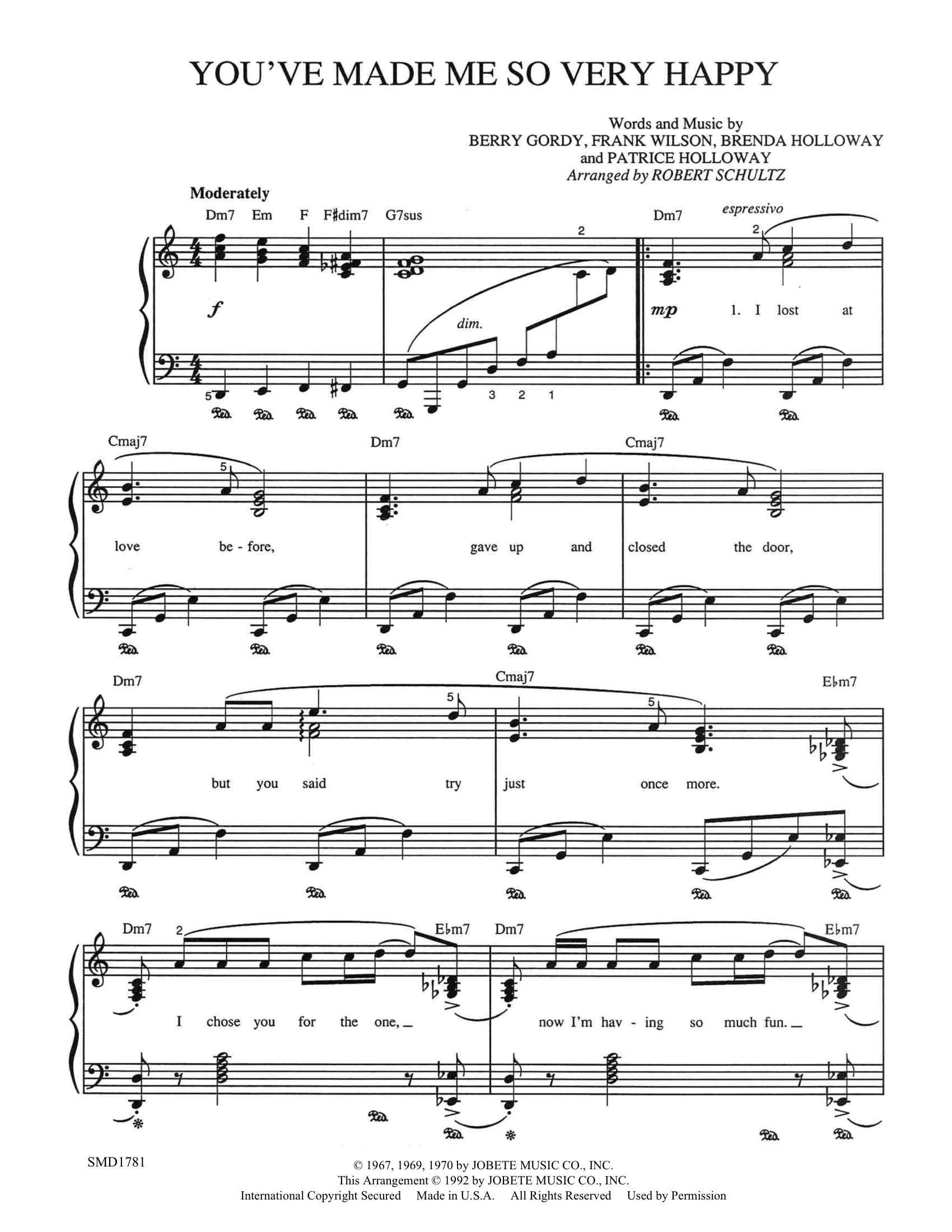
You know that feeling when a song starts and you immediately just know it? That's exactly what happens with the brassy, explosive opening of the Blood, Sweat & Tears version of "You Made Me So Very Happy." But honestly, the you made me so very happy lyrics weren't always the bombastic anthem we think of today. They started out as a much more intimate, Motown-inflected plea. If you look closely at the words, they tell a story of total, almost desperate gratitude.
It’s rare. Most love songs are about the chase or the heartbreak. This one? It’s about the relief of finally being seen.
The Motown Roots You Probably Forgot
Brenda Holloway wrote the track alongside Berry Gordy, Patrice Holloway, and Frank Wilson. She released it in 1967. At the time, Brenda was a powerhouse at Motown, but she was often overshadowed by the bigger names like Diana Ross. Her original version is smooth. It’s soulful. It’s got that classic Detroit backbeat that makes you want to sway rather than shout.
The lyrics in the original version feel more like a personal confession. When she sings about being "so lonely" before this person came along, you believe her. It wasn’t a chart-topping monster immediately, peaking at number 39 on the Billboard Hot 100. It took a group of jazz-rockers from New York to turn it into a global phenomenon.
How Blood, Sweat & Tears Changed the Vibe
In 1969, Blood, Sweat & Tears (BS&T) took the track and basically injected it with high-octane brass. David Clayton-Thomas brought a grit to the vocals that transformed the meaning of the words. While Holloway’s version was a gentle thank you, Clayton-Thomas’s delivery sounds like a man who was drowning and just got pulled onto a life raft.
The structure of the BS&T version is fascinating from a technical standpoint. They didn't just cover it; they deconstructed it. The tempo shifts are wild. One minute you’re in a slow, jazzy lounge, and the next, the trumpets are screaming at you. This dynamic range mirrors the emotional highs and lows mentioned in the text.
Breaking Down the You Made Me So Very Happy Lyrics
Let’s get into the actual poetry of it. The song opens with a heavy admission: "I lost at love before / Got mad and closed the door."
That’s a universal starting point. We’ve all been there—shutting down because the world felt too heavy. The genius of the song is how it moves from that isolation to a place of vulnerability.
"But you said try just once more."
That line is the pivot. It’s not just about finding someone attractive; it’s about finding someone who has the patience to wait for you to open that door again. Honestly, that's the part that resonates most today. In an era of swipe-left culture, the idea of someone sticking around to help you "try just once more" feels almost radical.
The Chorus: Simplicity as a Power Move
"I'm so glad you came into my life / You made me so very happy."
It’s not Shakespeare. It doesn’t need to be. Sometimes the most profound things we say to the people we love are the simplest ones. The repetition of "so very happy" acts as a rhythmic anchor. When Clayton-Thomas belts it out, he’s hitting notes that feel like they’re bursting out of his chest.
There's a specific nuance in the phrasing "I'm so glad you came into my life." It’s passive. It suggests fate. It’s not "I found you"; it’s "You happened to me." That distinction matters because it highlights the singer's sense of wonder. They didn't do anything to deserve this; it just arrived.
The Production Magic That Defined an Era
If you listen to the 1969 recording, the horn section—featuring Lew Soloff and Chuck Winfield—is doing a lot of the heavy lifting. They aren't just playing chords; they are responding to the lyrics. When the lyrics talk about happiness, the horns soar. When the mood is reflective, they drop into these smoky, Miles Davis-esque textures.
It's a "wall of sound" approach but with jazz precision.
Interestingly, David Clayton-Thomas almost didn't sing it. He was a new addition to the band, replacing Al Kooper. Kooper’s version of BS&T was much more experimental and "arty." When Clayton-Thomas stepped in, he brought a commercial sensibility that some purists hated but the public loved. The song went to number 2 on the Billboard Hot 100, kept off the top spot only by The 5th Dimension’s "Aquarius/Let the Sunshine In."
Misconceptions About the Meaning
A lot of people think this is a wedding song. And yeah, it gets played at weddings constantly. But if you listen to the bridge, there's a certain level of intensity that suggests it’s about more than just a happy couple.
"I can't live without you / No, no."
That’s heavy. That’s co-dependency territory. Or at least, it’s the kind of all-consuming love that feels like a necessity for survival. In the late 60s, amidst the Vietnam War and massive social upheaval, lyrics like these offered a sanctuary. They weren't political. They were purely, unapologetically emotional.
Some critics at the time, like those at Rolling Stone, were occasionally dismissive of the "horn-rock" sound, calling it over-produced or "Las Vegas." But they missed the point. The over-the-top nature of the production matched the over-the-top nature of the emotion. You can't be "so very happy" in a quiet, reserved way. You have to shout it.
The Lou Rawls and Alton Ellis Versions
To really understand the you made me so very happy lyrics, you have to hear how other genres handled them.
- Lou Rawls: He brought a sophisticated, late-night R&B flavor to it in 1970. His version feels like a velvet suit. It’s less about the explosion of joy and more about the deep, resonant satisfaction of a grown man who knows what he’s got.
- Alton Ellis: This is the hidden gem. The "Godfather of Rocksteady" took the track to Jamaica. The reggae lilt changes the entire DNA of the song. It becomes breezy. The "happiness" feels like a sunny day in Kingston rather than a smoky club in Manhattan.
- The Temptations: They gave it the full Motown treatment later on, bringing it back to its roots but with that polished, multi-part harmony that only they could deliver.
Seeing how these different artists interpreted the same words proves how sturdy the songwriting is. You can’t break these lyrics. They work in any tempo, in any style.
Why We Still Listen in 2026
It’s the sincerity.
We live in a very cynical time. Irony is the default setting for most art. But "You Made Me So Very Happy" doesn't have a cynical bone in its body. It’s a song that wears its heart on its sleeve, then rolls up those sleeves and gets to work.
When you hear it in a movie trailer or a commercial today, it still cuts through the noise because it’s a direct hit to the tear ducts. It reminds us of a time when music was played by twenty people in a room together, breathing at the same time, hitting the notes at the same time. You can feel the air moving in the room on those old analog recordings.
Technical Brilliance vs. Raw Soul
There’s a tension in the BS&T version between the "correctness" of the jazz arrangements and the "wildness" of the soul vocals. That tension is where the magic happens. If it were too perfect, it would be boring. If it were too messy, it would be unlistenable.
Instead, it sits in this sweet spot. It’s the sound of a band firing on all cylinders, trying to do justice to a song that Brenda Holloway poured her soul into two years earlier.
The Enduring Legacy of Brenda Holloway
It’s worth noting that Brenda Holloway’s contribution often gets sidelined in the "classic rock" narrative. She was a brilliant songwriter and a violinist. She wasn't just a singer who was handed a script. She lived these lyrics.
When she sued for royalties later in life, it was a reminder of how the music industry often treated the creators of these hits. Every time you stream the song or look up the you made me so very happy lyrics, you’re engaging with her legacy. She wrote a song that became a standard, a piece of the Great American Songbook, and that’s a feat very few songwriters ever achieve.
Actionable Takeaways for Music Lovers
If you're looking to dive deeper into this track or the era that birthed it, here’s how to do it right:
- Listen to the 1967 and 1969 versions back-to-back. Don't just skip through. Notice the difference in the bass lines. Holloway’s version has a "walking" bass that feels like a heartbeat; BS&T has a more aggressive, syncopated feel.
- Check out the live footage. There is a legendary performance of Blood, Sweat & Tears at Woodstock (though it wasn't in the original movie due to legal disputes). Watching the horn players' veins pop while they hit those high notes adds a whole new layer of appreciation for the physical effort of the song.
- Explore the "Holloway catalog." If you like the lyrics here, listen to "Every Little Bit Hurts." It’s another masterclass in soulful vulnerability.
- Analyze the "Bridge." Most pop songs today have very simple structures. "You Made Me So Very Happy" has a complex bridge that transitions through several key changes. It’s a great study for anyone interested in how to build tension in songwriting.
Ultimately, the song works because it’s true. It’s a thank-you note set to music. Whether it’s the smooth Motown original or the brassy rock cover, the message remains: finding someone who makes you "so very happy" is the ultimate win. And that's something worth singing about, loudly and often.