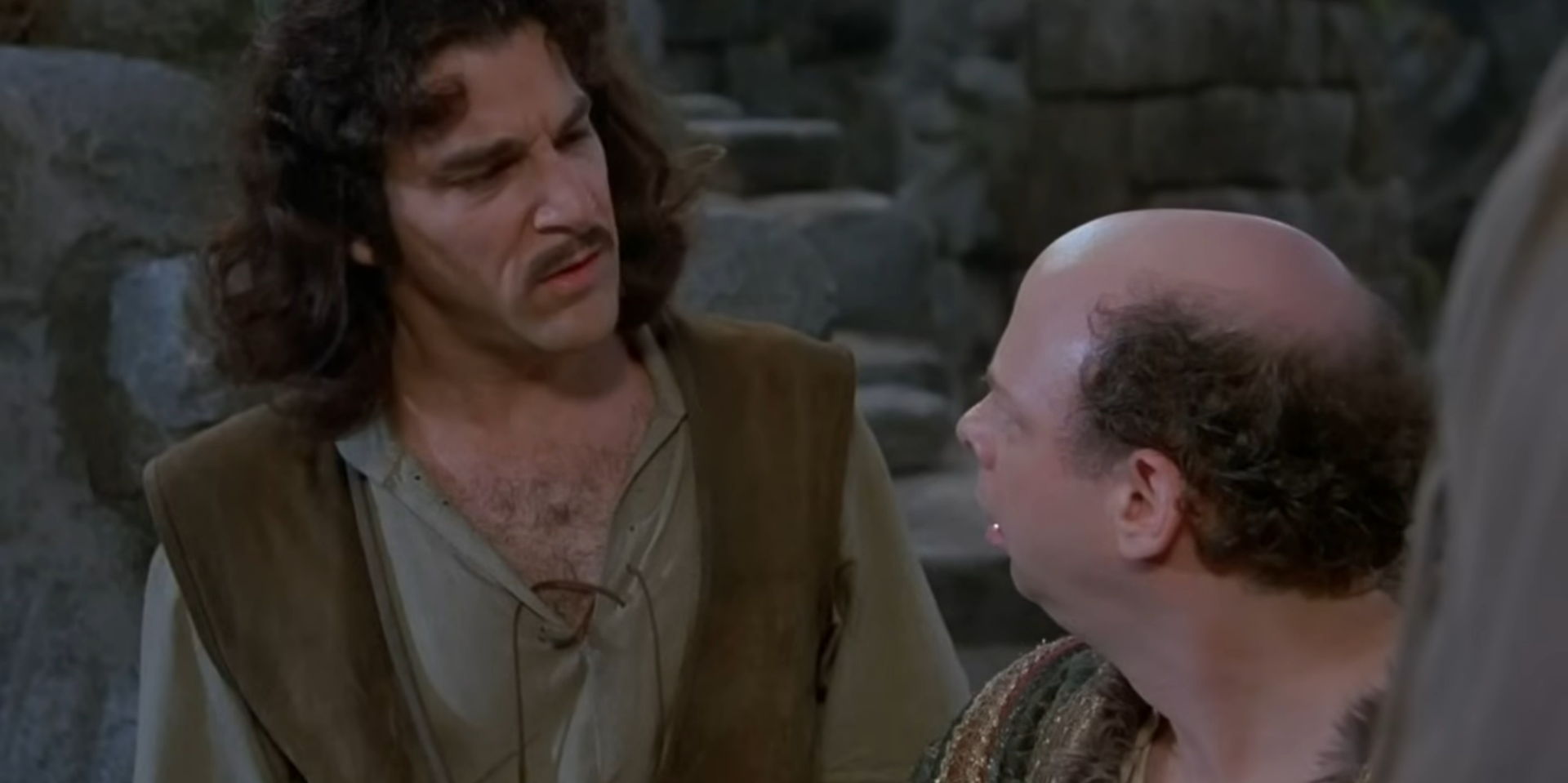
Inigo Montoya is tired. Honestly, he’s been tired since 1987, but the internet won't let him rest. You've seen the face—Mandy Patinkin’s rugged, slightly perplexed features framed by 80s hair—staring back at you whenever someone on social media tries to sound smarter than they actually are. It’s the you keep using that word meme, and it’s basically the ultimate "gotcha" for the digital age.
Wait. Before we go any further, let's get the line right. Most people mess it up. In the actual movie, The Princess Bride, Inigo says: "You keep using that word. I do not think it means what you think it means." It’s directed at Vizzini, the self-proclaimed genius played by Wallace Shawn, who spends the first half of the film screaming "Inconceivable!" every time things don't go his way.
The irony is thick. Vizzini uses "inconceivable" to describe things that are, in fact, happening right in front of him. A giant climbing a rope? Inconceivable. A masked man following them? Inconceivable. The meme works because we live in an era of hyperbole where words like "literally," "gaslighting," and "fascism" are tossed around like confetti at a parade.
Why Vizzini’s Vocabulary Failed Him
The scene itself is a masterclass in comedic timing. Vizzini is a man obsessed with his own intellect. He believes he is the smartest person in the room—maybe the world. When the Man in Black starts gaining on them, Vizzini’s brain can’t process the failure of his "perfect" plan. So, he defaults to a big word to mask his mounting panic.
Inigo Montoya, the Spaniard driven by a singular quest for revenge, is the grounded one. He isn't a linguist. He isn't a scholar. He’s just a guy observing reality. When he finally delivers the line, it’s not an insult. It’s a genuine observation. That’s why the you keep using that word meme hits so hard. It isn't just about being a grammar Nazi. It's about pointing out when someone's internal map doesn't match the actual terrain.
Mandy Patinkin has talked about this role for decades. He once told CBS Sunday Morning that the film’s staying power comes from its heart, but the meme culture has given it a second, much weirder life. It’s transitioned from a cult classic movie quote into a universal shorthand for "you are full of it."
The Evolution of the Meme: From Tumblr to Twitter (X)
Memes don't just happen. They evolve. Around 2010, the image macro version of this quote started popping up on sites like Quickmeme and Meme Generator. It usually featured a still of Inigo from the scene where they are resting near the Cliffs of Insanity.
Back then, the internet was obsessed with "pwnage." If you caught someone using a word incorrectly, you "pwned" them. But as the internet matured—or at least got more crowded—the meme shifted. It became a tool for political discourse, scientific debates, and even corporate fluff.
- The Corporate Spin: Think about the word "synergy." In the early 2010s, every CEO was obsessed with it. If you posted the Inigo Montoya meme under a LinkedIn post about "synergizing legacy platforms," you were the office hero.
- The Political Arena: This is where things get messy. Whether it’s the definition of "inflation" or "democracy," partisans love using the you keep using that word meme to shut down the opposition.
- The Literary Snobs: There is a special circle of hell for people who misuse "ironic." Alanis Morissette practically built a career on it, and Inigo Montoya has been there to correct her (retroactively) ever since.
Is It Pedantry or Truth?
Some people hate this meme. They see it as a "shut-up" button that prevents actual conversation. If you’re in the middle of a heated debate about social justice or economic theory, and someone drops the Inigo Montoya image, it can feel like a cheap shot. It shifts the focus from the argument to the vocabulary.
But here’s the thing: words actually matter.
In a 2014 piece for The New Yorker, writer Mary Norris (the "Comma Queen") discussed how certain words lose their edge through misuse. When "literally" was officially updated in the dictionary to also mean "figuratively" (for emphasis), the internet nearly broke. People didn't just want the definition; they wanted the logic. That’s where the meme lives. It’s a defense mechanism for logic.
The "Inconceivable" Paradox
We can't talk about Inigo without talking about Vizzini. Wallace Shawn, the actor who played Vizzini, is actually an incredibly brilliant playwright and intellectual in real life. There’s a delicious layer of meta-humor in a genius playing a man who thinks he’s a genius but doesn't understand basic vocabulary.
Shawn has noted in various interviews, including a fun retrospective with The Hollywood Reporter, that people still yell "Inconceivable!" at him on the street. He doesn't mind. The word has become a badge of honor. But for the rest of us, it’s a warning. If you call everything "inconceivable," nothing is. If everything is "epic," nothing is. If everyone is a "genius," then we’re all just average.
The you keep using that word meme is a reminder to slow down. It’s a plea for precision in a world of "vibes."
Semantic Bleach: Why Words Melt
Linguists call it "semantic drift." It’s the process by which a word’s meaning changes over time. Usually, it happens slowly. Over centuries. "Awful" used to mean "full of awe"—basically what we mean by "awesome" today.
But the internet has accelerated semantic drift to warp speed. We use "trauma" to describe a bad sandwich. We use "gaslighting" to describe someone simply disagreeing with us. When a word's meaning is stretched too thin, it snaps. It becomes "semantic bleach." It loses its color.
Using the Inigo Montoya meme is like applying a restoration dye. It’s saying, "Hey, let’s get back to what this word actually represents."
Real-World Examples of the Meme in Action
- Quantum Physics: Pop science loves the word "quantum." They use it to mean anything mysterious or magical. Real physicists often find themselves channeling their inner Inigo Montoya. "Quantum" doesn't mean "magic"; it refers to the discrete increments of energy.
- Entitlement: This word has been flipped on its head. Originally a legal term for having a right to something, it’s now almost exclusively used as an insult for "acting spoiled."
- Woke: Perhaps the most exhausted word of the 2020s. It has been used to mean everything from "aware of systemic injustice" to "anything I don't like on Disney+." At this point, the meme is the only appropriate response to 90% of its usage.
How to Use the Meme Without Being a Jerk
If you’re going to deploy the you keep using that word meme, you have to do it with a bit of Inigo’s grace. Remember, Inigo wasn't trying to be a bully. He was actually quite polite about it. He waited until Vizzini had said it about five times before speaking up.
If you jump on someone the very first time they misuse a word, you’re just a pedant. If you wait until they’ve built an entire faulty skyscraper of logic on a single misunderstood word? That’s when you strike.
Also, make sure you are right. There is nothing more embarrassing than posting the Inigo Montoya meme only to have someone reply with a dictionary link proving that the other person was actually using the word correctly. Check your work. Don't be a Vizzini pretending to be an Inigo.
The Cultural Legacy of Mandy Patinkin’s Delivery
Why does this specific quote work better than, say, a clip from a documentary or a dictionary definition? It’s the delivery. Patinkin brings a weary, soulful quality to the line. He isn't angry; he’s just disappointed.
That disappointment is what we feel when we see language being butchered for the sake of an argument. We want words to mean things because if they don't, we can't communicate. If we can't communicate, we can't solve problems. The meme is a tiny, pixelated stand for the importance of shared meaning.
Practical Steps for Better Vocabulary (and Better Memeing)
If you find yourself on the receiving end of the you keep using that word meme, don't get defensive. Use it as a moment to recalibrate.
- Audit your "crutch" words. We all have them. Words we use when we’re too lazy to find the specific one. Are you calling things "toxic" when you really mean "inconvenient"?
- Read more long-form content. Books and deep-dive articles (like this one) help reinforce the nuance of language that social media strips away.
- Look up the etymology. Knowing the "why" behind a word makes you less likely to misuse it. For instance, "decimate" technically means to remove one-tenth, not to completely destroy. Use that at your next dinner party if you want people to stop talking to you.
- Save the meme for the big stuff. Don't waste Inigo on a typo. Save him for the big, structural misuses of language that actually confuse people.
The you keep using that word meme is more than just a funny picture from an old movie. It’s a linguistic guardrail. It’s a reminder that while the world changes, and the internet moves at the speed of light, the definitions we agree upon are the only things keeping us from total "inconceivable" chaos.
Next time you’re scrolling through a comment section and you see someone misapplying a heavy-duty concept to a lightweight situation, you know what to do. Just make sure you’ve got the right still of Mandy Patinkin ready to go. Accuracy is, after all, the point.



