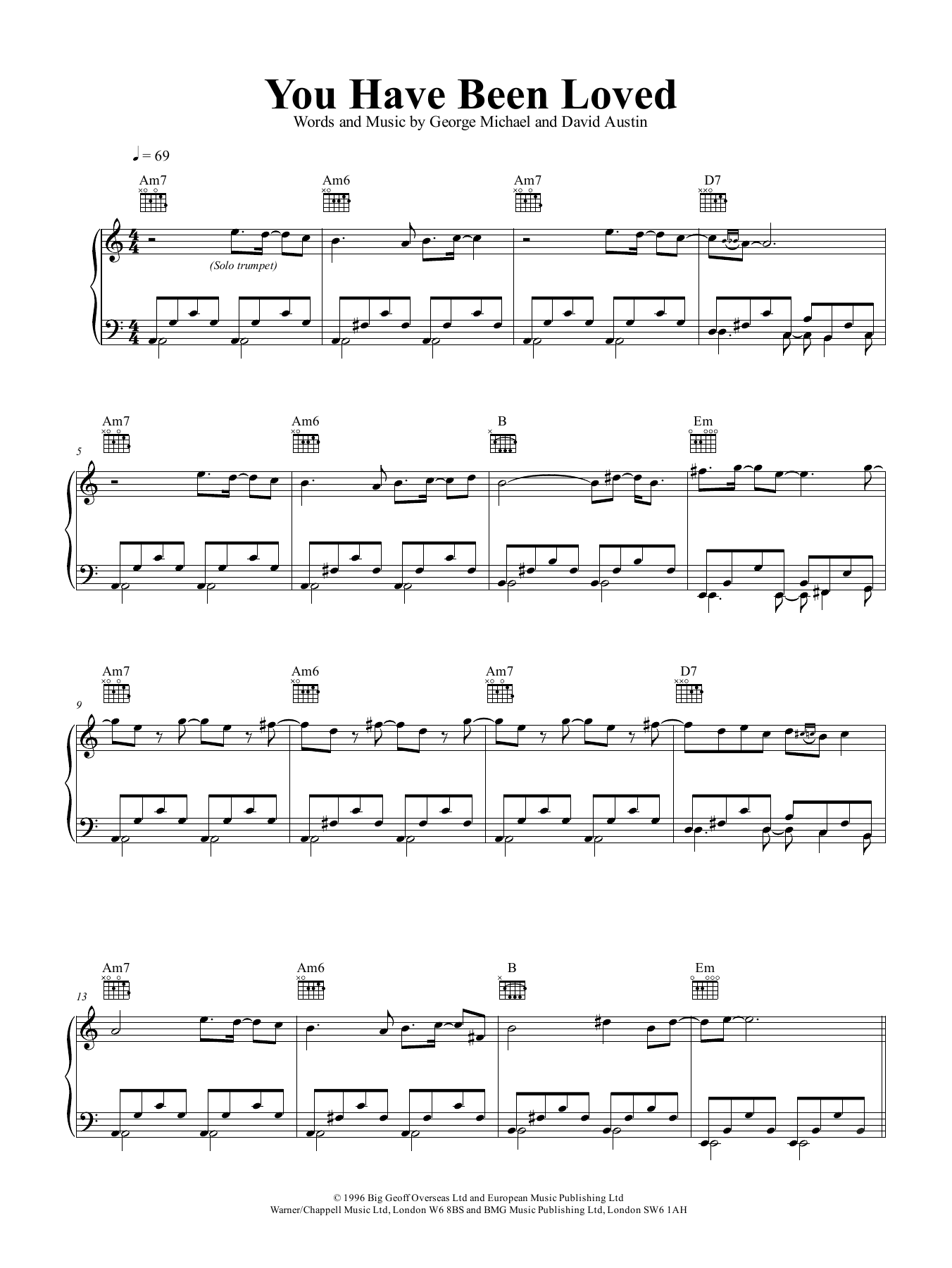
Music has this weird way of acting like a time capsule. You hear a specific chord progression, and suddenly it’s 1996 all over again. For many, that specific emotional trigger is the song You Have Been Loved by George Michael. It isn’t just a ballad. It’s a heavy, atmospheric piece of art that dealt with grief in a way pop music rarely dared to back then.
It’s personal.
George Michael wrote it during a period of immense psychological weight. He was mourning Anselmo Feleppa, his partner who had died of an AIDS-related illness in 1993. Then his mother, Lesley Angold Panayiotou, passed away shortly after. You can hear that double-layered grief in every single breath he takes on the track. It’s haunting. Honestly, it’s one of those songs that feels almost too private to listen to, yet it became a massive commercial success, peaking at number two on the UK Singles Chart.
The Raw Truth Behind You Have Been Loved
Most people think of George Michael as the "Faith" guy or the upbeat force behind Wham! But You Have Been Loved showed the world a man who was utterly stripped of his bravado. The song was part of the Older album cycle. If you look at the credits, George co-wrote it with David Austin. It wasn't some over-produced studio project. It was a stripped-back, jazz-inflected funeral march for the living.
The lyrics focus on a mother figure questioning a higher power. It’s devastating. He sings about a "cruel god" and the "ghost of a boy." This wasn't just radio fodder; it was a public processing of the AIDS crisis, which was still a terrifying, stigma-heavy reality in the mid-90s. While some critics at the time found the Older album too somber, the public disagreed. The single was released as a double A-side with "The Strangest Thing '97," and it resonated because it gave a voice to a specific kind of quiet, dignified suffering.
Why the melody feels like a heartbeat
Musically, it’s fascinating. It doesn't rely on big, crashing crescendos. Instead, it uses a sparse arrangement. There’s a Rhodes piano, a gentle bassline, and George’s voice, which stays mostly in a hushed, intimate register.
He wasn't shouting. He was whispering.
When you analyze the structure, you notice it lacks the traditional "hook-verse-hook" aggression of a pop song. It flows more like a prayer or a poem. This is why it’s often played at memorials. It doesn't demand your attention; it sits with you in the room. Experts in musicology often point to Michael's use of space—the silences between the notes—as the reason the track feels so heavy. He knew when to stop singing.
The Cultural Impact of 1997
1997 was a massive year for celebrity grief. We had the death of Princess Diana, who was a close friend of George Michael. When Diana died, You Have Been Loved took on a third life. It became an anthem for a grieving nation, alongside Elton John’s "Candle in the Wind 1997."
It’s interesting to note that George actually performed at Diana’s funeral—well, he attended as a guest and was visibly distraught—but the song became inextricably linked to that era of public mourning. People started calling into radio stations to request it not just for their own lost loved ones, but as a tribute to the "People's Princess."
The shift in George Michael’s career
Before this era, George was fighting Sony. He was the "rebel" trying to escape his contract. But You Have Been Loved proved he didn't need the leather jacket or the model-filled music videos to sell records. He just needed his soul. The Older album eventually went 6x Platinum in the UK.
Think about that.
A jazz-pop album about death and aging out-sold many of the high-energy Britpop albums of the same year. It showed that the audience was maturing along with him. They didn't want "Wake Me Up Before You Go-Go" anymore; they wanted the truth.
Technical Brilliance in the Studio
Recording this track wasn't easy. George Michael was a notorious perfectionist. He would spend weeks on a single vocal take, sometimes punching in syllable by syllable to get the exact emotional resonance. In interviews, David Austin has mentioned how the atmosphere in the studio during the Older sessions was thick with the reality of what George was going through.
They weren't just making "hits." They were documenting a life.
The song uses a subtle 4/4 beat, but it’s so soft it almost feels like it’s in free time. The use of the "muted" trumpet sound adds a layer of Miles Davis-esque melancholy. It’s sophisticated music. Even today, if you play the high-fidelity remaster, the production holds up because it isn't cluttered with the trendy synthesizers of 1996. It’s timeless because it’s organic.
Dealing with the "Cruel God" Controversy
One of the most striking lines in You Have Been Loved is: "Take care of my son, she said, for he can only be happy with you."
Then it hits the line about the cruel god.
At the time, some religious groups were a bit prickly about the lyric. But George wasn't attacking faith; he was questioning the fairness of a world where young, vibrant men were being snatched away by a plague. It was an honest theological struggle. He was capturing the moment when a person’s belief system shatters under the weight of loss. It’s a very human perspective.
Comparisons to other tracks
If you compare this to "Jesus to a Child," which was also about Anselmo, You Have Been Loved feels more grounded in the physical world. While "Jesus to a Child" is ethereal and shimmering, this track is about the dirt, the gravestone, and the mother standing in the rain. It’s the "sequel" to the initial shock of grief—the long, slow realization that life has to continue without the person you loved.
What we can learn from the song today
So, why are we still talking about this in 2026?
Because grief hasn't changed.
The way we process loss is still messy and quiet. In a digital age where everything is loud and performative, You Have Been Loved reminds us that the deepest emotions are usually the ones we can barely whisper.
For creators, the lesson is simple: vulnerability is a superpower. George Michael took his absolute lowest point—the deaths of the two most important people in his life—and turned it into a piece of music that helped millions of others breathe through their own pain. That’s the definition of "E-E-A-T" in a creative sense. He had the "Experience" and the "Expertise" of loss, and he shared it with "Authority."
Actionable insights for listeners and creators
- Listen for the "Space": If you’re a musician, pay attention to how much George doesn't sing in this track. Silence is a tool.
- Context Matters: To truly appreciate the song, read up on the history of the 1990s AIDS crisis. It transforms the lyrics from a generic sad song into a historical document.
- Vulnerability over Polish: Don't be afraid to let the cracks show. The "perfection" of this song is in its emotional honesty, not just its pitch-perfect vocals.
- Revisit the Older Album: Don't just stop at the single. The entire album is a masterclass in mid-tempo soul that rewards deep, focused listening sessions.
To truly understand the legacy of George Michael, you have to look past the tabloids and the scandals. You have to go back to the music. You Have Been Loved stands as a monument to a man who was brave enough to be broken in front of the whole world. It’s a reminder that even when we feel forgotten, the impact we had on others remains. You were loved. You are loved. And that, ultimately, is enough.



